Aftermarket Lamp Performance for Projectors
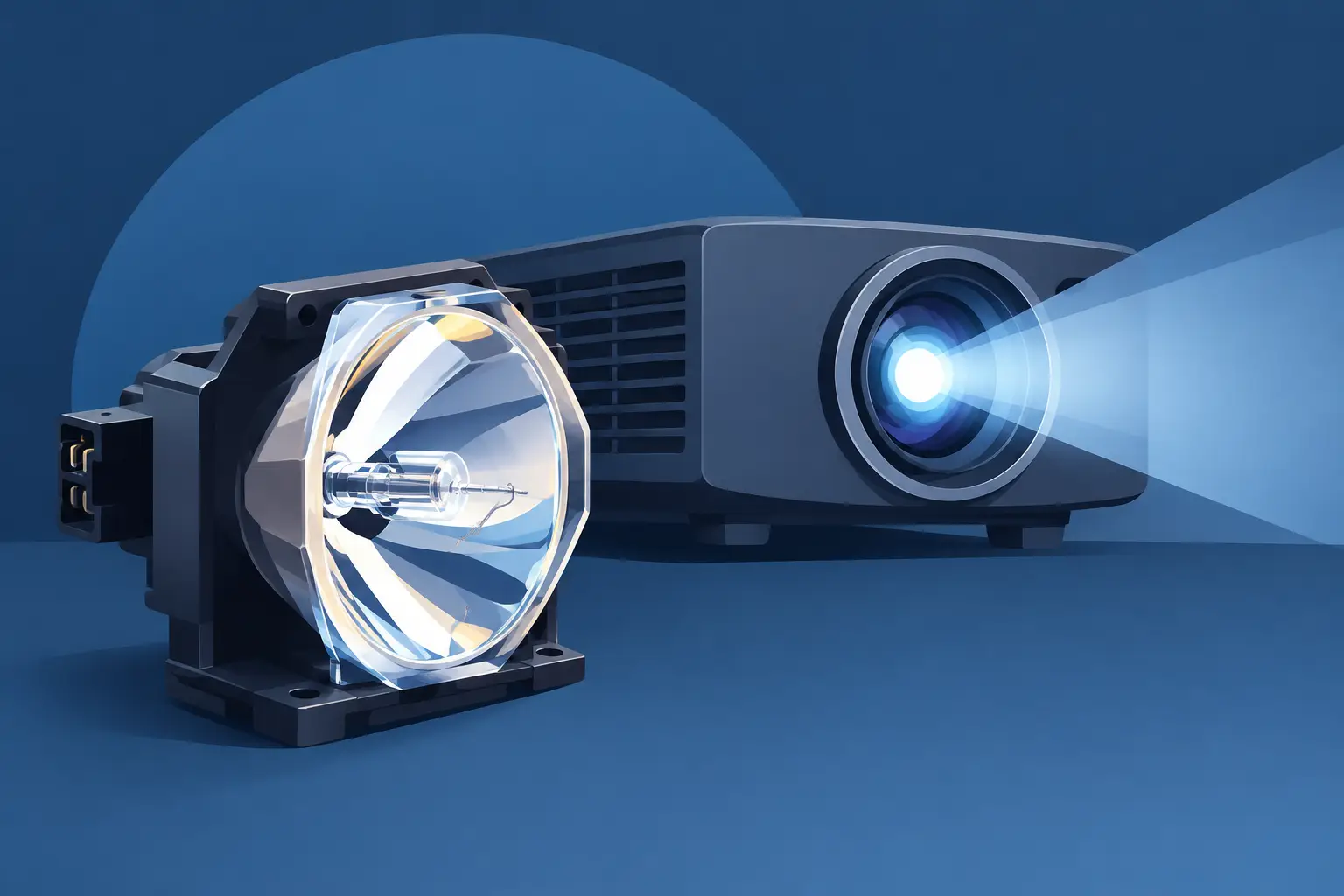
A replacement lamp can restore a projector to service quickly, but aftermarket lamp performance determines whether that repair remains profitable and reliable after installation. For distributors, repair centers, and AV service teams, the real question is not simply whether a lamp powers on. It is whether it delivers stable brightness, correct electrical behavior, practical service life, and a predictable customer experience across the installed fleet.
A lower acquisition cost can improve margin, especially when OEM lamps are expensive or difficult to source. However, a poorly matched lamp may introduce dim output, color inconsistency, lamp errors, early failure, or repeat truck rolls. The correct evaluation process looks beyond the label and focuses on the components, compatibility controls, and supplier support behind the replacement.
What Determines Aftermarket Lamp Performance?
Projector lamps are high-pressure discharge systems operating under demanding thermal and electrical conditions. Their performance is not defined by a single specification. It results from the interaction of the burner, reflector, housing, wiring, connector arrangement, projector ballast, cooling system, and firmware behavior.
The burner is central to optical output and operating stability. Electrode quality, arc gap accuracy, gas pressure, seal integrity, and manufacturing consistency affect how efficiently the lamp produces light and how steadily it maintains the arc. A lamp may initially appear bright but lose output quickly if these conditions are not controlled during production.
Reflector geometry is equally significant. The projector optical engine expects light to enter at a precise position and angle. If the arc position is off-center or the reflector does not correctly focus the light, the projected image can lose brightness and uniformity even when the burner itself is functional. This is one reason lamp wattage alone is not a reliable measure of replacement quality.
The housing must also match the projector mechanically and electrically. Correct seating, secure terminals, heat-resistant materials, and accurately positioned connectors reduce installation risk. For service providers handling multiple brands and models, a well-built lamp module saves time at the bench and reduces the chance of field installation issues.
Brightness Is More Than an Initial Reading
Many buyers evaluate lamps by comparing brightness immediately after installation. Initial output matters, but sustained output is usually the more meaningful commercial measure. A lamp that starts bright and declines sharply can create dissatisfaction long before the rated life is reached.
Arc Stability and Light Maintenance
Stable arc behavior supports consistent illumination across the image. Unstable operation can appear as flicker, intermittent dimming, delayed ignition, or changes in color balance. These issues may be mistaken for a ballast or mainboard fault, creating avoidable diagnostic time and unnecessary parts replacement.
Light maintenance describes how well a lamp retains usable brightness through its operating life. It depends on burner design, electrode wear, cooling conditions, and operating mode. Projectors used in classrooms, conference rooms, museums, and rental environments often run for extended hours. In those applications, stable output over time has greater value than a strong first-hour measurement.
Lamp mode also changes the result. Eco mode can reduce thermal load and extend practical life, while standard or high-brightness modes place greater demand on the lamp and cooling system. A reliable supplier should provide realistic expectations rather than presenting one life rating as universal across all usage conditions.
Color, Contrast, and Image Uniformity
Aftermarket lamp performance also affects image quality. In commercial installations, users notice when presentations look dull, white areas appear uneven, or color rendering shifts after a lamp replacement. These symptoms are often linked to light output distribution and reflector accuracy, not only to the projector's imaging panels or color wheel.
The target should be a replacement lamp that supports the projector's intended optical performance without creating visible hot spots, edge dimming, or inconsistent color across the screen. This is particularly relevant for education, simulation, exhibition, and multi-projector installations, where image consistency directly affects the end user's perception of the system.
Compatibility Must Be Verified at the Model Level
A compatible-looking housing is not enough. Projector manufacturers frequently use similar lamp assemblies across model families while varying wattage, connectors, reflectors, thermal sensors, or ballast requirements. A module may fit physically but still produce an error code, fail to ignite reliably, or operate outside the expected electrical range.
For procurement teams and resellers, model-level matching should include the projector model, lamp part number, housing type, connector design, and lamp wattage. Where available, verify the original burner reference as well. This approach is more dependable than purchasing by appearance or relying on a broad brand-only description.
Compatibility verification should also account for the condition of the projector. A replacement lamp cannot correct blocked air paths, damaged fans, weak ballast output, contaminated optics, or a failing power supply. When a lamp failure occurs unusually early, the service process should inspect the full thermal and electrical environment before assigning responsibility to the replacement module.
OEM, Original Burner, and Compatible Alternatives
The aftermarket includes several product categories, and buyers should distinguish them clearly. An OEM lamp is supplied through the projector manufacturer's channel. It may be the preferred choice for warranty-sensitive installations or applications with strict manufacturer requirements, but it can involve high cost and limited availability.
A replacement module using an original branded burner can offer a practical balance of performance and cost when it is assembled with a correctly engineered housing. The quality of assembly remains important. A genuine burner installed in a poorly designed module will not deliver the expected result.
Compatible alternatives may use replacement burners designed for broad market coverage. Their suitability depends on manufacturing control, component selection, test procedures, and supplier accountability. These products can be valuable where cost pressure is high and OEM supply is constrained, provided that the supplier can demonstrate consistent specifications and supports legitimate claims.
ZORSIKA works with established burner manufacturers and develops replacement solutions intended to provide strong brightness and service-life value for common projector models. For trade buyers, the key advantage is not a generic low-price substitute. It is access to a controlled alternative supported by product matching, warranty terms, and a supplier that understands projector accessory applications.
How to Evaluate a Lamp Supplier Before You Buy
Supplier qualification should be based on repeatability, not on a single sample. Request clear identification of the lamp category, compatible projector models, module part number, wattage, and warranty coverage. Ambiguous descriptions create risk for purchasing teams that must support diverse fleets.
Ask how compatibility is validated. A dependable supplier should have a defined process for checking physical fit, connector placement, ignition behavior, and operational stability. For higher-volume orders, it is reasonable to test samples in representative projector models before standardizing on a replacement line.
Warranty handling deserves the same attention as product specifications. A long warranty is useful only when the supplier can identify batches, respond to fault reports, and provide a practical replacement process. Service organizations should track failures by projector model, operating hours, installation environment, and lamp batch. That data helps separate isolated equipment faults from a recurring product issue.
Inventory continuity is another commercial factor. A technically acceptable lamp is less useful if replenishment is unpredictable. Distributors and repair providers should assess whether the supplier maintains coverage for older installed models as well as current platforms, and whether part-number information remains consistent across repeat orders.
Installation and Maintenance Affect the Result
Even a well-made replacement can underperform after an incorrect installation. Technicians should allow the projector to cool fully, avoid touching the lamp glass or reflector surfaces, confirm that the module is fully seated, and reset the lamp timer only after the correct replacement is installed. Loose lamp-door switches, damaged connectors, and improperly routed leads can create intermittent faults that resemble lamp failure.
Airflow deserves special attention. Dust-loaded filters and restricted vents raise internal temperatures, accelerating electrode wear and stressing the lamp housing. In high-use environments, lamp replacement should be paired with filter inspection and cleaning of the cooling path. This small step can protect both lamp life and the projector's broader optical system.
The most dependable purchasing decision is usually the one that connects lamp quality with the actual operating environment. Match the correct module, verify the supplier's controls, preserve airflow, and record results after installation. That process gives service teams a stronger basis for protecting uptime, margin, and customer confidence on every replacement cycle.