Best AV Spare Parts for Projector Service Teams
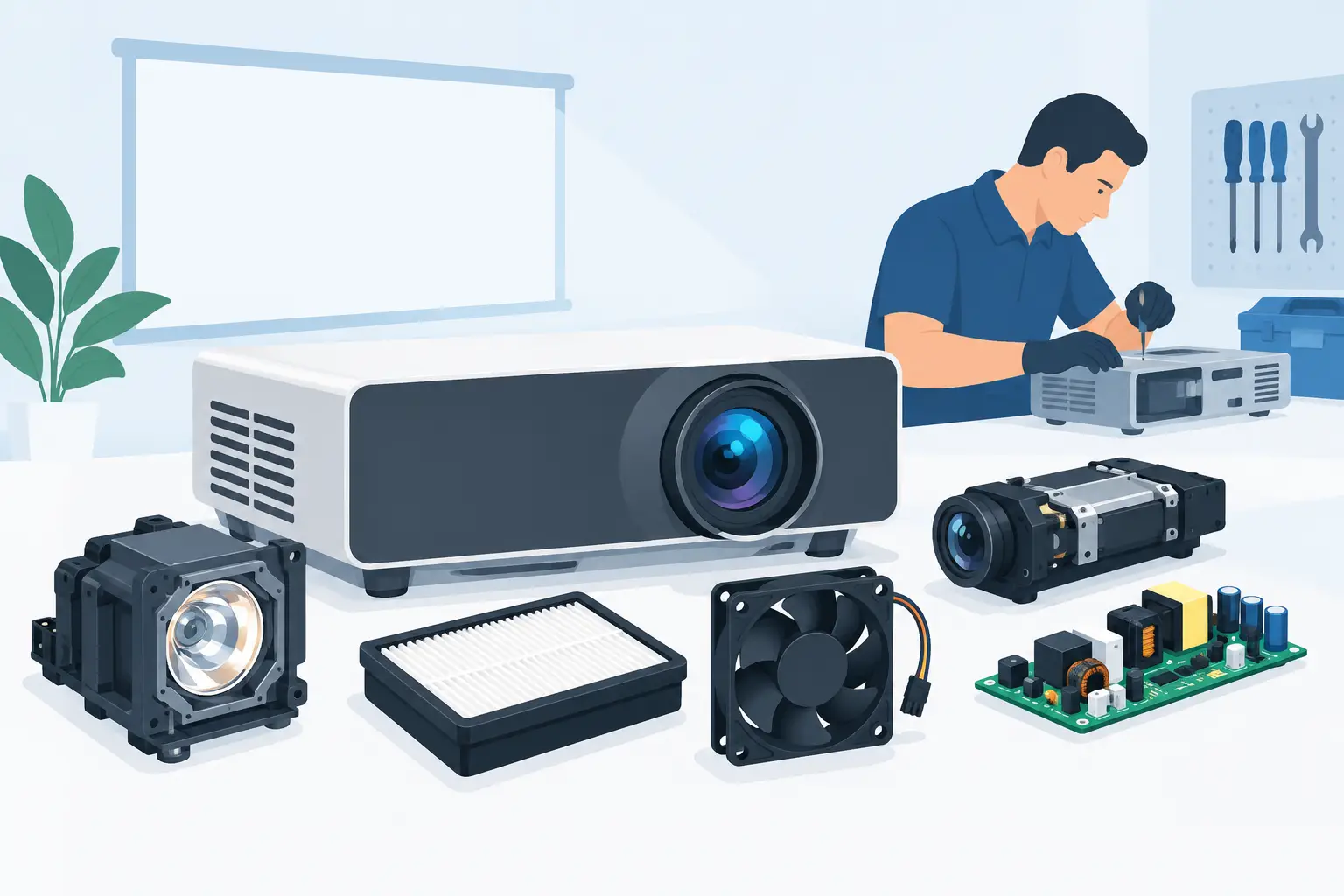
A projector can be technically repairable and still remain out of service because the replacement part is wrong, unavailable, or not economical to install. For distributors, service centers, and AV integrators, the best AV spare parts are not simply the lowest-priced components. They are correctly matched parts that restore performance, protect the equipment, and keep customer systems operating without unnecessary return visits.
Projector fleets in education, corporate meeting rooms, museums, rental inventories, and exhibition environments often include multiple brands and generations of equipment. That creates a purchasing challenge: service teams need broad coverage, dependable compatibility data, predictable quality, and a supplier that understands the difference between a part that fits and a part that performs.
What Makes the Best AV Spare Parts Different
A suitable spare part must satisfy three requirements at the same time: technical compatibility, dependable operating performance, and a commercially practical cost. Missing any one of these can turn a routine maintenance job into an expensive service issue.
A low-cost lamp that produces unstable brightness, a lens with incorrect shift characteristics, or an air filter that restricts airflow may initially appear acceptable. Over time, however, these choices can create overheating, image complaints, premature component failure, or repeat labor. For a professional buyer, the actual cost includes more than the purchase price. It includes technician time, shipping, installation risk, warranty exposure, and the cost of equipment downtime.
The right replacement strategy therefore begins with the projector model, installed application, operating hours, and the customer’s performance expectations. A classroom projector with moderate daily use has different requirements from a high-brightness unit running extended hours in a control room or event venue.
Projector Lamps: Performance Starts With the Light Source
Projector lamps remain among the most frequently replaced AV components. They are also one of the areas where quality differences are immediately visible. A replacement lamp should deliver consistent brightness, stable color, dependable ignition, and a service life appropriate for the projector and application.
Buyers should first distinguish between a complete lamp module and a bare lamp burner. A complete module includes the lamp mounted in a housing and is generally the most practical option for field replacement. A bare lamp burner can reduce cost, but installation requires technical skill and careful handling. It may be appropriate for experienced repair centers, while a complete module is often the better choice for resellers and on-site service teams seeking faster, lower-risk replacement.
Lamp matching should be based on the exact projector model and the original lamp reference, not visual similarity alone. Housing design, connector layout, wattage, burner geometry, and ballast requirements all affect compatibility. Even closely related projector models can use different lamp assemblies.
For professional fleets, brightness retention matters as much as initial output. Lamps that maintain more than 95% of original brightness and achieve more than 90% of original service life provide a practical alternative where OEM lamp costs are difficult to justify. Direct cooperation with established lamp manufacturers such as Philips, Osram, Ushio, and Phoenix also supports more consistent sourcing and product control.
When a Lamp Problem Is Not a Lamp Problem
A lamp replacement will not solve every image or startup issue. Before ordering, technicians should consider lamp-hour warnings, ballast condition, thermal protection faults, fan operation, and projector firmware status. Replacing a lamp without checking these factors can result in a repeat failure and an unnecessary warranty claim.
It is also good practice to inspect the lamp housing area for dust buildup, heat damage, loose connectors, or broken retaining components. A clean installation environment protects both the new lamp and the projector’s cooling system.
Projector Lenses: Compatibility Is More Than a Mount
Interchangeable projector lenses offer service teams an effective way to adapt installed projectors to changing room layouts and application requirements. However, a lens should never be selected only because it physically mounts to a projector. Throw ratio, lens shift range, zoom range, image quality, and supported resolution all determine whether it will work correctly in the field.
Throw ratio is the first calculation. It determines the relationship between projection distance and image width. A short-throw lens may be required for a small training room, while a long-throw lens is more suitable for an auditorium, house of worship, or large venue where the projector must be installed far from the screen.
Lens shift is equally important. Vertical and horizontal shift allow image placement without excessive keystone correction. When a replacement lens does not provide the required shift range, installers may need to relocate the projector, alter the mount, or accept image distortion. Those changes increase labor and can affect the finished installation.
For high-resolution commercial applications, lens optical performance deserves close attention. Low light loss, strong color reproduction, 4K support, and high contrast capability help preserve the projector’s intended image quality. Structural design also matters. A lens designed for straightforward installation reduces handling time and lowers the chance of mount or alignment errors.
Confirm These Details Before Selecting a Lens
A lens order should be checked against the projector series and lens mount type, required throw ratio at the installed distance, screen dimensions, available lens shift, and the resolution required by the end user. These details are especially important for fleet operators supporting multiple projector generations. A precise model match prevents unnecessary returns and avoids project delays caused by an otherwise high-quality lens that is unsuitable for the room.
Air Filters Protect More Than Image Quality
Air filters are easy to overlook because they do not change the image immediately. Yet they play a direct role in projector reliability. Dust, smoke, fibers, and airborne contaminants can block airflow and accumulate on internal optical components, fans, and heat-sensitive electronics. The result can be higher operating temperatures, louder fan noise, reduced light output, and shortened equipment life.
The correct filter must fit the projector’s intake design and allow appropriate ventilation. A filter that is too dense can restrict airflow. A filter that is too open may allow contaminants into the projector. Professional replacement filters need a balanced material structure that captures dust while maintaining the airflow required by the cooling system.
Filter replacement intervals depend on the environment. A clean corporate office may require less frequent service than a school, warehouse, restaurant, smoking area, or event venue. Procurement teams should consider stocking filters alongside lamps rather than treating them as an afterthought. Combining preventive filter replacement with lamp service can reduce truck rolls and help extend the useful life of the projector.
Build a Spare Parts Program Around the Installed Fleet
The most efficient purchasing process is based on fleet data, not urgent single-unit searches. Service providers should maintain an active record of projector brands, model numbers, installed locations, lamp references, lens types, filter references, average operating hours, and common failure patterns. This information makes it easier to forecast demand and identify the parts worth stocking locally.
For commonly deployed models, holding a controlled quantity of lamps, filters, and high-turn accessories can significantly reduce downtime. For specialized lenses or low-volume legacy models, supplier availability and accurate lead-time communication may be more valuable than carrying excess inventory.
A practical stocking policy considers four factors:
- Service frequency and operating hours for each projector model
- The operational impact of downtime at each customer location
- Part value, shelf life, and storage conditions
- Supplier warranty terms and replacement support
There is no single inventory level that works for every AV business. A regional repair center may stock parts for its most common brands, while a systems integrator may only hold critical spares for contract customers with defined response-time commitments. The key is to align inventory with service obligations rather than purchasing solely on unit price.
Evaluate Suppliers by More Than Catalog Size
A large product range is useful, but professional buyers also need clear model matching, stable product quality, warranty support, and responsive technical communication. When a service team is troubleshooting a customer installation, vague compatibility claims are not enough.
A dependable supplier should be able to support selection by projector model, original part reference, and application need. It should also understand the practical differences between original, OEM-equivalent, and alternative replacement options. This allows the buyer to choose the right balance of performance, availability, and margin for each job.
ZORSIKA focuses on projector accessories that address these service requirements, including projector lenses, lamps, air filters, and related replacement products. Its product approach is built around broad compatibility coverage, controlled performance standards, and practical alternatives for professional AV buyers managing cost-sensitive fleets.
The best AV spare parts program is the one that helps your technicians complete repairs correctly the first time. Start with accurate model data, match components to the actual installation, and treat lamps, lenses, and filters as connected parts of projector reliability rather than separate purchasing decisions.