Best Projector Filter Materials for Reliable Airflow
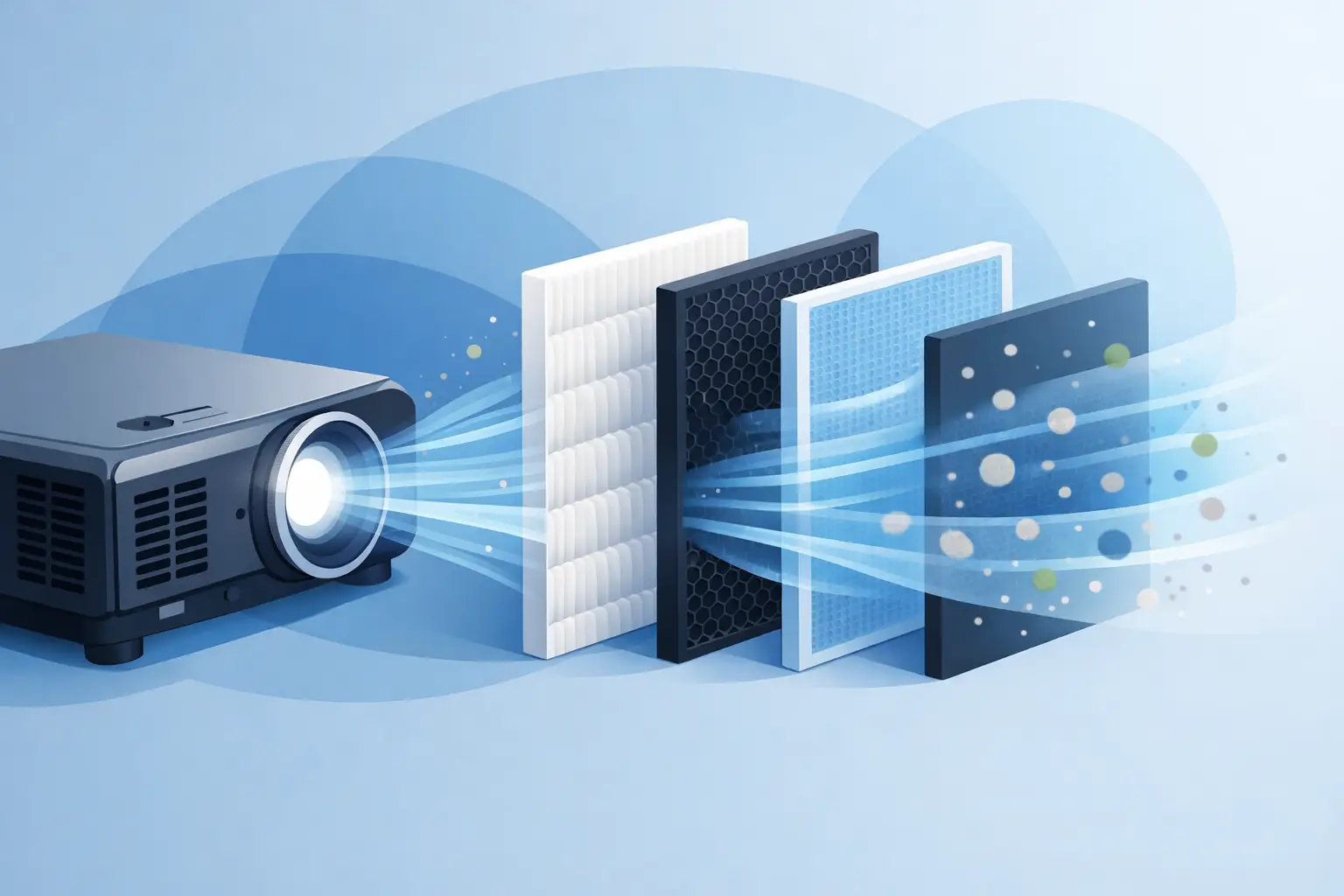
A projector filter can look like a low-value replacement part until a clogged intake causes thermal shutdown, color-wheel stress, reduced brightness, or an avoidable service call. For distributors, repair centers, and AV integrators, selecting the best projector filter materials is therefore not simply a matter of catching the most dust. The filter must protect critical optical and cooling components while preserving the airflow the projector was designed to receive.
The right choice depends on the projector’s intake layout, fan capacity, installation environment, and expected maintenance cycle. A dense material may capture finer particles, but it can also raise airflow resistance and accelerate heat-related faults if the filter area is not sufficient. A low-density material may move air well but allow dust to accumulate on panels, lenses, and heat sinks. Commercial buyers need a material system that balances filtration efficiency, pressure drop, durability, fit, and replacement cost.
What Defines the Best Projector Filter Materials?
For projector applications, material performance should be judged as part of a complete filter assembly. The media, frame, seal, thickness, pleat or foam structure, and cut accuracy all affect field results. A filter that uses suitable media but fits loosely in the filter bay can permit bypass air, allowing dust to enter around the edges rather than through the material.
The primary requirement is controlled airflow. Projector cooling systems use specific fan curves and thermal tolerances. When replacement media is substantially denser than the original design, the projector may pull less cooling air even though the filter appears cleaner. This is particularly relevant for high-brightness projectors used in classrooms, conference rooms, museums, retail displays, and event installations, where lamp or laser-engine heat must be removed continuously.
Dust-holding capacity is the second requirement. A filter should retain particles throughout its service interval rather than becoming surface-loaded immediately. Media with useful depth can capture dust through its structure, extending operating time before airflow falls below an acceptable level. This is generally more valuable than a material that provides high initial capture but clogs quickly in real installations.
Compatibility remains equally important. Filter dimensions, locating tabs, frame rigidity, gasket placement, and airflow direction must match the applicable projector model. Procurement teams should avoid treating all foam or fiber filters as interchangeable sheets. The best material cannot compensate for an incorrect shape or poor sealing design.
Common Projector Filter Materials and Their Trade-Offs
Reticulated polyurethane foam
Open-cell polyurethane foam is widely used in projector air filters because it offers a practical balance of airflow, particle retention, flexibility, and cost. Reticulated foam has a controlled pore structure that allows air to pass through while trapping larger dust particles. It is especially suitable for conventional projector intake filters where the original design relies on a foam media layer.
Foam is available in different pore-per-inch ratings and thicknesses. Lower-density foam generally offers stronger airflow and lower pressure drop, while finer foam improves dust capture but can load faster. For service suppliers, the correct grade should be selected according to the original filter design rather than choosing the densest option available.
Its limitations are worth recognizing. Foam can degrade after long exposure to heat, humidity, smoke residue, cleaning chemicals, or repeated washing. In environments with fine construction dust or heavy airborne contamination, foam alone may not provide enough loading capacity. It remains a strong, cost-effective choice for standard office and education installations when the replacement interval is managed properly.
Nonwoven synthetic fiber media
Nonwoven synthetic media, commonly made from polyester or polypropylene fibers, is a frequent choice for replacement filters requiring greater depth loading than basic foam. The random fiber structure can retain dust across multiple layers, supporting a longer useful service life in installations with regular airborne particulates.
This material can be engineered for different weights, thicknesses, and filtration grades. It is dimensionally stable, resistant to moisture, and suitable for die-cut or framed filter assemblies. When paired with an accurately molded or rigid frame, nonwoven media can provide consistent fit and repeatable airflow characteristics across higher-volume replacement programs.
The trade-off is that synthetic fiber media must be specified carefully. A heavy or tightly packed sheet may restrict airflow more than the projector can tolerate. A thin, low-basis-weight sheet may have acceptable initial airflow but limited particle capture. For commercial fleets, the correct solution is usually a media grade matched to the intended maintenance interval and the original intake area.
Composite foam and fiber filters
Composite filters combine two media types, often an open-cell foam pre-filter with a nonwoven fiber layer. This approach can improve overall performance where installations face a mix of larger debris and finer dust. The foam layer helps intercept lint and larger particles, while the fiber layer increases dust-holding capacity.
A layered design is useful for projectors operating in education facilities, public venues, and other locations with more variable air quality. It can reduce the speed at which fine dust reaches internal components without relying on an extremely dense single layer. However, every additional layer increases resistance. The full assembly must be tested or validated against the projector’s airflow requirements.
For replacement-part buyers, composite media should be evaluated on total pressure drop, not only its claimed filtration performance. A multi-layer filter that causes thermal warnings will create more service cost than it prevents.
Electrostatic synthetic media
Some synthetic filter materials use electrostatic charge to attract and retain fine particles. This can improve initial capture efficiency without requiring an excessively dense fiber structure. For projector filters, electrostatic media may be beneficial in controlled indoor applications where fine dust is the main concern and airflow margin is limited.
Performance can change over time, particularly after washing, high humidity exposure, or heavy contamination. Buyers should not assume that an electrostatic designation guarantees longer life. The media still needs sufficient depth, stable construction, and compatible airflow performance. It is most appropriate when it replicates or improves upon a known original specification rather than being used as a generic upgrade.
Materials That Are Often Unsuitable for Standard Projector Intakes
HEPA-grade media, activated carbon sheets, and very dense household HVAC materials are not automatically better for projectors. HEPA media is designed for high particle efficiency, but its pressure drop can be too high for compact projector fans unless the projector was specifically engineered for it. Restricting intake air can raise internal temperatures and increase fan noise as the unit attempts to compensate.
Activated carbon is intended mainly for odor and gas adsorption. It can be useful in specialized smoke- or odor-exposed environments, but it does not replace particle filtration media and may add unnecessary resistance. For most commercial projector applications, a properly specified foam, synthetic fiber, or composite filter is the more practical choice.
Cotton, loosely woven fabric, and improvised cut-to-size materials also present risks. Their pore structure, shedding behavior, moisture response, and dimensional consistency are difficult to control. They may leave fibers inside the air path, deform in the filter compartment, or allow dust bypass at the edges.
How to Specify Filter Media for a Projector Fleet
A purchasing specification should begin with the projector model and original filter construction. Record the overall dimensions, media thickness, frame material, sealing features, airflow direction, and whether the filter is intended to be cleaned or replaced. This prevents a common sourcing error: matching only the visible length and width.
Next, assess the installation environment. Corporate meeting rooms with routine HVAC maintenance may need a standard open-cell foam or medium-grade synthetic filter. Schools, workshops, retail spaces near entrances, and venues with frequent foot traffic may benefit from deeper synthetic or composite media. Sites exposed to smoke, stage effects, or construction dust need shorter replacement cycles even when using higher-capacity materials.
It is also useful to separate washable and disposable requirements. Washable foam filters can reduce recurring material cost where technicians have access and cleaning procedures are followed. Disposable fiber-based filters may provide more predictable replacement performance and avoid the risk of reinstalling a filter that has not dried fully or has been damaged during cleaning.
For high-volume procurement, request consistent manufacturing controls: stable media grade, accurate die cutting, secure frame bonding, repeatable gasket placement, and packaging that prevents deformation. A filter that arrives compressed, warped, or with poorly bonded media can compromise fit before it enters the projector.
Verify Performance Beyond the Material Name
Material labels alone do not establish quality. Two filters described as polyester, foam, or electrostatic media can perform very differently. Practical verification should include fit testing in the applicable projector housing, inspection for edge bypass, airflow comparison with the original-style filter, and thermal observation under normal operating load.
Service teams should also track field indicators. Rising fan noise, repeated temperature alerts, visible dust accumulation, and shorter lamp life may point to a filter specification or maintenance interval that needs adjustment. These observations are more useful than selecting media based only on a generic filtration claim.
ZORSIKA develops projector air filters with ventilation performance and dust protection in mind, supporting replacement needs across diverse projector models and service environments. For professional buyers, the objective is dependable protection without creating an airflow bottleneck that affects projector uptime.
The most effective filter program is usually the one that matches media to the projector’s original cooling design, then sets replacement intervals according to the actual site conditions. That approach protects equipment, controls service cost, and gives customers a replacement part they can install with confidence.