Commercial AV Sourcing for Projector Parts
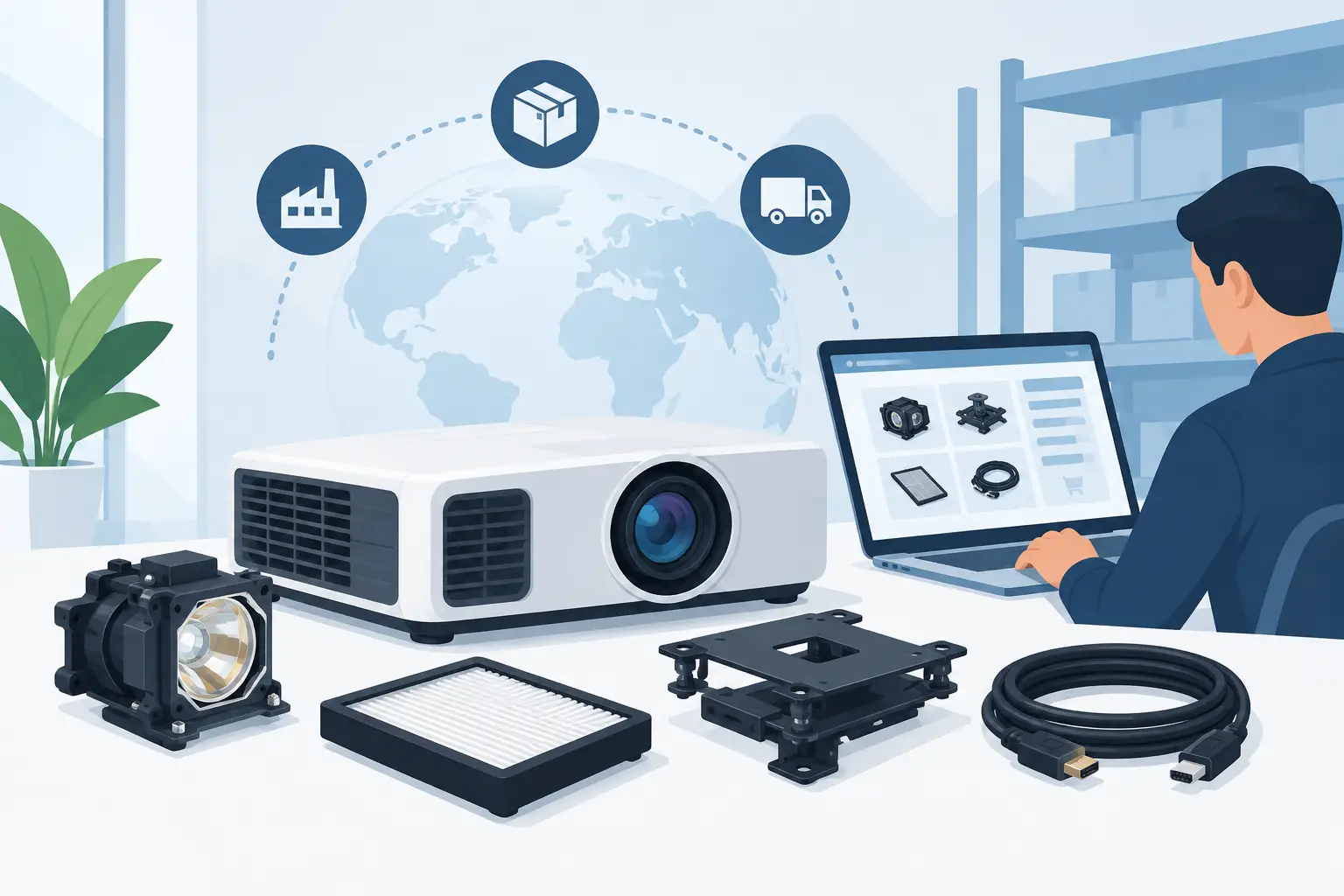
A projector fails in a classroom, boardroom, museum, or rental inventory, and the cost is not limited to the replacement part. The real cost includes technician time, equipment downtime, missed room availability, expedited freight, and pressure on the service team. Effective commercial AV sourcing reduces those costs by treating replacement lenses, lamps, filters, and related components as operational inventory rather than one-off purchases.
For distributors, integrators, repair centers, and procurement teams, the objective is clear: obtain compatible parts at a workable price without creating performance problems or warranty disputes later. That requires more than comparing a few product listings. It requires a sourcing process that checks part identification, supplier capability, product consistency, and long-term availability.
Commercial AV Sourcing Starts With Accurate Identification
Projector accessories are highly model-specific. A similar-looking lamp, lens, or filter may not fit the intended chassis, may produce different optical results, or may trigger operational errors. Part numbers, projector model numbers, lens throw requirements, lamp housing design, and connector configurations should be verified before a purchase order is issued.
This is particularly important for installed fleets with equipment purchased over multiple years. A school district may operate several projector generations from the same manufacturer. An event company may carry models configured with different lens types for different venues. A repair business may receive equipment with incomplete service records. In each case, sourcing by brand name alone is not enough.
A qualified supplier should be able to support matching by projector model, original part number, and product category. For lenses, the technical review should also include throw ratio, mounting interface, resolution support, and the application environment. A lens selected for a short-throw education installation is not automatically suitable for a large venue projection system.
When information is incomplete, buyers should confirm details before ordering in volume. A clear product-matching process is usually faster than processing returns, arranging replacements, and explaining avoidable downtime to an end user.
Price Matters, but Total Service Cost Matters More
Commercial buyers are right to protect margin. OEM projector parts can carry significant cost, especially for lamps and lenses used in large installed bases. Compatible replacement products can provide a practical alternative when they meet the required performance and reliability standard.
However, the lowest quoted unit price is not always the lowest operating cost. A low-cost lamp with inconsistent brightness, a filter with poor airflow, or a lens with excessive light loss can lead to repeat service calls and customer dissatisfaction. The same is true when a supplier cannot maintain stock after a buyer has standardized a replacement part across multiple locations.
A useful purchasing decision considers the full operating picture:
- Product performance against the required application
- Compatibility accuracy and installation fit
- Expected operating life and consistency between batches
- Warranty terms and the supplier's response process
- Stock availability, lead time, and freight reliability
- The supplier's ability to support future replenishment
For a repair center, a lower-priced part may be appropriate for a short-term replacement where the customer understands the trade-off. For a corporate campus or university with critical presentation spaces, reliability and continuity may justify a higher purchase price. Commercial AV sourcing should reflect the application, the customer commitment, and the cost of a return visit.
Evaluate Performance by Product Category
Not every projector accessory should be qualified in the same way. The essential performance criteria differ by category.
Projector lamps and lamp modules
For replacement bulbs, buyers should look beyond stated wattage. Brightness retention, arc stability, operating life, burner quality, housing fit, and electrical compatibility all affect field performance. A lamp module should install correctly and deliver dependable output without creating avoidable stress on the projector.
Where an import-alternative bulb is being considered, compare its claimed brightness and life with the original specification, then evaluate the supplier's manufacturing and quality controls. Direct relationships with established bulb manufacturers can be relevant, but buyers still need confidence that assembly, testing, and model matching are controlled at the module level.
It also helps to distinguish between a bare bulb and a complete lamp module. A bare bulb may reduce material cost for a technically capable repair operation, while a complete module can reduce installation time and handling risk. The right choice depends on the service workflow.
Projector lenses
Lens sourcing carries a different risk profile because image quality is immediately visible. Color reproduction, light transmission, focus uniformity, contrast support, and mechanical alignment all influence the final result. A lens that technically fits but produces weak edge focus or noticeable light loss may be unacceptable in a museum, simulation environment, auditorium, or high-value corporate installation.
Confirm 4K support where the projector and content demand it. Also verify the throw ratio against the installed projection distance and screen size. A sourcing error at this stage can require a costly site correction, especially when lifts, rigging, or custom housings are involved.
Air filters
Air filters are inexpensive compared with lenses and lamps, but they have a direct effect on projector protection. A filter with poor ventilation can contribute to heat buildup. One with inadequate filtration may allow dust or smoke to enter the system, increasing maintenance requirements and shortening the useful life of internal components.
For high-use environments such as schools, retail spaces, houses of worship, and event venues, filter replacement planning should be part of the service schedule. Buyers should source filters that balance airflow with effective dust protection and are designed for the relevant projector model.
Build Supply Continuity Into Commercial AV Sourcing
Availability is a purchasing issue until it becomes a service issue. When a supplier cannot replenish a frequently used lamp or filter, the buyer must qualify another product, update internal records, and possibly rework customer pricing. For larger accounts, a single discontinued component can affect dozens or hundreds of projectors.
Ask suppliers how they manage product continuity. Do they maintain inventory for common models? Can they advise on equivalent replacement options when an older item becomes unavailable? Are product specifications consistent across production batches? These questions are especially relevant for distributors and service companies supporting multi-brand fleets.
Forecasting also improves results. Rather than waiting for emergency failures, review service history to identify the lamps, filters, and lenses used most often. Establish practical stocking levels for high-turn parts, accounting for seasonal demand, contract obligations, and shipping lead times. Critical items can be held locally, while slower-moving models may be sourced to order.
A supplier with broad projector accessory coverage can simplify this process. Consolidating compatible parts through fewer qualified sources reduces administrative work and makes it easier to standardize product data, warranty procedures, and purchasing controls.
Warranty Support Is Part of Product Quality
A warranty has value only when the process is clear and workable. Commercial buyers should understand the coverage period, the information required for a claim, the expected response time, and whether the supplier provides technical assistance during diagnosis.
Documentation matters. Record the projector model, installed part number, installation date, operating hours where available, and observed fault. This helps distinguish a product issue from a projector fault, power condition, ventilation problem, or incorrect installation. It also gives the supplier enough information to respond quickly.
Strong suppliers do not treat warranty as an afterthought. They provide product identification support before purchase and responsive handling if a problem occurs after installation. For service providers, that support protects both margin and customer relationships.
ZORSIKA focuses on this practical requirement by supplying projector lenses, bulbs, air filters, and related accessories for professional buyers who need dependable product matching, warranty support, and cost-effective alternatives for ongoing service work.
Create a Repeatable Supplier Qualification Process
The best sourcing process is repeatable. Once a supplier and product line have been evaluated, document the approved models, technical notes, pricing structure, warranty terms, and any application limitations. This prevents different buyers or technicians from making inconsistent purchasing decisions.
For new suppliers, begin with representative samples or limited-volume orders where possible. Evaluate installation fit, image or brightness performance, operating stability, packaging quality, and support responsiveness. A controlled field trial is more informative than a catalog specification alone.
Procurement teams should also communicate with technicians. Purchasing may identify a favorable unit price, but technicians see whether a lamp housing fits cleanly, whether a filter seats properly, and whether a lens delivers acceptable image quality in the field. Their feedback turns commercial AV sourcing into a quality-control system rather than a transaction.
Reliable projector accessory sourcing protects service continuity, improves purchasing confidence, and gives commercial AV providers more control over their margins. Start with accurate model matching, qualify performance for the intended application, and keep a clear record of suppliers that consistently support the equipment your customers depend on.