Glass Versus Plastic Projector Lenses Compared
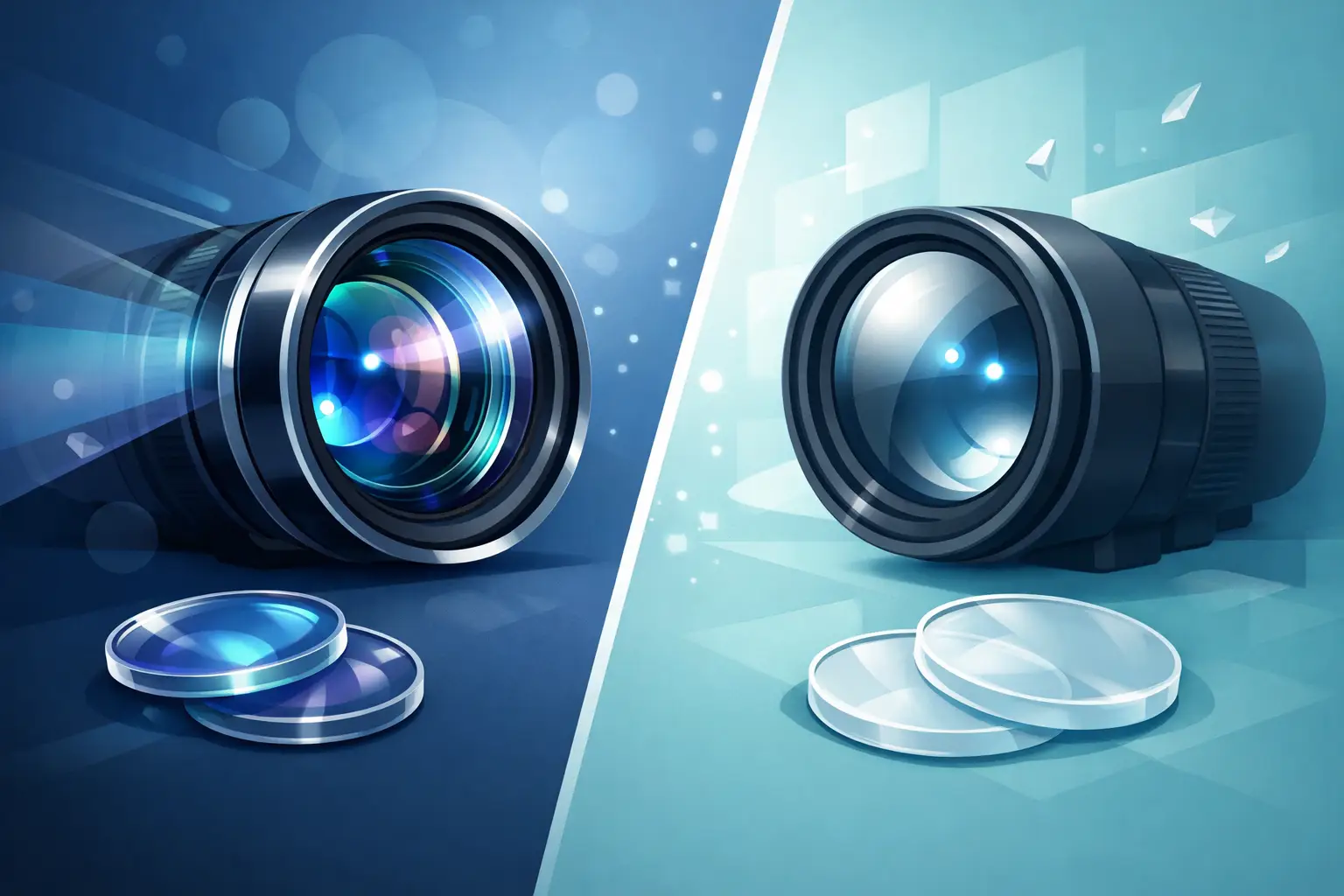
A lens assembly can determine whether a replacement projector returns to service with a clean, stable image or creates a new round of complaints about focus, brightness, and edge sharpness. For distributors and repair teams evaluating glass versus plastic projector lenses, the useful question is not simply which material is better. It is which optical design will perform reliably in a specific projector model, installation environment, and service plan.
Glass generally offers stronger optical stability and heat resistance. Plastic can support lower cost, lower weight, and practical performance in the right design. Neither material should be judged in isolation. Lens geometry, coatings, aperture design, alignment, and compatibility with the projector's optical engine all affect the final result.
Glass Versus Plastic Projector Lenses: The Core Difference
A glass lens element is typically chosen where the optical system requires tight control of image quality, thermal behavior, and long-term dimensional stability. Glass has a high refractive index range, can be manufactured with precise surfaces, and is less likely to deform under sustained heat from a traditional lamp projector. These properties make it well suited to demanding optical paths, including higher-brightness commercial models and applications where image clarity must remain consistent over long operating hours.
Plastic lens elements are commonly made from optical-grade polymers. Their primary advantages are molding efficiency, weight reduction, and cost control. A molded plastic element can be produced in complex shapes at scale, which is valuable in compact or price-sensitive projector designs. Modern optical plastics can provide good results, especially when used in a carefully engineered multi-element assembly rather than as a standalone indicator of overall lens quality.
For a buyer, the material label is only the starting point. Many projector lens assemblies are hybrid designs that combine glass and plastic elements. A compatible replacement must match the original optical design, focal characteristics, mounting structure, and projector model requirements.
Optical Performance and Image Quality
Sharpness, focus, and color control
Glass usually has an advantage when a lens must maintain high sharpness across the full image area. It can be polished to precise tolerances and generally provides reliable control of optical aberrations when paired with appropriate element shapes and coatings. In practical service terms, this can mean better center-to-edge focus, more stable geometry, and fewer visible compromises on large projection surfaces.
Plastic is more susceptible to factors that can affect precision, including molding variation, temperature change, and material aging. That does not mean a plastic-containing assembly will produce a poor image. In a properly designed projector, plastic elements may handle functions where their optical limitations are controlled by surrounding glass elements and the overall lens design.
Color reproduction also depends on the complete optical system. Lens material influences dispersion, or the way different wavelengths of light bend through the element. Glass often gives designers more options for controlling chromatic aberration. However, coatings and the quality of assembly alignment are equally relevant. A replacement lens with incorrect coatings, poor centering, or inaccurate element spacing can reduce image quality regardless of whether it is glass or plastic.
Light transmission and contrast
A lens should transmit as much usable light as possible while limiting internal reflections. High-quality glass with appropriate anti-reflective coatings can support low light loss and strong contrast. This is particularly important in conference rooms, classrooms, exhibitions, and other commercial environments where ambient light already reduces perceived image quality.
Plastic optics can also be coated, but coating adhesion and long-term durability require careful manufacturing control. A low-cost plastic element may yellow, haze, scratch, or lose coating performance sooner in demanding conditions. For service providers, those risks can lead to repeat repairs and lower customer confidence.
When evaluating a replacement assembly, ask for performance information that goes beyond the material claim. Resolution support, contrast performance, transmission control, and quality inspection standards provide a more useful basis for comparing products.
Heat, Durability, and Installed Conditions
Traditional lamp-based projectors place significant thermal stress on their optical components. Glass remains dimensionally stable at temperatures that can cause some plastics to expand, soften, or gradually distort. Heat exposure is not always dramatic enough to cause immediate failure. More often, it contributes to slow focus drift, reduced optical consistency, or surface degradation over extended use.
This matters most in high-brightness lamp projectors, units with restricted ventilation, and installations that run for many hours each day. Dust accumulation, blocked air filters, and aging cooling systems can increase the temperature inside the optical chamber. In these conditions, the durability advantage of glass becomes more meaningful.
Plastic offers a weight advantage, which can be beneficial in compact portable projectors and designs where mechanical loading must be minimized. But it is generally more vulnerable to scratching during handling and cleaning. Aggressive cleaning chemicals, abrasive cloths, and careless removal procedures can permanently affect the surface. Glass is not immune to damage, but it normally tolerates routine service handling more effectively.
A lens material decision should therefore be matched to the operating environment. A short-use portable unit and a ceiling-mounted projector operating eight hours per day do not place the same demands on their optics.
Cost Is More Than the Purchase Price
Plastic lenses are often less expensive to manufacture, especially at high production volumes. That cost advantage can be appropriate where the projector platform was designed around a plastic or hybrid optical assembly. It can help resellers maintain competitive pricing for entry-level products and routine replacements.
Glass components usually cost more because of material, processing, polishing, coating, and inspection requirements. Yet the lowest unit price is not always the lowest service cost. If a higher-quality compatible lens reduces image complaints, repeat visits, and early replacement risk, it may provide better value across the installed base.
For procurement teams, the practical calculation includes more than part cost. Consider technician time, projector downtime, return rates, shipping, warranty exposure, and the customer impact of a failed repair. In commercial AV, a projector that cannot maintain focus before an event, class, or presentation creates costs that are rarely visible on the original purchase order.
Compatibility Is the Non-Negotiable Requirement
A projector lens is not a universal accessory. It must match the model's optical path and mechanical structure. Even assemblies that appear similar can differ in focal length, throw ratio, mounting points, aperture position, sensor integration, zoom range, or element configuration.
Using an incompatible lens can result in poor focus, uneven brightness, image distortion, physical fit problems, or damage during installation. A material upgrade is not automatically an upgrade if it changes the design specifications required by the projector. For example, substituting a glass-only assembly for an original hybrid design may introduce alignment or optical path problems unless it was engineered specifically for that model.
Before ordering, technical buyers should confirm the projector brand and exact model, original part number when available, lens assembly type, and the failure symptom being addressed. It is also useful to distinguish between a lens problem and a lamp, color wheel, DMD, LCD panel, mirror, or dust-contamination issue. Replacing the lens will not correct a fault elsewhere in the optical engine.
What to Look for in a Replacement Lens Supplier
A dependable supplier should provide clear model matching and product specifications rather than broad claims that one material is universally superior. For commercial buyers, the most useful indicators are compatibility coverage, optical inspection, structural accuracy, coating quality, consistent production control, and warranty support.
Ask whether the replacement is designed to support the projector's expected resolution and contrast level. Check whether the mounting structure allows straightforward installation without modification. For larger fleets, confirm availability across the brands and models your technicians service most often, as well as the supplier's ability to maintain consistent quality between orders.
ZORSIKA focuses on projector accessory solutions built around practical compatibility, low light loss, high color reproduction, 4K support, high contrast, and installation-friendly structural design. For repair businesses and AV distributors, those specifications matter because a lens replacement must protect both image performance and service efficiency.
Choose by Application, Not by Material Alone
Glass is usually the stronger choice when high brightness, long operating hours, heat exposure, optical precision, and service life are central requirements. Plastic can be a sensible choice when the original projector design uses it appropriately and weight or cost are major constraints. Hybrid assemblies often represent the intended balance between performance and production efficiency.
The best replacement decision is the one that restores the projector to its designed optical performance with the least compatibility risk. Verify the model, inspect the full optical condition, and select a lens assembly based on documented specifications and supplier support. That approach keeps installed projectors working, protects service margins, and gives end users the consistent image quality they expect.