How Often Replace Projector Filter?
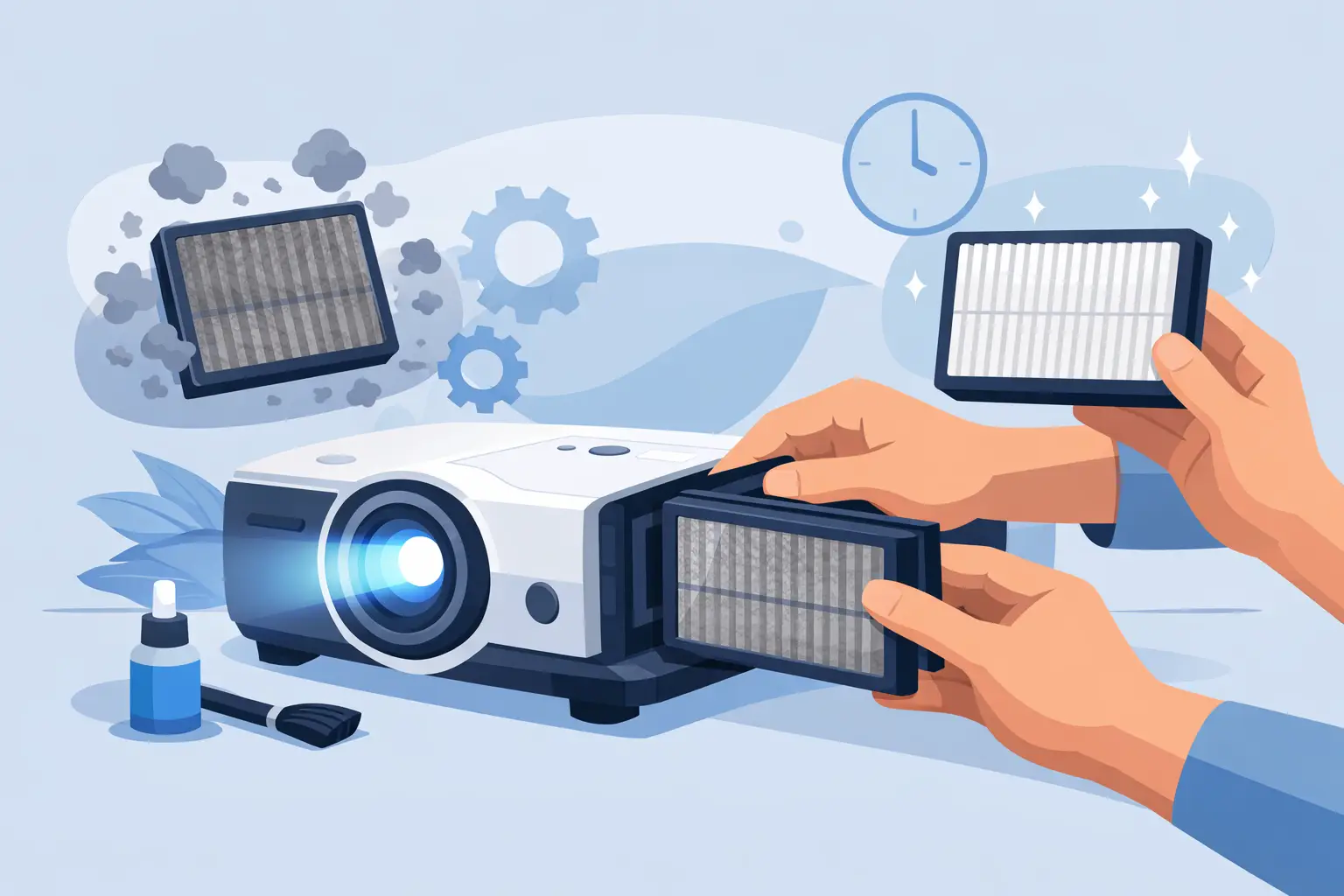
A projector that runs hot, gets louder, or starts losing brightness usually does not need a major repair first. In many cases, the first question is much simpler: how often replace projector filter parts for that model and environment? For service teams, resellers, and facility buyers managing multiple units, that answer affects uptime, lamp life, and maintenance cost more than many operators realize.
How often replace projector filter parts?
There is no single replacement interval that fits every projector fleet. A practical baseline is to inspect filters every 100 to 300 operating hours in dusty or high-use environments, and every 300 to 500 hours in cleaner indoor spaces. Many commercial projector manufacturers recommend cleaning or replacing the filter around the same time as routine lamp or optical path inspection, but actual replacement timing depends on contamination, airflow resistance, and the projector's cooling design.
For many installed projectors in classrooms, conference rooms, houses of worship, and exhibition spaces, replacement often lands somewhere between 500 and 2,000 hours. That is a wide range, but it reflects reality. A ceiling-mounted projector in a clean boardroom may go much longer than a unit near construction dust, stage haze, kitchen grease, or heavy foot traffic. If you support mixed fleets, the environment matters as much as the model number.
The best maintenance practice is not to wait for a fixed number alone. Replace the filter when inspection shows visible loading, reduced airflow, deformation, or material breakdown, even if the rated interval has not been reached. A low-cost filter changed at the right time is usually cheaper than heat-related wear on lamps, LCD panels, DLP optics, fans, and power components.
Why filter replacement intervals vary so much
Projector air filters are simple parts, but they work inside a system with tight thermal tolerances. Cooling performance depends on fan speed, intake design, internal channel layout, and the resistance created by the filter media itself. That is why two projectors operating in the same room can show different service needs.
Usage pattern is one major variable. A projector used for eight to ten hours daily will accumulate debris faster than a unit used only for weekly presentations. Long operating sessions also increase thermal stress, so any airflow restriction becomes more serious.
Room conditions are another factor. Dust is the obvious issue, but smoke, textile fibers, grease aerosol, and fine construction particles can load a filter differently. In retail, hospitality, entertainment, and temporary event setups, contamination is often sticky rather than dry. That kind of buildup reduces ventilation faster and is less suitable for repeated cleaning.
Projector location also changes the schedule. Ceiling-mounted units near HVAC vents, open doors, or high rafters may collect more airborne particles than projectors enclosed in protected meeting spaces. Portable units moved between sites are exposed to the widest range of conditions and usually need more frequent checks.
Then there is filter quality. Media density, frame fit, and airflow balance all matter. A poorly matched replacement can either clog too quickly or allow excess dust into the projector. For buyers supporting service continuity across multiple brands, consistent quality and proper model compatibility are more important than the lowest unit price.
Signs the filter should be replaced now
A projector rarely fails without warning. In many cases, the air filter gives clear service signals first.
The most common sign is increased fan noise. When airflow is restricted, the cooling system compensates by raising fan speed. If a previously stable projector starts running louder under similar load conditions, the filter is worth checking before assuming a deeper fault.
Heat alarms and automatic shutdowns are also strong indicators. A clogged filter can cause internal temperature rise, especially in high-brightness units and older installations where dust has been building over time. If overheat warnings appear, replacing the filter should be part of the first service step.
Image performance may change as well. Reduced brightness is not always a lamp issue. Excess heat can affect lamp efficiency and overall operating stability. In LCD projectors, poor cooling can accelerate wear in temperature-sensitive optical components.
Visible dirt, discoloration, hardened media, torn edges, or a warped frame are direct replacement triggers. Once the media structure degrades, cleaning is no longer enough. At that point, the filter is not only less effective but may also bypass particles around the edges.
Replace or clean? It depends on the filter type
Some projector filters are designed for periodic cleaning and reuse for a limited number of cycles. Others are disposable and should be replaced once loaded. The service manual for the exact model is the first reference point, but field condition still decides whether cleaning is realistic.
If the filter uses durable foam or mesh media and contamination is dry, light cleaning may restore acceptable airflow. If the media has become embedded with fine dust, smoke residue, or oily particles, cleaning often gives only partial recovery. The filter may look better but still restrict airflow.
For commercial service providers, replacement is usually the safer option when labor cost, repeat visits, and equipment risk are considered. A cleanable filter that has already been serviced several times may not hold shape or filtration performance as intended. In installed environments where downtime is expensive, predictable replacement is often better than trying to extend a low-cost part too far.
Building a filter schedule for multi-projector fleets
For distributors, repair businesses, and facility managers, the better question is often not just how often replace projector filter units, but how to standardize the decision across different brands and locations.
Start by grouping projectors by environment: clean office, education classroom, public venue, stage or event, industrial, and mobile rental use. Then assign inspection intervals rather than only replacement intervals. Inspection catches the units that are loading faster than expected and prevents over-servicing cleaner sites.
Next, align filter checks with other planned maintenance windows. Lamp replacement, brightness checks, optical cleaning, and fan inspection are logical points to review filter condition. Combining these tasks reduces labor cost and minimizes unnecessary access to ceiling-mounted installations.
It also helps to track three simple service data points: operating hours, site condition, and reason for replacement. Over time, this gives a more accurate interval than generic guidance. A school district, rental fleet, or AV integrator supporting repeat locations can quickly identify which models and environments consume filters faster.
Finally, keep matched replacement stock. Delays caused by part availability can turn a routine service item into avoidable downtime. This is one reason professional buyers tend to favor specialized suppliers with broad compatibility coverage and stable availability.
The cost of waiting too long
A projector filter is a small part, but delayed replacement can drive larger service costs. Restricted airflow increases internal temperature, and heat is one of the fastest ways to reduce component life.
Lamp systems are especially affected. High heat can shorten lamp life, reduce brightness stability, and increase the chance of premature failure. Fan assemblies also work harder under restricted intake, which may lead to noise issues or early wear.
In severe cases, dust bypass and poor cooling can contribute to contamination of the optical engine. That creates more complicated service work and a higher total repair cost than routine filter maintenance would have required. For organizations managing many projectors, these small failures add up in labor, replacement parts, and room downtime.
This is where part quality matters. A well-made replacement filter should balance ventilation and particle capture while fitting the housing correctly. ZORSIKA focuses on projector air filters with good ventilation rates and reliable protection against dust and smoke, which is exactly the combination commercial service teams need when they are maintaining installed equipment at scale.
What buyers should look for in replacement filters
Not all compatible filters perform equally. For professional procurement, the key issues are dimensional accuracy, media consistency, airflow performance, and stable supply.
A filter that fits loosely can allow edge leakage. A filter that is too dense can reduce airflow even when new. A filter with inconsistent media can create unpredictable service intervals across the same fleet. Those are avoidable problems if sourcing is based on model matching and supplier quality control, not just price.
For resellers and repair providers, warranty support and repeat availability are also commercial issues, not just technical ones. If a part performs well once but cannot be sourced again for the same customer fleet, the maintenance program becomes harder to manage.
A practical purchasing standard is simple: buy filters that are clearly matched by projector model, built for stable airflow, and available from a supplier that understands projector accessory applications rather than treating the part as a generic consumable.
Projector maintenance is rarely complicated, but it does reward discipline. If the goal is fewer shutdowns, longer component life, and more predictable service cost, filter inspection should be routine and replacement should happen before airflow becomes a problem, not after.