How to Source Cross Brand Projector Parts
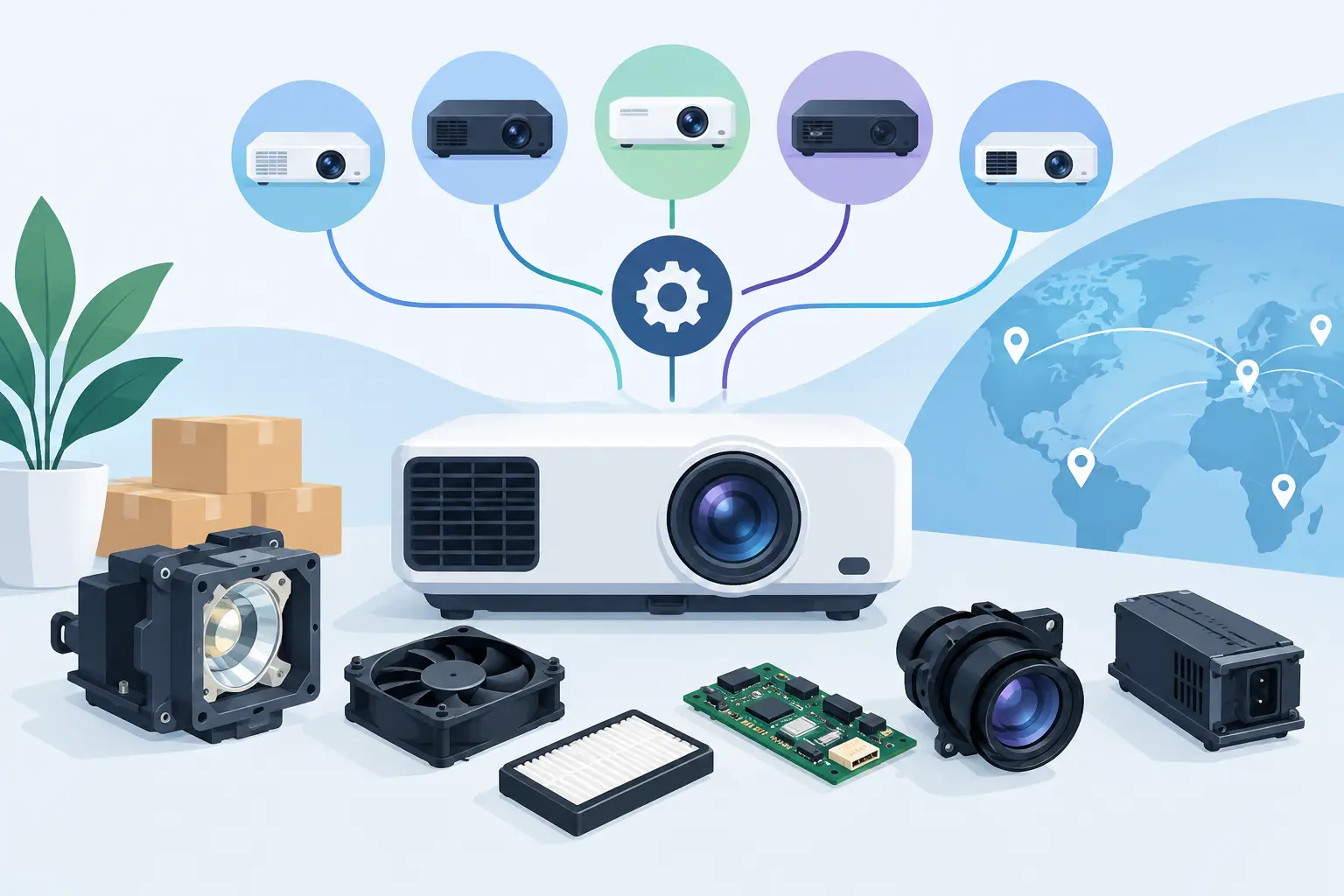
A service department may support dozens of projector models across education, corporate, rental, and exhibition sites. When an OEM part is unavailable or priced beyond the repair value of the unit, knowing how to source cross brand projector parts becomes an operational advantage. The objective is not simply to find a lower-cost replacement. It is to obtain a part with confirmed fit, predictable performance, traceable quality, and warranty support that protects both the repair margin and the end user's uptime.
Start With the Projector Model, Not the Part Name
Cross-brand sourcing starts with accurate equipment identification. A part described as a “projector lamp,” “filter,” or “lens” is rarely specific enough for commercial purchasing. Different projector series can use similar-looking assemblies while having different electrical connectors, optical geometry, firmware recognition requirements, or mounting points.
Record the full projector manufacturer, model number, and serial range where available. Then collect the original part number from the removed component, service manual, or projector label. For lamps, identify whether the requirement is for a bare bulb, lamp module, housing, burner, ballast-related component, or complete assembly. For lenses, document the projector platform, throw ratio requirement, mounting interface, and the application’s screen size and projection distance.
This information prevents the most common sourcing failure: purchasing based on appearance or a shortened model name. A replacement can physically fit a projector and still create low brightness, unstable operation, focus problems, overheating, or error codes.
How to Source Cross Brand Projector Parts by Compatibility
The phrase “cross brand” does not mean that every part can move freely from one projector brand to another. It means a qualified supplier can support multiple brands and identify alternatives across a broad equipment fleet. Compatibility must be confirmed at the model and component level.
For bulbs and lamp modules, verify the bulb designation, electrical specifications, burner type, reflector design, housing fit, connector position, and control-board requirements. Some projector lamp modules use the same underlying bulb family but different housings or connectors. In those cases, a bare bulb may be interchangeable for an experienced repair center, while a complete lamp module is not.
For air filters, match the outer dimensions, frame profile, filter media density, airflow direction, and retention points. A filter that is too restrictive can raise internal operating temperatures. One that fits loosely can allow dust and smoke to bypass the media, increasing the risk of optical engine contamination.
Projector lenses require an even more disciplined review. Confirm the lens mount, supported projector series, throw ratio range, zoom and shift requirements, 4K capability where applicable, and expected light transmission. A compatible lens should preserve image geometry and color performance rather than merely attach to the chassis.
A dependable supplier should be able to work from the projector model and original part number, then provide a clear compatibility confirmation before shipment. If the application is unusual, provide photos of the original component and mounting area. This is especially useful for older installed equipment, regional variants, and units that have undergone prior repairs.
Evaluate Quality at the Component Level
Cross-brand replacement parts are not equal simply because they share a model reference. Procurement teams should evaluate the quality standard behind each product category.
For projector bulbs, ask what bulb source and burner design are used. Lamp performance depends on arc stability, electrode quality, reflector alignment, thermal design, and manufacturing consistency. Brightness claims without information about the underlying bulb and burner offer little value to a professional buyer. A viable alternative should deliver stable illumination, acceptable color performance, and service life aligned with the repair economics of the installed base.
For lenses, evaluate optical performance rather than focusing only on the throw ratio. High color reproduction, low light loss, 4K support, high contrast capability, and a sound mechanical structure are relevant when replacing lenses in demanding venues. Installation also matters. A lens that requires excessive adjustment or does not hold alignment can turn a routine replacement into a return visit.
For filters, ventilation rate and media performance should be assessed together. The goal is to block dust and smoke while maintaining sufficient airflow for the projector’s cooling system. Lower-priced filter media may save a small amount on the purchase order while shortening the life of more expensive internal components.
Request product specifications, quality-control information, and warranty terms that are appropriate for your market. For recurring purchases, sample testing on representative projector models is a practical way to qualify a new replacement line before adding it to regular inventory.
Compare the Total Cost of the Repair
OEM parts can be the correct choice for equipment under manufacturer warranty, highly specialized installations, or projects with a strict end-user specification. However, OEM availability and pricing may not support economical service for older projectors. A qualified compatible part can preserve repair viability and reduce lead times.
The purchasing decision should consider more than unit cost. Calculate the complete cost of the repair: part price, freight, installation labor, expected return rate, warranty exposure, and the cost of a repeat site visit. For a school district or corporate campus, a failed low-cost lamp may create more cost than the savings achieved at purchase.
This is why commercial buyers often use a two-tier approach. They retain OEM options for projects that require them and qualify reliable alternatives for common service models. The right balance depends on the application, contract requirements, fleet age, and customer expectations.
Build a Supplier Qualification Process
A supplier with broad brand coverage can reduce purchasing complexity, but coverage should be supported by technical discipline. Before placing volume orders, assess whether the supplier can provide accurate model matching, consistent part numbering, product photos, specification records, and responsive technical communication.
Use the following checks when qualifying a cross-brand projector parts supplier:
- Confirm that the supplier matches parts by full projector model and original part number, not by generic product descriptions.
- Review warranty scope, claim handling, and the process for identifying defective or incorrectly matched items.
- Ask about stock planning, lead times, and whether common parts can be supplied consistently across multiple brands.
- Evaluate packaging and shipping protection, particularly for bulbs, lenses, and components with fragile optical surfaces.
- Test a controlled sample order before committing to a large inventory purchase or service contract.
For distributors and repair businesses, clean catalog data is also valuable. Consistent model references make it easier to list products, train support teams, and avoid incorrect order entry. A supplier that understands catalog-level requirements can save time throughout the order cycle.
Plan Inventory Around Failure Patterns
The most effective sourcing strategy combines supplier access with practical stocking decisions. Do not stock every part for every projector. Stock the fast-moving components tied to the installed base you actually serve.
Review service history by customer segment, projector brand, model family, and failure type. Education fleets may produce steady demand for lamps and filters. Event and rental environments may require rapid access to lenses, lamp modules, and high-use accessories. Corporate installations often need planned maintenance parts that minimize disruption during scheduled service windows.
Keep critical parts in local inventory when downtime is expensive or site access is difficult. Use supplier-held stock for slower-moving items, provided lead times are acceptable. This approach reduces capital tied up in inventory while maintaining service coverage for a diverse fleet.
It is also useful to standardize internal records. Every installed projector should be associated with its approved replacement lamp, filter, lens, and relevant accessory references. When a service ticket arrives, the team can source against verified data instead of restarting the identification process.
Control Risk After Installation
Sourcing does not end when the part ships. A short post-installation verification process protects the customer relationship and improves future purchasing decisions.
After fitting a lamp module, check startup behavior, brightness, color balance, fan operation, lamp-hour reset procedure, and error indicators. With a replacement lens, verify focus uniformity, image alignment, zoom range, shift operation, and edge-to-edge clarity. After replacing a filter, confirm correct seating and unobstructed airflow.
Track returns by projector model, part type, and supplier batch. A single return may result from installation error or handling damage. Repeated returns on the same reference indicate a compatibility, quality, or packaging issue that should be addressed before the next order. Reliable field feedback is one of the strongest tools for improving cross-brand sourcing accuracy.
ZORSIKA supports professional buyers with projector lenses, bulbs, air filters, and related accessories designed for practical compatibility, dependable performance, and commercial service requirements. For parts buyers, the most useful supplier relationship is one that turns a complex multi-brand fleet into a controlled, repeatable sourcing process.
The right part is the one that restores performance without creating another service call. Make every purchase decision traceable to a verified model match, defined quality standard, and supplier commitment that can support the repair after installation.