Laser Projector Light Source Replacement Guide
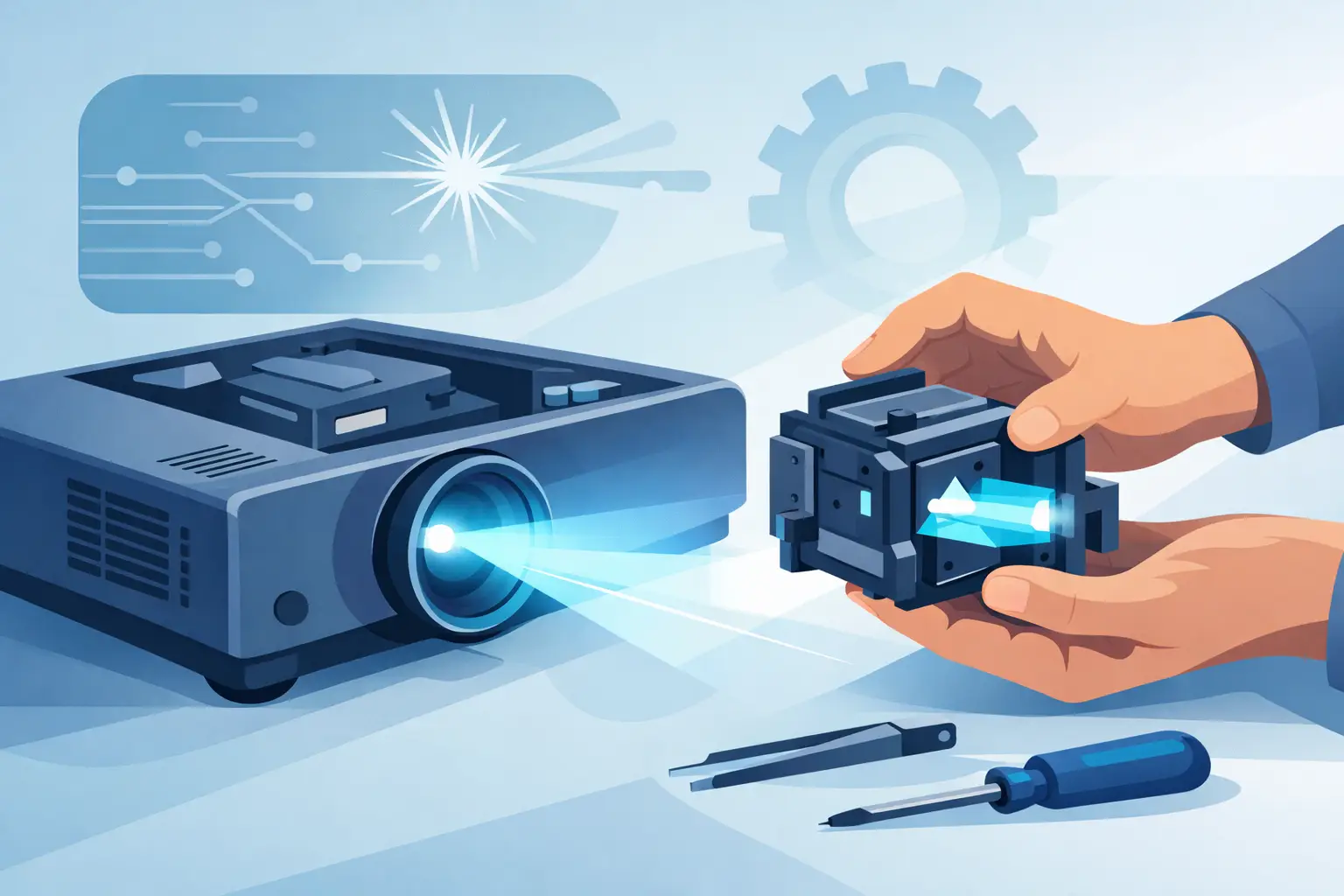
When a customer asks for laser projector light source replacement, the real question is usually not whether the light engine can be changed. It is whether the replacement makes commercial sense for that model, that installation, and that service timeline. For distributors, repair centers, and AV integrators, the answer depends on cost, availability, compatibility risk, and how much downtime the end user can tolerate.
Laser projectors are often marketed as low-maintenance products, and compared with lamp-based units, that is generally true. They remove routine lamp changes and reduce service intervals. But low maintenance does not mean no service. Over time, brightness drops, phosphor components age, optical paths collect contamination, cooling systems degrade, and in some cases the laser light source or related driver assemblies fail. When that happens, buyers need a clear decision framework rather than assumptions.
What laser projector light source replacement really involves
In a lamp projector, replacement is usually straightforward. The bulb module is designed as a field-replaceable part. In a laser projector, the light source is typically integrated into a larger optical or illumination system. Depending on the product design, replacement may involve the laser diode array, phosphor wheel, light engine, driver board, thermal components, or a complete optical block.
That distinction matters for service planning. In many models, the failed part is not treated as a simple consumable. It may require disassembly, recalibration, and verification of thermal and optical performance after installation. For service businesses, this means labor cost and technical risk are part of the replacement equation, not just the price of the part itself.
There is also a difference between light source failure and perceived light source failure. A projector that looks dim may have air flow restriction, dust buildup, degraded optics, color wheel issues in hybrid systems, or mainboard control problems. If the diagnosis is incomplete, replacing the laser assembly may not solve the problem.
When laser projector light source replacement is worth considering
For commercial fleets, replacement is usually justified in three cases. The first is a high-value projector with strong installed demand, where replacing the light source extends useful life at a lower cost than full unit replacement. The second is a specialized installation where throw ratio, mounting position, or system design makes swapping the entire projector disruptive. The third is a fleet environment where standardization matters and keeping the same chassis in service simplifies support.
In these situations, laser projector light source replacement can preserve margin and reduce customer disruption. A university lecture hall, museum installation, or conference venue may prefer repair if a replacement projector would trigger remounting, lens changes, control reconfiguration, and image realignment.
However, it is not always the right move. If the projector is already facing multiple age-related issues, such as fan wear, optical contamination, power board instability, or declining image uniformity, replacing only the light source may simply postpone a larger failure. The total service outcome matters more than the appeal of replacing one expensive component.
Why replacement is often more complex than buyers expect
The challenge is not only the part itself. It is the level of integration inside laser projection systems. Manufacturers design these systems around thermal balance, optical alignment, and control logic. Even when a replacement assembly is available, service teams may need to verify firmware behavior, thermal sensor response, and brightness consistency across operating modes.
This is why compatibility discipline is critical. Matching by brand alone is not enough. Buyers need the exact model, sub-model, region variant if applicable, and ideally the original part number or service documentation reference. Similar-looking laser modules may differ in connector layout, driver requirements, heat sink design, or mounting geometry.
For procurement teams supporting mixed projector fleets, this creates a sourcing challenge. Availability can be inconsistent, especially for older commercial models. OEM parts may be expensive or restricted, while non-OEM supply quality varies widely. A dependable supplier should be able to confirm compatibility clearly, communicate warranty terms, and set realistic expectations around lead time and service outcome.
Lifespan claims versus field reality
Laser projectors are commonly rated for long operating life, often around 20,000 hours or more, but that figure needs context. It usually refers to a brightness drop threshold under controlled test conditions, not a guarantee of trouble-free operation in every real-world installation.
Usage pattern has a major effect. Projectors running in dusty environments, high ambient temperatures, restricted ventilation spaces, or extended high-brightness modes will age faster. Event use, transport vibration, and stop-start duty cycles can also affect supporting components. In fixed commercial installations, neglected filter maintenance and poor air flow are frequent causes of early performance decline.
For service providers, the practical takeaway is simple: do not treat rated laser life as a maintenance-free promise. Evaluate the full operating environment. In many cases, preventive maintenance around filters, cooling, and optical cleanliness can delay the point at which light source replacement becomes a discussion.
Cost analysis for repair businesses and AV buyers
The commercial decision should be based on total service cost, not part cost alone. Laser projector light source replacement may look attractive compared with buying a new projector, but labor, testing time, shipping risk, and callback exposure can narrow that gap.
A repair center should consider five cost factors: the replacement assembly price, technician labor, calibration and testing time, turnaround expectations, and warranty liability. If any of these are uncertain, margin can disappear quickly. For resellers and integrators, there is also the reputational risk of putting a repaired unit back into a critical installation without confidence in the remaining service life of adjacent components.
That said, replacement can still be the better business decision when part quality is stable and compatibility is well controlled. In those cases, the ability to restore a commercial projector without a full capital replacement is valuable, especially for customers managing large estates across education, corporate, and public display environments.
How to source the right replacement part
The safest purchasing process starts with precise identification. Collect the projector brand, exact model number, serial information if needed, failure symptoms, and any visible part markings from the existing light engine or service documentation. If brightness loss is gradual rather than sudden, confirm whether filters, fans, and optical components have already been inspected.
A qualified supplier should then confirm whether the replacement is for a complete laser light source assembly, a related optical module, or another service component. This avoids a common problem in the market: ordering a part labeled broadly as a laser module when the actual failure is in the driver circuit, cooling system, or internal optical path.
For trade buyers, warranty support is not a minor detail. It is part of the purchasing decision. A supplier with projector accessory specialization and broad model coverage can reduce sourcing time, improve compatibility accuracy, and help service teams avoid tying up capital in the wrong inventory. This is where experienced category suppliers such as ZORSIKA are positioned to support professional buyers with clearer matching and more practical replacement options.
Repair or replace the whole projector?
There is no universal rule. The better choice depends on projector class, application, and the age of the installed base. High-brightness professional models, specialized short-throw systems, and units paired with costly lenses are stronger candidates for repair. Entry-level or aging models with declining support are often better replaced entirely.
A useful threshold is operational disruption. If replacing the projector means redesigning the installation, changing lenses, adjusting mounts, or requalifying the system, repair becomes more attractive. If a current replacement unit can be installed quickly with better performance and full warranty coverage, whole-unit replacement may be the lower-risk option.
Service history should also guide the decision. A projector with stable electronics and a clean maintenance record is a better repair candidate than one that has already shown repeated thermal, power, or image quality issues.
What buyers should ask before placing an order
Before committing to laser projector light source replacement, ask four practical questions. Is the failure correctly diagnosed? Is the offered part matched to the exact model and assembly type? What post-installation adjustment or testing will be required? And what warranty covers the part after installation?
These questions help avoid the most expensive mistake in projector service: buying a technically compatible part that is commercially unsuitable. A lower purchase price means little if the installation is difficult, the turnaround is too slow, or the failure returns because the root cause was elsewhere.
Laser projectors reduce routine maintenance, but they do not eliminate service decisions. Buyers who treat replacement as a technical and commercial evaluation, not just a parts order, usually get better outcomes. The right part, matched correctly and supported properly, can keep a valuable projector in service longer without creating new risk for the next job.