Laser Projector Service: Parts That Protect Uptime
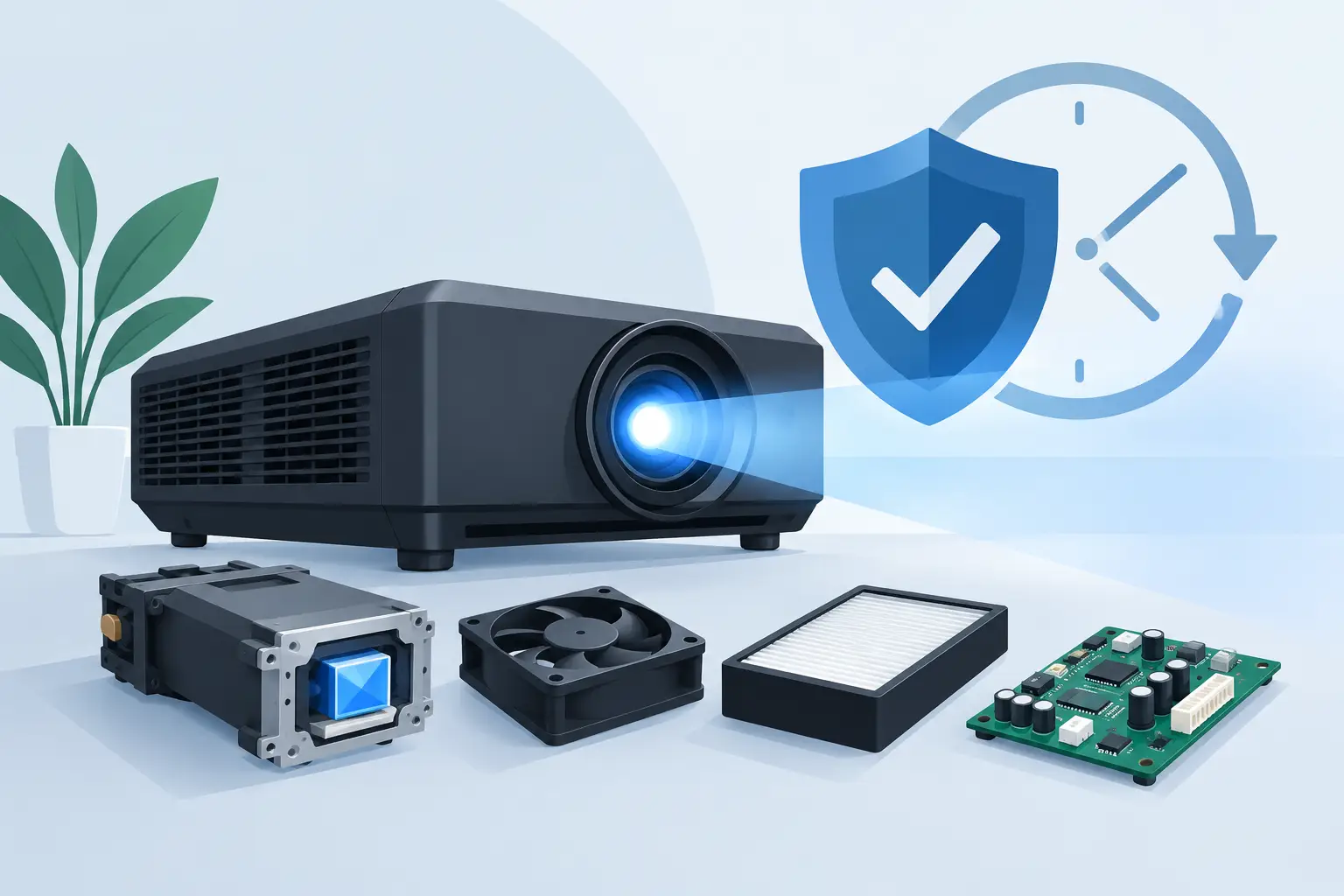
A laser projector can reduce lamp replacement work, but it does not eliminate the service requirements that affect installed AV systems. For distributors, integrators, and repair teams, the practical question is not simply whether a laser light source lasts longer. It is whether the projector can maintain specified brightness, image quality, and operating stability throughout its service life.
That depends on the full optical and thermal system. Lenses, air filters, cooling components, power assemblies, and correct installation practices still determine whether a projector remains productive in a classroom, conference room, museum, house of worship, or event venue. A long-life light engine is valuable, but it cannot compensate for a contaminated optical path, restricted airflow, or an incorrectly matched replacement part.
What Changes With a Laser Projector
Conventional lamp projectors use a replaceable lamp as their primary light source. Laser models use a laser-phosphor or RGB laser light engine designed for extended operation. This changes the maintenance profile significantly. There is no routine lamp cycle for many laser projector models, and users can expect more stable brightness over a longer period than with a traditional high-pressure lamp.
However, “maintenance-free” is not an accurate description. Laser light engines are integrated assemblies, often not field-replaceable in the same way as a projector bulb. When a laser light source or its associated optical components fail, repair can require specialized diagnosis, factory-level service, or full-unit replacement. The longer source life therefore raises the importance of protecting the projector from avoidable stress.
For service providers, this changes inventory planning. Demand may shift away from lamp modules for some fleets, but compatible filters, lenses, mounts, cooling-related parts, remote controls, and other accessories remain essential. Organizations operating mixed fleets must also continue supporting lamp-based equipment already installed across multiple sites.
The Parts That Still Determine Image Performance
A projector image is only as reliable as the path between the light source and the screen. Buyers should evaluate accessory requirements according to the projector model, installation environment, and required image specification rather than assuming all laser units have the same service needs.
Projection lenses are application-critical
Interchangeable lenses are common in large-venue, installation, and professional projection platforms. A laser light engine may provide the brightness, but the lens determines throw distance, image geometry, edge sharpness, and much of the visible color and contrast performance.
A mismatched lens can create immediate operational problems: the projector may not reach the required screen size, may require an unsuitable mounting position, or may produce uneven focus across the image. For replacement or upgrade purchases, technical teams should confirm the projector series, lens part number, throw ratio, lens shift requirements, resolution support, and mechanical mount design.
For 4K applications, lens quality deserves particular attention. A lens designed with low light loss, high color reproduction, and appropriate optical precision helps preserve the performance the laser projector was selected to deliver. Installation convenience also matters. In multi-site deployments, a scientifically designed lens structure can reduce fitting time and lower the risk of alignment errors during service calls.
Air filters protect the thermal system
Laser projectors generate heat and rely on controlled airflow to keep internal electronics and optical assemblies within operating limits. Dust, smoke, textile fibers, and airborne contaminants can restrict intake paths and settle on sensitive internal surfaces. The result may be higher fan noise, thermal warnings, reduced brightness, unexpected shutdowns, or progressive image degradation.
The correct air filter is a low-cost preventive component with a high operational value. It must fit the designated model and provide effective particle capture without unnecessarily limiting ventilation. A filter that is too restrictive can create its own cooling problem. A poorly fitted filter can leave gaps that allow contamination into the projector.
Filter service intervals should follow actual conditions, not only a calendar. A clean corporate boardroom and a busy education facility do not expose equipment to the same dust load. Retail floors, workshops, transportation areas, and event venues often require more frequent inspection. In environments with haze or smoke, service teams should plan for accelerated contamination and document filter condition at each visit.
Cooling and power components require accurate diagnosis
When a laser projector reports overheating, reduced output, or intermittent shutdowns, replacing a filter without diagnosis may not solve the issue. Fans, sensors, power boards, control boards, and thermal pathways can all contribute. Technicians should inspect airflow first, verify fan operation, check error codes, and confirm that the projector is installed with the required clearance.
This is also where compatible parts sourcing must be controlled. A lower purchase price is not meaningful if a replacement component creates repeat failures, requires rework, or voids the expected service outcome. Buyers need clear model matching, consistent quality, and warranty support from suppliers that understand professional projector platforms.
A Practical Service Plan for Laser Projector Fleets
Preventive maintenance is most effective when it is standardized across the installed base. For organizations supporting many models and locations, a simple service record should identify each projector’s model, serial number, operating hours, lens type, installation environment, prior faults, and replacement-part history.
During scheduled inspections, technicians should address four areas:
- Check air filters, intake vents, exhaust paths, and mounting clearance for dust buildup or obstruction.
- Confirm lens condition, lens lock position, focus uniformity, and image alignment on the installed screen.
- Review operating hours, error logs, fan behavior, temperature alerts, and any reported changes in brightness or color.
- Verify that firmware, cables, mounts, and external control connections are appropriate for the current installation.
These checks take less time than an emergency callout and provide useful purchasing data. If a certain site repeatedly shows contaminated filters or overheating alerts, the issue may be environmental or installation-related rather than a projector defect. That distinction helps procurement teams order the right parts and helps integrators propose a durable correction.
Replacement Parts: Compatibility Is the First Requirement
The projector accessories market includes products described as compatible, replacement, aftermarket, or OEM equivalent. Those labels alone do not confirm suitability. A professional buyer should require exact part identification and verify the product against the projector model and, where relevant, regional or revision-specific variations.
For lenses, compatibility includes more than mechanical attachment. The lens must support the projector’s optical architecture and intended resolution. For filters, dimensions, frame design, airflow characteristics, and installation orientation matter. For lamp-based projectors that remain in a mixed fleet, the lamp housing, burner specifications, brightness target, and expected operating life should be evaluated as a complete assembly.
Service businesses also need consistency between orders. A replacement part that performs well once but varies from batch to batch adds avoidable risk to field operations. Reliable suppliers support repeatable sourcing with clear specifications, broad model coverage, and warranties that match the commercial importance of the equipment.
Managing Mixed Fleets Without Excess Inventory
Many commercial AV customers will operate both laser and lamp projectors for years. Replacing every lamp model immediately is rarely the most cost-effective decision. Existing equipment may still be suitable for smaller rooms, temporary installations, or lower-hour applications if replacement lamps and filters remain available.
The best approach is to segment the fleet. High-use installations, difficult-access locations, and critical presentation spaces may justify laser upgrades because reduced lamp service lowers disruption. Lower-use projectors may remain economically viable with quality replacement bulbs, filters, and planned maintenance. This avoids treating laser technology as an all-or-nothing purchasing decision.
For resellers and repair providers, stocking strategy should reflect that reality. Fast-moving filters and common accessories support laser fleets, while proven replacement bulbs remain necessary for installed lamp projector populations. Model-level demand history is more useful than broad assumptions about technology trends.
Selecting a Supplier for Long-Term Service Support
A parts supplier should help reduce compatibility risk rather than transfer it to the buyer. Look for accurate product identification, technical response capability, stable availability, and a warranty process that is practical for commercial service operations. Product quality should be judged by field performance: fit, optical results, brightness, operating life, and consistency across repeat orders.
ZORSIKA supports projector service businesses with a focused range of projector lenses, replacement bulbs, and air filters designed around practical model compatibility and dependable supply. For a laser projector fleet, the objective is straightforward: protect the optical system, maintain airflow, and keep the correct replacement accessories available before a small maintenance issue becomes equipment downtime.