Laser vs Lamp Projectors: Which Fits Best?
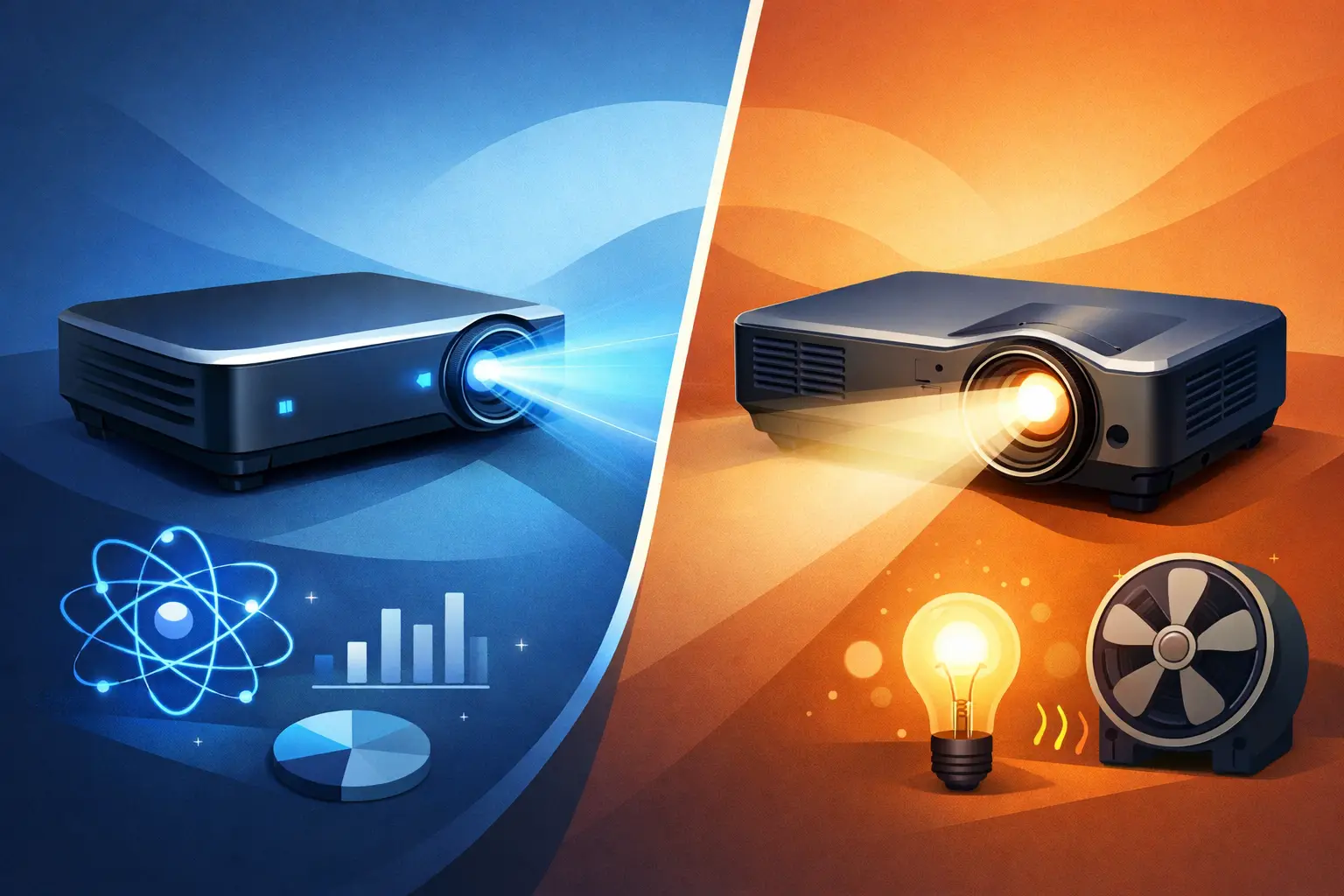
A projector that looks good on a spec sheet can still become a poor fleet decision once maintenance cycles, replacement costs, and uptime targets enter the picture. That is why laser vs lamp projectors is not just a technology comparison. For distributors, integrators, and service teams, it is a purchasing and support decision that affects margins, parts planning, and customer satisfaction over time.
Laser vs lamp projectors in commercial AV
At the most basic level, the difference is the light source. Lamp projectors use a replaceable high-pressure lamp, while laser projectors use a laser-based light engine designed for a much longer operating life. That sounds simple, but the real distinction is how each platform behaves in the field.
Lamp-based models are familiar, widely deployed, and often cheaper at the initial purchase stage. They remain common in education, conference rooms, and legacy installations where budgets are tight and replacement lamp support is already built into the service model. For many buyers, especially those supporting mixed fleets, lamp projectors still make financial sense.
Laser projectors, by contrast, are usually selected when lower maintenance, longer operating cycles, and more predictable performance matter more than the lowest upfront price. In museums, digital signage, simulation, large venues, and higher-usage corporate environments, that trade-off is often justified quickly.
Upfront cost versus lifetime cost
This is where many buying decisions are won or lost. Lamp projectors usually carry a lower purchase price, which makes them attractive for cost-sensitive tenders or high-volume deployments. If the projector will be used only a few hours per day, or if the site already has a lamp replacement process in place, the lower entry cost can be the right decision.
However, lamp ownership does not stop at procurement. Lamp replacements, labor, downtime, brightness decline, and inventory management all add cost over the life of the unit. A low initial price can become less attractive when a fleet manager is tracking service calls across dozens or hundreds of installed units.
Laser projectors generally cost more to acquire, but their long light-source life reduces routine intervention. That matters for installations with difficult access, strict uptime expectations, or limited on-site technical staff. When labor cost and disruption matter as much as the hardware itself, laser often comes out ahead.
The answer depends on usage hours, installation complexity, and how the customer values maintenance avoidance. A budget classroom and a 12-hour-per-day retail display should not be evaluated the same way.
Brightness stability and image performance
From a service and user-experience standpoint, brightness consistency is one of the most practical differences between the two categories. Lamp projectors can produce strong brightness, but output declines over time. That decline is expected, and in some installations it is manageable. In others, especially environments requiring consistent presentation quality, it becomes a recurring complaint.
Laser projectors tend to maintain brightness more consistently over a longer portion of their service life. For customers who care about image uniformity across multiple rooms or displays, that can simplify support. It also reduces the need to replace lamps early just to maintain acceptable brightness.
Color performance depends on more than the light source alone. Optics, imaging chip design, processing, and calibration all matter. Still, laser systems are often favored in applications where buyers expect stable color and brightness over extended operating periods. If image consistency is tied to the commercial value of the installation, laser offers a practical advantage.
That said, lamp projectors are not automatically a poor visual choice. Many lamp-based models still deliver excellent performance, especially when paired with quality replacement components and maintained properly. In service markets, the condition of the lamp, air filter, and optical path can have as much impact on picture quality as the original projector category.
Maintenance, downtime, and parts planning
For professional buyers, this is often the deciding factor.
Lamp projectors require scheduled replacement of consumable lamps. That creates an ongoing need for compatible stock, model matching, and service scheduling. In exchange, the platform is straightforward. If a lamp reaches end of life, the unit can often be restored quickly with the correct replacement part. For repair businesses and resellers, that creates a well-defined aftermarket opportunity.
Laser projectors reduce lamp-related maintenance, but they do not eliminate service requirements. Airflow management, filter condition, thermal performance, and optical cleanliness still matter. A laser light source with poor cooling conditions will not deliver its expected operational life. Buyers sometimes treat laser as maintenance-free, and that assumption causes avoidable failures.
This is one reason accessory supply remains important in both categories. Filters, compatible optical components, and properly matched replacement parts continue to affect reliability regardless of light source type. ZORSIKA works with many professional buyers who need dependable coverage across different projector brands and generations, especially where uptime matters more than marketing claims.
From an inventory standpoint, lamp fleets require more active consumables planning. Laser fleets shift more of the focus toward preventive maintenance and broader lifecycle management. Neither is inherently simple. They just create different service workflows.
Laser vs lamp projectors for different applications
Usage profile should lead the recommendation.
For classrooms, small meeting rooms, and budget-driven commercial deployments, lamp projectors often remain a practical fit. If the customer accepts routine lamp replacement and the usage hours are moderate, they can deliver strong value. They also make sense when replacement lamps are already stocked and technicians are comfortable supporting the installed base.
For high-hour applications such as signage, control rooms, visitor attractions, and large-venue environments, laser projectors usually offer better operating economics. The reduction in service interruptions is often worth the initial premium. This becomes even more relevant when projectors are ceiling-mounted at height, installed in hard-to-access enclosures, or deployed across multiple remote sites.
Rental and staging is more nuanced. Some event providers prefer laser because of lower maintenance and more consistent output. Others still use lamp units where capital efficiency, specific model availability, or event-by-event asset utilization make lamp-based inventory viable. In this segment, the right answer depends on fleet age, turnover plans, and customer expectations.
Risk, compatibility, and procurement strategy
A projector purchase decision should also consider what happens after year one. Lamp fleets require trusted replacement lamp sourcing, because quality inconsistency in the aftermarket can quickly create call-backs, reduced brightness, or shortened life. For procurement teams and service providers, supplier reliability matters as much as unit price.
Laser fleets reduce dependence on lamp replenishment, but they can introduce different procurement challenges. Initial replacement cost is higher if a unit fails out of warranty, and component-level repair may be less straightforward depending on the model. Buyers should not assume that longer-rated light-source life means lower total operational risk in every case.
Compatibility management remains critical in both environments. Mixed fleets are common, especially among universities, enterprise campuses, and service companies supporting multiple customer sites. Standardizing where possible helps, but real-world operations usually involve many brands and model families. That is why professional buyers look for suppliers who can support broad compatibility, stable quality, and clear product matching.
Which one is better?
If the question is purely technical, laser often looks stronger. If the question is commercial, the answer is conditional.
Choose lamp projectors when initial budget is the primary constraint, usage hours are moderate, and the customer has a clear maintenance plan. They remain a workable option for many installed environments, especially where replacing consumables is normal and labor access is easy.
Choose laser projectors when uptime, service reduction, and brightness stability have measurable business value. The higher purchase price is easier to justify when the installation runs long hours, maintenance access is difficult, or performance consistency affects the customer experience.
For many professional AV buyers, the smartest approach is not choosing one category across the board. It is aligning the technology to the application, then building a dependable support strategy around it. That includes the right accessories, the right replacement parts, and the right supplier response when equipment needs attention.
A good projector decision is rarely about the light source alone. It is about how well the product fits the site, the service model, and the cost structure you have to support long after the installation is complete.