OEM Versus Compatible Projector Lamps Compared
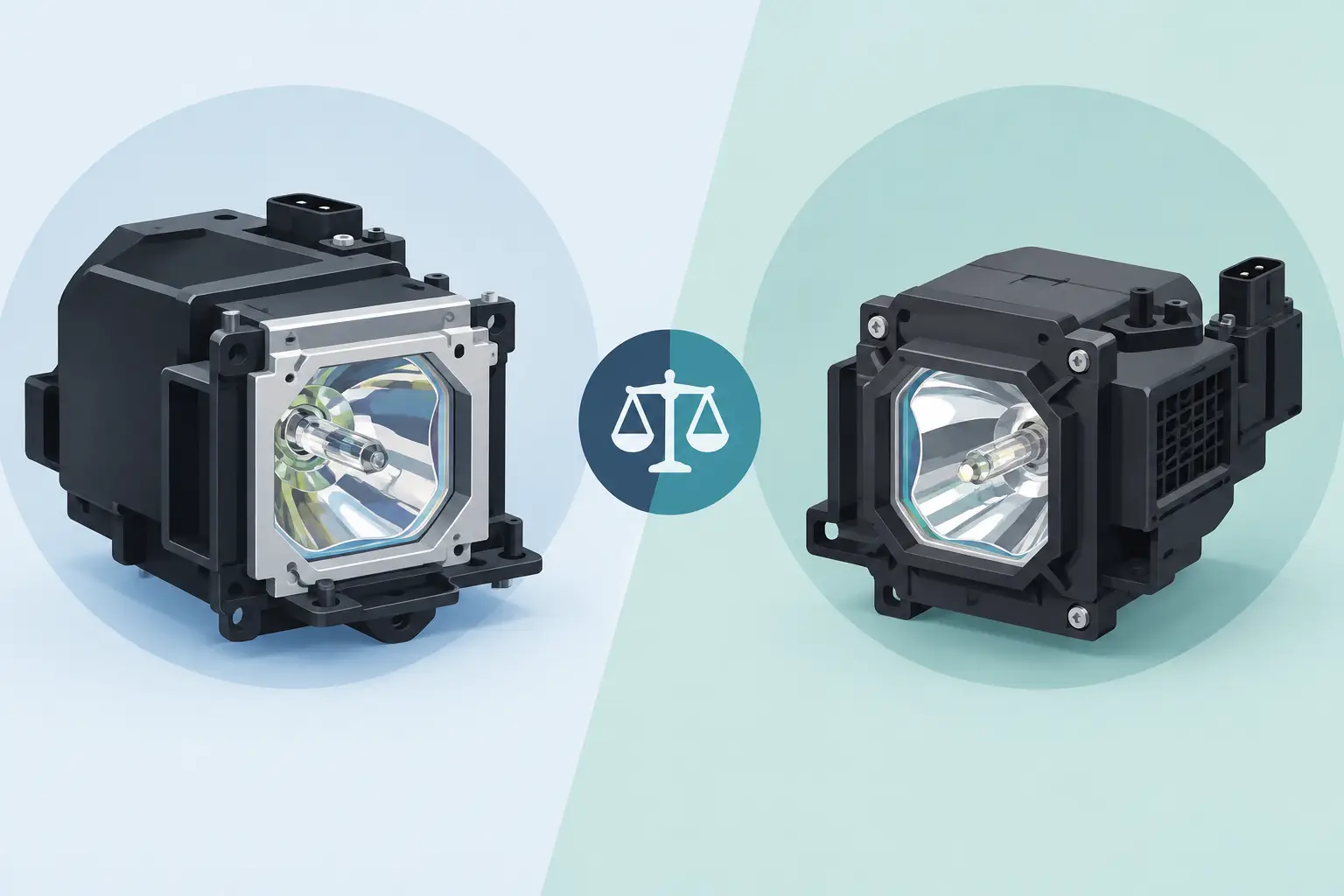
A lamp replacement should not turn into an avoidable service call. For distributors, AV integrators, and projector repair teams, the choice between OEM versus compatible projector lamps affects equipment uptime, service margin, image consistency, and the risk profile of every installed unit. The correct option depends on the projector model, operating environment, customer expectations, and the quality level behind the replacement part.
An OEM lamp is not automatically the right commercial decision, and a compatible lamp is not automatically a compromise. The key is to understand what is inside the lamp assembly, how it is manufactured, and what support stands behind it.
What OEM Projector Lamps Actually Mean
OEM means original equipment manufacturer. In projector lamp purchasing, however, the term can describe several different products. A genuine OEM lamp module is supplied through the projector brand's authorized channel and normally includes the original lamp burner, housing, connector, and mounting configuration for that model.
The lamp burner itself may have been produced by an established lamp manufacturer such as Philips, Osram, Ushio, or Phoenix. The projector brand then specifies the complete module design and sells it under its own part number. For buyers, this usually provides a known fit, expected electrical characteristics, and alignment with the projector manufacturer's warranty requirements.
The primary limitation is cost. OEM modules often carry a significant price premium, particularly for discontinued projectors or high-volume education and corporate fleets. Availability can also become difficult as a projector moves later in its product life cycle. A service provider may be left choosing between a high-priced remaining OEM part and a qualified compatible alternative that can restore the projector quickly.
What Is a Compatible Projector Lamp?
A compatible projector lamp is a replacement made for a specific projector model but sold outside the projector brand's original channel. Compatible products are not all built to the same standard. This is the point that procurement teams and resellers must evaluate carefully.
A higher-grade compatible module may use an original-brand burner in a compatible housing. Another option may use a professionally manufactured compatible burner and housing designed to match the electrical, optical, and mechanical requirements of the original module. Lower-grade alternatives may use unverified burners, weak reflector construction, inconsistent connectors, or housings with poor dimensional control.
These differences directly affect brightness, color stability, startup behavior, fan noise, operating life, and safety. Treating every non-OEM lamp as the same product creates unnecessary risk. The supplier's component sourcing, quality control, model matching process, and warranty policy matter more than a generic compatible label.
OEM Versus Compatible Projector Lamps: The Commercial Trade-Off
The OEM versus compatible projector lamps decision is usually a balance of cost, continuity, and application requirements rather than a simple quality ranking.
Cost and service margin
OEM modules are typically the highest-cost option. They can be appropriate when a customer contract requires genuine branded parts, when the projector remains under manufacturer warranty, or when the installation supports a mission-critical application with strict approved-parts policies.
Compatible lamps offer a more favorable acquisition cost and can help service companies maintain reasonable margins on routine replacements. For large projector fleets, the unit cost difference can be substantial over a maintenance cycle. The savings only hold value when the compatible lamp has dependable performance and low return rates. A low purchase price is not a benefit if repeat visits, failures, or customer complaints absorb the margin.
Brightness and image quality
A new OEM lamp is designed to meet the projector manufacturer's original output specification. A quality compatible lamp should deliver stable, usable brightness close to the original requirement, but actual output depends on burner quality, reflector geometry, ballast condition, optics cleanliness, and the projector's operating mode.
For classrooms, conference rooms, training facilities, and standard meeting spaces, a tested compatible lamp can be a practical replacement choice. For color-critical display, premium simulation, rental inventory, or high-visibility presentation environments, buyers may set a tighter performance requirement and favor genuine OEM modules or compatible units with documented, proven component quality.
Brightness alone should not be the only acceptance criterion. Poor burner consistency can affect color balance, flicker behavior, and brightness stability over time. A lamp that appears acceptable immediately after installation may perform differently after several hundred operating hours.
Lifespan and reliability
Lamp life is always an operating estimate, not a guaranteed fixed number. High lamp mode, frequent power cycling, poor ventilation, dust accumulation, high ambient temperature, and unstable power all shorten service life. These conditions affect OEM and compatible lamps alike.
The quality gap appears in how consistently a lamp performs under normal conditions. A dependable compatible lamp supplier should maintain stable production controls, inspect housings and connectors, and match the burner specification to the projector model. ZORSIKA develops compatible bulb burners for widely used projector models and works directly with established bulb manufacturers, supporting a practical alternative for buyers who need performance, availability, and controlled replacement cost.
Warranty and accountability
OEM parts may offer the reassurance of the projector brand's distribution system, but buyers should still review the actual lamp warranty and the process for handling premature failures. Compatible lamps require the same discipline. A supplier warranty has value only when it is clear, commercially workable, and supported by responsive technical service.
For resellers and repair centers, ask whether the supplier can provide model verification, batch traceability, failure analysis, and a clear replacement process. These details reduce friction when supporting an end customer. They are particularly valuable when managing mixed fleets across multiple projector brands.
Check the Module, Not Just the Lamp Name
Many purchasing errors begin with an incomplete part description. A projector lamp may be sold as a complete lamp module with housing, or as a bare burner that must be installed into an existing housing. These are different service products.
A complete module is generally the safer choice for field replacement. It reduces handling of the lamp burner, avoids reusing a heat-damaged or distorted housing, and simplifies installation for technicians. A bare lamp can reduce cost, but installation requires appropriate technical capability and careful alignment. Incorrect installation can damage the burner, create poor optical positioning, or reduce heat management.
Before ordering, verify the projector manufacturer, full model number, original lamp part number, connector layout, and whether the projector uses a standard or proprietary lamp housing. Do not rely only on a family name printed on the projector chassis. Closely related models can use different lamp modules.
Choosing the Right Option by Application
The correct lamp policy should reflect the end user's operating requirements. OEM modules are a logical choice when the project is still covered by the projector manufacturer's warranty, a customer specification mandates original parts, or a high-value application allows no flexibility on approved components.
Quality compatible modules are often well suited to post-warranty corporate, education, hospitality, retail, and general commercial installations. They are especially useful where a service provider maintains many older projectors and needs predictable availability across different brands. In these cases, compatible lamps can support lower total maintenance cost without forcing customers to replace otherwise functional equipment early.
Avoid selecting solely on the lowest quoted price. A professional replacement decision accounts for verified fit, burner source, housing quality, stated performance, warranty coverage, and supplier responsiveness. A compatible module from a specialist projector-accessories supplier is not comparable to an unverified marketplace part with limited technical information.
Installation Practices That Protect Lamp Life
Even the right lamp can fail early if installation and projector maintenance are neglected. Technicians should allow the projector to cool fully, disconnect power, avoid touching the lamp glass, and confirm that the lamp door is secured before operation. The lamp timer should be reset only after the replacement is completed according to the projector's service procedure.
Airflow deserves equal attention. A clogged air filter, blocked intake, or dust-heavy projector can increase internal temperature and place unnecessary stress on the lamp and electronics. When replacing a lamp in a high-hour projector, inspect the air filter, clean the cooling path as appropriate, and check that fans operate normally. This approach protects the replacement investment and helps prevent repeat failures that are incorrectly blamed on the lamp.
The strongest purchasing decision is the one that matches the lamp specification to the installation, verifies every model detail before shipment, and gives the service team a supplier they can rely on when the next replacement is needed.