Projector Air Filter Replacement Guide
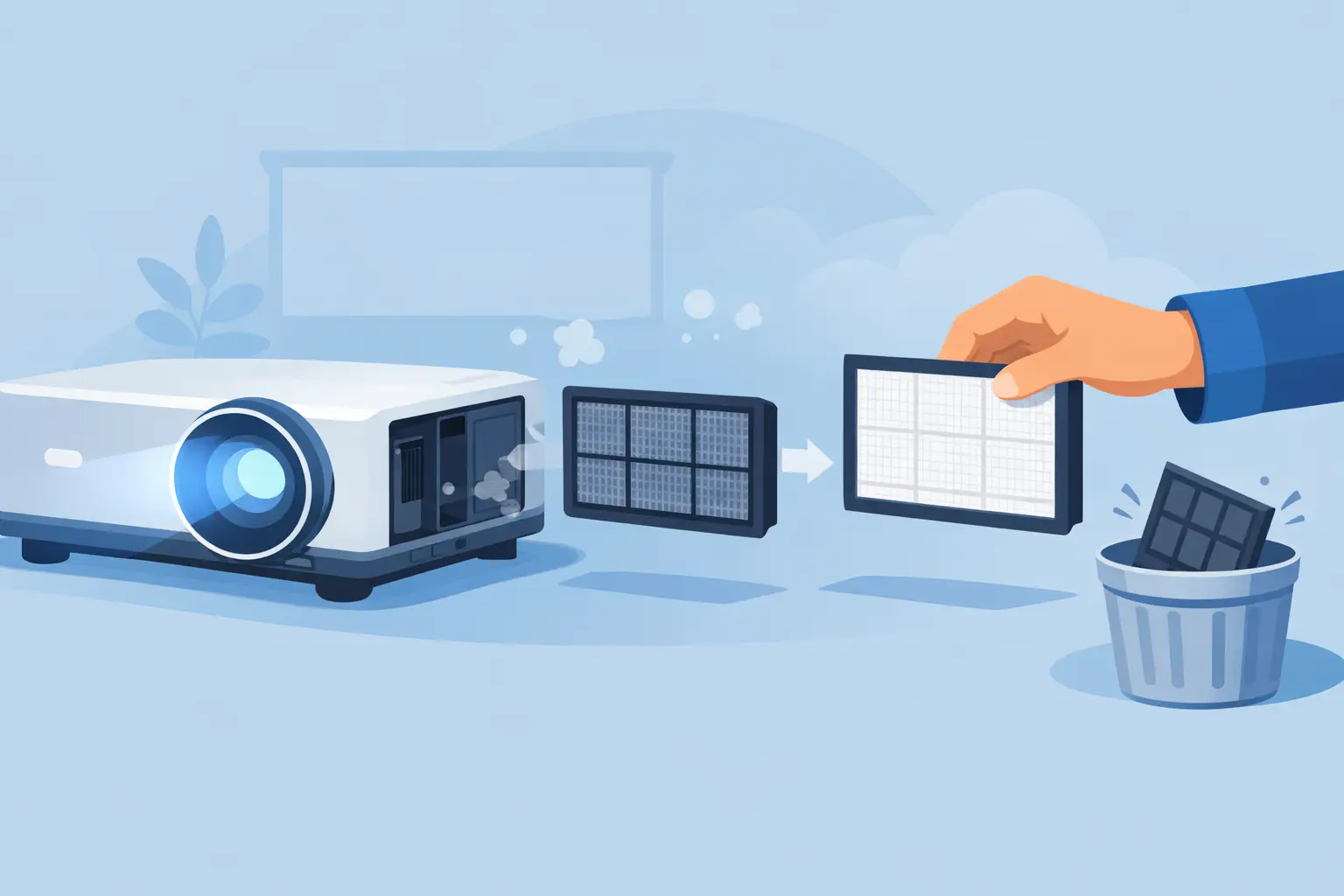
A clogged intake filter rarely fails all at once. More often, the projector starts running hotter, fan noise increases, brightness stability drops, and service intervals become less predictable. That is why projector air filter replacement is not a minor maintenance item for commercial AV environments. It directly affects thermal performance, optical cleanliness, and the service life of higher-value components such as lamps, light engines, and internal boards.
For distributors, service teams, and procurement managers supporting mixed projector fleets, the issue is not simply whether a filter should be changed. The real question is when replacement is the better decision than cleaning, and how to source compatible filters without creating avoidable downtime or mismatch risk.
Why projector air filter replacement matters
Projectors move a large volume of air through compact housings. That airflow is necessary to control heat around the lamp, power supply, imaging components, and optical path. Once the filter loads up with dust, smoke residue, or fine airborne particles, airflow falls and internal temperature rises.
In the field, the impact shows up in several ways. Fan systems work harder and become louder. Thermal warnings may appear sooner than expected. Lamp life can shorten under higher operating temperatures. In more demanding installation environments such as classrooms, retail, houses of worship, rental staging, and exhibition spaces, poor filtration can also allow more particulate contamination to move deeper into the unit.
For service businesses, this creates an avoidable cost chain. A low-cost filter that is replaced on time can help reduce call-backs, protect more expensive parts, and improve consistency across service schedules. For buyers managing large installed bases, that makes projector air filter replacement a purchasing and maintenance issue, not just a cleaning task.
Cleaning vs. projector air filter replacement
Many technicians clean filters as part of regular maintenance, and in some cases that is reasonable. A lightly loaded foam or mesh filter in a relatively clean environment may be usable after careful cleaning if the projector manufacturer allows it. But that approach has limits.
A filter that has absorbed oily residue, smoke, or very fine dust often does not return to original airflow after cleaning. Media can deform, tear, or lose structural consistency over repeated handling. Edges may no longer seat correctly in the filter frame, which reduces sealing performance and lets unfiltered air bypass the media.
Replacement is usually the better choice when the filter shows visible wear, permanent discoloration, deformation, reduced airflow after cleaning, or contamination from demanding environments. It is also the stronger option for service providers who need repeatable maintenance standards across multiple customer sites. Cleaning may save a small amount in the short term, but inconsistent results can cost more if the projector returns with overheating or dust-related issues.
When to replace filters across commercial fleets
There is no universal replacement interval because operating conditions vary. A conference room projector used intermittently in a clean office will not accumulate debris at the same rate as a unit installed in a school hallway, worship venue, museum, or event space.
The most practical approach is to tie filter replacement to environment, runtime, and service history. High-use projectors in dusty or smoky settings need more frequent checks. Units installed near HVAC vents, construction activity, kitchens, entryways, or staging areas often require earlier replacement. If lamp changes are already scheduled, that is a logical point to inspect or replace the air filter as part of the same service visit.
For fleet managers, consistency matters more than guessing. A defined preventive maintenance cycle reduces emergency failures and helps forecast parts demand. That is especially important when supporting multiple brands and older models where parts lead times may vary.
Compatibility is where buyers make or lose time
The filter itself is a simple part, but compatibility errors create unnecessary delay. Dimensions, frame design, media density, airflow characteristics, and fit tolerances all matter. A filter that seems close in size but does not seat properly can compromise cooling or allow particulate bypass.
For resellers and service teams, the safest purchasing method is model-based matching backed by clear supplier verification. Brand family alone is not enough. Projector manufacturers often use different filter structures within the same series, and regional model variations can create additional confusion.
This is one reason specialist accessory suppliers matter. A broad compatibility range is only useful when it is supported by reliable identification, stable production quality, and responsive communication. Buyers handling recurring service work need sourcing partners that understand model matching, not just generic dimensions.
What to look for in replacement filter quality
Not all aftermarket filters perform the same way. In this category, cost savings are valuable, but only when airflow and protective performance remain dependable.
Good replacement filters should maintain adequate ventilation while capturing dust effectively. If the media is too restrictive, cooling performance can suffer. If it is too loose, internal contamination risk increases. Frame accuracy also matters because poor fit reduces stability and sealing inside the projector housing.
For trade buyers, quality should be evaluated in practical terms: consistent manufacturing, dependable fit, stable ventilation rate, and product availability across common projector brands and models. Warranty support is also important. If a supplier cannot stand behind a basic service part, it raises questions about consistency across the rest of the accessory range.
ZORSIKA has independently developed projector air filters with good ventilation rates to protect projectors from dust and smoke while supporting normal operation, which is the standard professional buyers should expect from any serious supplier in this segment.
Common mistakes in projector air filter replacement
The first mistake is treating every dirty filter as a cleaning candidate. In high-contamination environments, replacement is often faster, more consistent, and more defensible from a service standpoint.
The second is ordering by appearance instead of model. Two filters may look similar in photos while differing in thickness, edge geometry, or holding structure. That small mismatch becomes a field problem when the unit cannot close properly or airflow is reduced.
The third is separating filter maintenance from overall thermal service. If a projector is already showing heat-related symptoms, replacing the filter alone may not resolve the issue if vents, fan paths, or internal surfaces are heavily contaminated. Technicians need to assess the complete cooling condition.
The fourth is understocking fast-moving maintenance parts. For repair centers and AV integrators, projectors often sit idle not because the part is expensive, but because a basic filter is unavailable when needed. Planned stock for common models reduces turnaround time and helps preserve service margin.
How buyers should approach sourcing
For procurement teams and distributors, the best filter supplier is not necessarily the one with the lowest unit price. The stronger choice is the supplier that reduces total operating friction. That includes broad model coverage, stable quality, predictable lead times, clear communication, and support when compatibility questions arise.
This matters even more when supporting international customers or mixed-brand commercial fleets. Buyers need a source that can help consolidate orders across bulbs, filters, and other projector accessories rather than forcing separate purchasing channels for each category. That improves efficiency and simplifies replenishment planning.
There is also a margin question. OEM parts may be preferred in some cases, but many buyers need reliable alternatives that protect equipment performance without carrying OEM pricing or availability constraints. In that context, aftermarket filter sourcing is not just a maintenance decision. It is part of a broader parts strategy tied to service continuity and profitability.
Building projector air filter replacement into routine service
The most effective programs make filter replacement routine instead of reactive. That means documenting model-specific filter types, estimating site conditions, and aligning replacement schedules with lamp service or regular inspection windows. Once that structure is in place, maintenance becomes more predictable for both the service provider and the end customer.
It also improves customer communication. It is easier to justify a scheduled filter replacement than to explain an overheating shutdown that could likely have been prevented. For resellers and repair businesses, those small preventive decisions support credibility and repeat business.
Projector systems do not fail only because major components wear out. They also fail because low-cost maintenance parts are overlooked. A disciplined approach to projector air filter replacement helps protect runtime, reduce contamination risk, and keep installed equipment operating on schedule. For professional buyers, that is not extra maintenance. It is part of doing the job correctly.