Projector Bulb Batch Testing That Reduces Returns
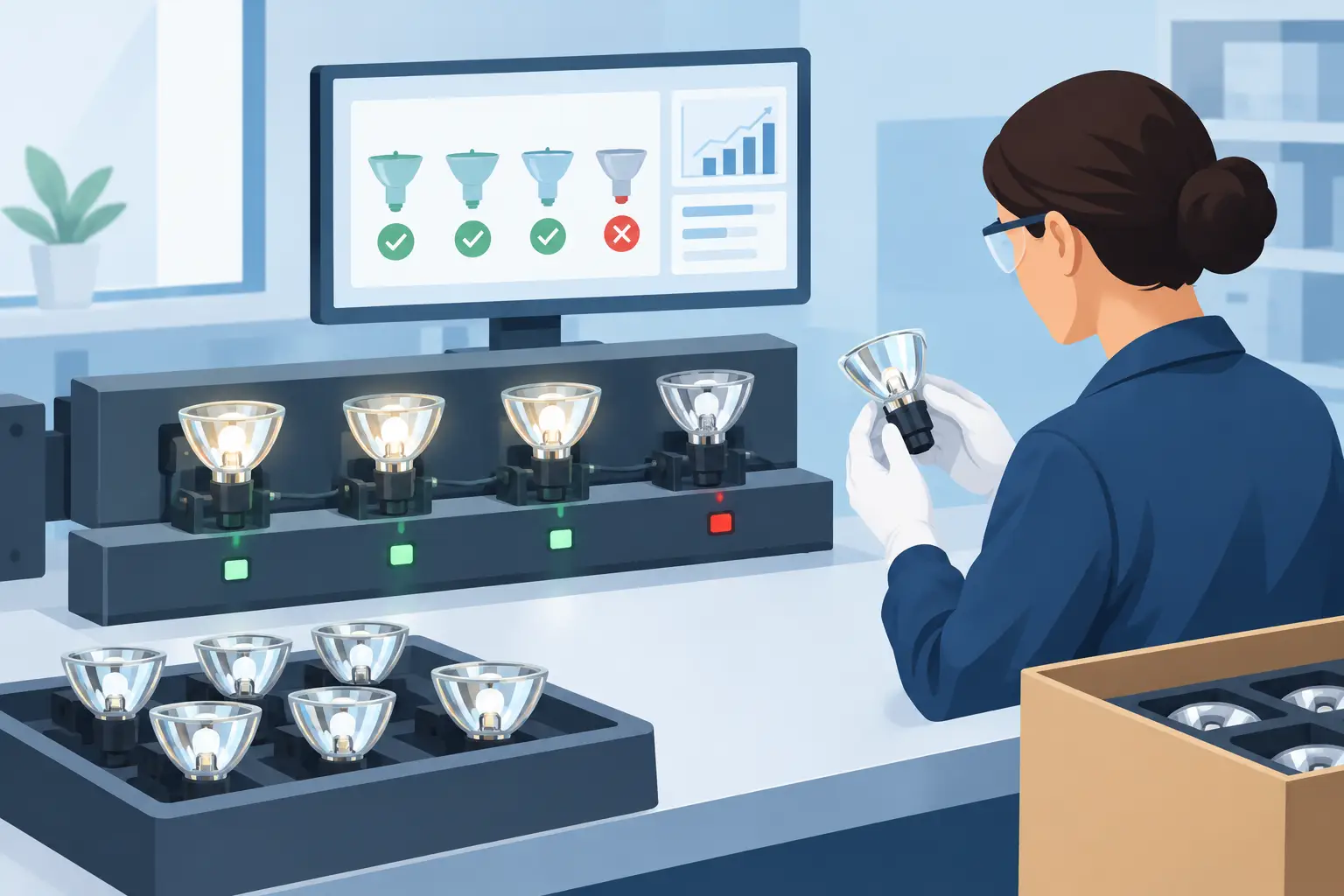
A replacement lamp can appear correct at incoming inspection and still create a costly service call weeks later. That is why projector bulb batch testing matters to distributors, repair centers, and AV integrators managing installed equipment. A supplier must verify more than whether a lamp ignites. It must confirm that units across the same shipment deliver consistent brightness, electrical behavior, fitment, and operating life.
For professional buyers, batch consistency is often more valuable than the lowest unit price. A lamp that causes early dimming, unstable operation, or a compatibility issue can consume the margin on an entire order through returns, labor, freight, and customer downtime. Structured testing reduces that risk before lamps enter the service channel.
What Projector Bulb Batch Testing Should Confirm
Projector bulbs are high-pressure lamp systems operating under demanding thermal and electrical conditions. Their performance depends on the burner, reflector geometry, housing construction, connector quality, and compatibility with the projector's ballast and cooling system. A test process must therefore evaluate the complete replacement lamp assembly, not only the burner.
The first requirement is ignition and stable startup. Each sampled unit should ignite correctly in the intended projector platform or a suitable test fixture, then reach stable operation without repeated restrikes, flicker, abnormal noise, or ballast errors. Startup faults may point to burner quality, wiring resistance, connector alignment, or unsuitable electrical characteristics.
Brightness is the next critical measure. Buyers should expect output to be evaluated after the lamp has warmed up, rather than relying solely on an initial flash reading. A consistent batch maintains a narrow performance range between samples. Large variation can create uneven image quality across a customer installation and may signal inconsistent burner sourcing or reflector performance.
Color and image uniformity also deserve attention. A lamp can deliver acceptable light output while producing an uneven field, visible tint shift, or excessive hot spotting. These conditions affect presentation, classroom, retail, and exhibition applications where image quality is directly visible to the end user.
The Core Stages of a Reliable Test Process
A practical quality-control program combines incoming inspection, functional testing, and controlled endurance testing. The sampling rate should reflect the batch size, product history, and application risk. High-volume, repeat-order models with a proven record may follow an established sampling plan, while new housings, new burner sources, or models with a history of field failures should receive tighter inspection.
Incoming inspection and model verification
Before a lamp is powered, technicians should verify the model label, part number, housing shape, connector type, terminal position, screw placement, and reflector orientation. These details determine whether the lamp will install correctly in the designated projector.
This step prevents a common service-channel problem: a lamp that is electrically functional but mechanically incompatible. Even small housing tolerances can affect door closure, airflow clearance, lamp seating, and contact pressure. For fleets containing several similar projector generations, exact model matching is essential.
Technicians should also inspect the lamp assembly for damaged reflectors, loose fasteners, connector deformation, scratches, contamination, and packaging damage. A reflector with surface defects can reduce usable output or affect beam uniformity. A loose terminal may create intermittent operation that only appears after the projector heats up.
Electrical and optical performance checks
Functional testing confirms that the lamp starts, stabilizes, and runs within the expected operating range. The test should capture ignition behavior, warm-up stability, lamp current characteristics where applicable, and error-free operation in a compatible projector or controlled fixture.
Optical measurements should be compared against the approved specification or reference sample. The goal is not to claim that every replacement lamp will duplicate every OEM reading in every projector. Projector age, optical engine condition, power mode, ambient temperature, and screen environment all influence the final result. The goal is repeatable performance within the supplier's defined acceptance standard.
For replacement-lamp buyers, it is especially useful to distinguish between a bare burner and a complete lamp module. A quality burner can still underperform if it is assembled in a poorly designed housing or paired with a reflector that does not maintain correct optical alignment.
Burn-in and endurance screening
Early-life failures are among the most expensive lamp defects because they usually occur after installation. A burn-in period helps expose unstable burners, connection issues, weak housings, and thermal problems before shipment. Lamps should be operated long enough to pass the initial stabilization period and then reinspected for flicker, output change, unusual odor, overheating, or fault indications.
Endurance testing extends this principle. Rather than testing every unit to the end of its rated life, suppliers typically run representative samples through extended operating cycles. The test should account for realistic on-off use, cooling periods, and normal operating temperatures. Continuous operation alone can miss stresses associated with repeated ignition cycles.
Life testing is necessarily statistical. It cannot guarantee identical hours from every lamp because projector ventilation, filter maintenance, operating mode, and user behavior influence field life. It can, however, identify a batch trend that falls below an acceptable durability baseline.
Why Compatibility Testing Cannot Be Assumed
Projector lamp part numbers are not always as simple as they appear. Different projector brands and regional variants may use similar-looking modules with different connectors, ballast requirements, or firmware behavior. A compatible replacement must be checked against the actual application list, not selected solely by visual similarity.
Compatibility testing should verify installation, startup, stable operation, and normal projector status after the lamp door is closed. If a projector uses a lamp-hour reset procedure, that procedure should also be confirmed for the relevant model. The service team needs a lamp that can be fitted efficiently without modification or repeated troubleshooting.
Airflow is another factor. Projector filters, fan condition, and lamp housing design work together to control operating temperature. A lamp that restricts airflow or sits incorrectly in the compartment may run hotter than intended, shortening life and increasing the chance of thermal shutdown. This is why lamp testing should be viewed as a system check, not an isolated component test.
Setting Acceptance Standards for Commercial Supply
Effective batch testing requires clear pass and fail criteria. A supplier should document the reference model, inspection points, test conditions, sample quantity, measured output range, and disposition of nonconforming units. Without defined criteria, quality decisions become subjective and inconsistent between shipments.
For procurement teams, the most useful supplier discussion is not simply whether testing occurs. Ask what is tested, how compatibility is confirmed, whether the supplier controls burner sourcing, and how failed samples are handled. Also ask whether the supplier maintains traceability by production lot. Traceability makes it possible to isolate a concern quickly instead of holding an entire inventory position.
The appropriate standard depends on the application. A single classroom replacement has different risk exposure than a nationwide service contract, a rental fleet, or a mission-critical control room. Higher-risk installations may justify expanded sampling, longer burn-in, and retention samples from each delivered lot. These measures add cost, but they can be far less expensive than repeated field dispatches.
How Batch Testing Supports Better Margins
Testing is often viewed as a manufacturing expense, but it is also a margin-protection tool. An inconsistent lamp batch creates hidden costs that are rarely included in the purchase price: technician time, reverse logistics, emergency replacement stock, customer credits, and damage to the service provider's reputation.
A reliable supplier helps buyers control those costs with consistent product matching, verified electrical performance, and clear warranty support. ZORSIKA applies this practical approach to projector bulb supply, combining established burner sourcing with replacement solutions designed for broad market compatibility. For service businesses, the result is a more predictable part to stock and a more defensible alternative to high-cost OEM replacement lamps.
When evaluating a lamp program, do not treat batch testing as a line on a specification sheet. Treat it as evidence that the supplier understands what happens after the carton leaves the warehouse. The most valuable lamp is not merely one that powers on at the bench. It is one that installs correctly, performs consistently across the batch, and helps your customer keep the projector in service.