Projector Bulb Counterfeit Warning Signs
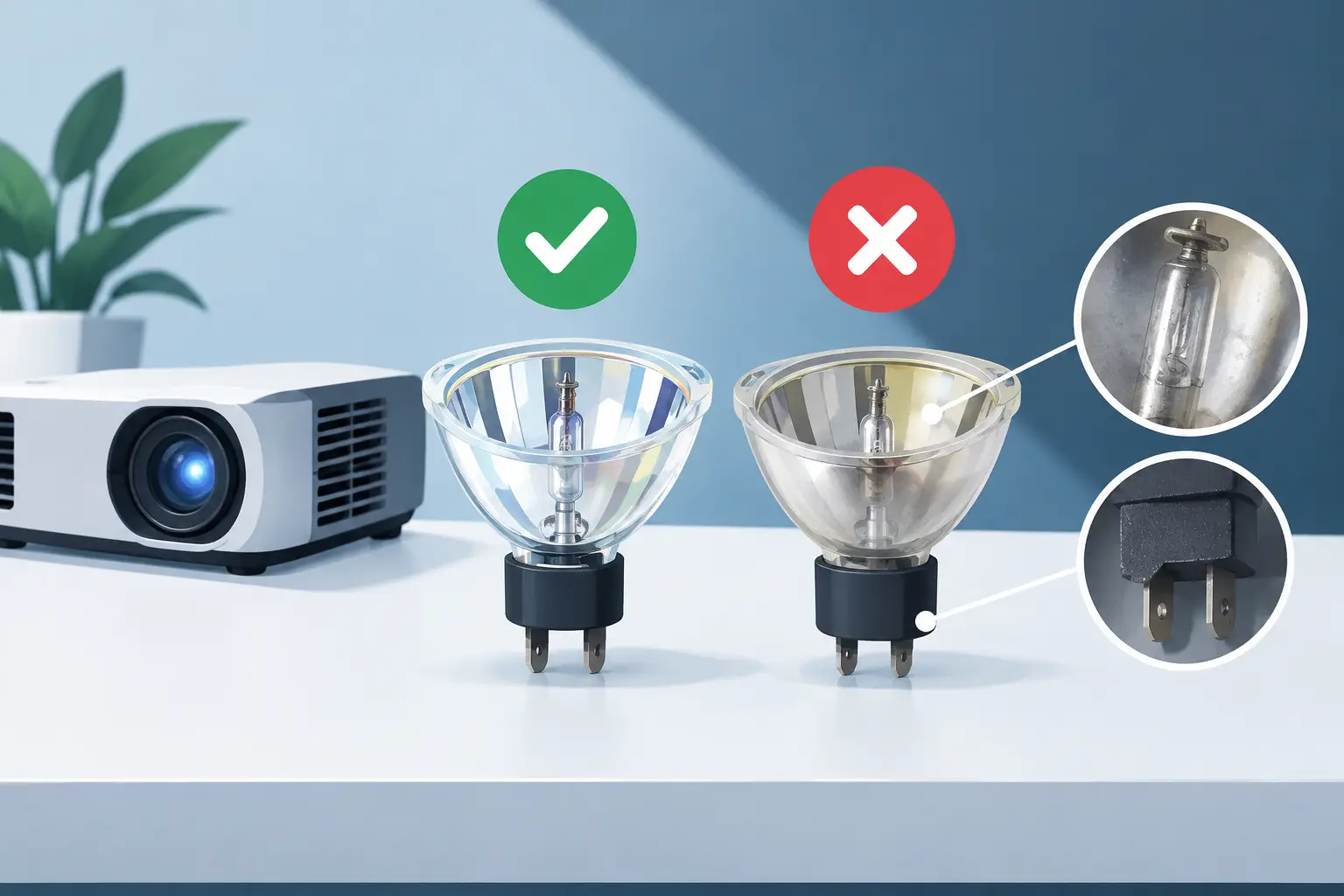
A replacement lamp may look correct at receiving, install without resistance, and still create a costly service call 50 hours later. For distributors, repair centers, and AV integrators, recognizing projector bulb counterfeit warning signs is not only a procurement task. It protects installed equipment, technician time, customer confidence, and the margin on every replacement job.
Counterfeit lamps are often designed to pass a quick visual inspection. They may use copied labels, familiar-looking packaging, and part numbers that resemble OEM references. The practical question is not whether a lamp is inexpensive. It is whether its origin, construction, electrical performance, and warranty support can be verified.
Counterfeit Is Not the Same as Compatible
This distinction matters when evaluating any projector bulb source. A legitimate compatible replacement is sold under its actual brand or as a compatible product. Its supplier should clearly identify the lamp type, housing configuration, supported projector models, performance expectations, and warranty terms.
A counterfeit product falsely presents itself as an OEM lamp or uses copied branding, marks, and packaging to imply manufacturer authorization. It may contain a lower-grade burner inside a reused or imitation housing. In some cases, the lamp is labeled as Philips, Osram, Ushio, or Phoenix even though the burner cannot be traced to that manufacturer.
For buyers managing mixed fleets, compatible products can be a sound commercial option when specifications are clear and supplier controls are consistent. A copied OEM claim, however, is a warning that the entire supply chain may be unreliable.
Projector Bulb Counterfeit Warning Signs at Receiving
The fastest way to limit exposure is to inspect lamps before they reach a technician or customer. A single clue does not always prove a counterfeit, but several inconsistencies should trigger a hold and supplier review.
Packaging and label quality do not match the claim
OEM packaging normally has consistent printing, model information, safety markings, barcode format, and product identification. Warning signs include blurred logos, uneven colors, spelling errors, labels applied over other labels, mismatched fonts, or a package that identifies the lamp only with a broad series name.
Check whether the lamp model, projector compatibility, and part number agree across the carton, internal label, housing, and purchase documentation. A box marked for one projector family with a housing label for another is not a minor cosmetic issue. It can indicate poor traceability or product substitution.
The lamp housing shows poor assembly control
Inspect the reflector, plastic housing, connector, screws, terminals, and mounting points. Counterfeit or poorly controlled lamps may have rough molding, visible adhesive residue, misaligned reflectors, loose components, inconsistent screw types, or contacts with thin or uneven plating.
A housing can be visually similar yet still create fit and thermal problems. If the lamp door does not close normally, the connector requires force, or alignment tabs do not seat cleanly, stop the installation. Forcing a lamp can damage the projector's lamp cage, connector, or interlock system.
Burner markings are missing, inconsistent, or suspicious
The burner is the core component. Where manufacturer markings are expected, compare their location, clarity, and format with known-good inventory. Etched identification is generally more credible than a loosely applied sticker, although markings alone are not sufficient proof of origin.
Be cautious when a supplier claims a branded burner but cannot explain its sourcing or provide consistent identification across shipments. A legitimate supplier should be able to state whether the product uses an original branded burner, a compatible burner, or a complete compatible lamp assembly.
The price is far below a credible market range
Price pressure is normal in replacement-parts purchasing. A low price is not automatically a counterfeit warning, particularly for compatible bulbs and high-volume orders. But a product advertised as a new original OEM lamp at a price dramatically below established market levels deserves scrutiny.
The relevant comparison is total operating cost, not only unit cost. A lamp that fails early can add return freight, technician labor, site disruption, customer credits, and repeat installation costs. For education, corporate, exhibition, and event environments, downtime can easily exceed the original lamp savings.
Documentation cannot support the product claim
Ask for clear part identification, warranty conditions, batch or lot information when available, and a defined process for defective units. Vague answers such as "same as original" or "OEM quality" do not establish whether a product is original, compatible, or counterfeit.
Reliable sourcing documentation does not need to be complicated. It should allow a buyer to identify what was purchased, from whom, for which projector models, and what remedy applies if the product is defective or misrepresented.
Warning Signs After Installation
Some issues appear only when the projector starts operating. Service teams should document these symptoms because they can reveal a lamp-quality problem before the customer experiences a complete failure.
Frequent ignition failures, delayed startup, flickering, unstable brightness, unusual color shifts, excessive fan activity, or repeated lamp-error messages are all reasons to investigate. A lamp that operates initially but loses brightness rapidly may have poor arc stability or inadequate burner quality. A lamp that runs hotter than expected can accelerate stress on internal optical components and cooling systems.
Do not assume every fault is the lamp. Ballast condition, airflow restrictions, dirty filters, projector firmware, power quality, and prior overheating can produce similar symptoms. The correct approach is to test with a verified lamp and inspect the projector's operating condition. This avoids incorrectly rejecting good inventory while also preventing a questionable lamp from being passed to the next customer.
Build a Practical Verification Process
For recurring purchases, verification should be part of receiving rather than a decision made during an urgent repair. A basic process creates consistency across technicians, warehouses, and purchasing teams.
Use a known-good sample or approved product record for each high-volume lamp family. Record the expected part number, housing appearance, connector style, packaging characteristics, and supplier claim. When a new shipment arrives, compare a sample before the stock is released.
For lamps marketed as OEM, require the supplier to state the exact product status in writing: original complete lamp, original burner in compatible housing, or fully compatible replacement. These are different products with different cost structures and should not be grouped under a vague "original compatible" description.
Maintain a failure log by supplier, projector model, lamp model, installation date, operating hours, and failure symptom. This data is more useful than anecdotal feedback. It can identify patterns such as early failures in one batch, fit problems in a specific projector series, or unusually high return rates after a supplier change.
A receiving checklist is especially useful when buying from multiple sources:
- Confirm the lamp part number, housing type, and supported projector model.
- Compare packaging, labels, and burner markings with approved inventory.
- Inspect connectors, reflector alignment, mounting points, and terminal condition.
- Verify the stated product category and warranty before stock is released.
- Quarantine products with inconsistent identification or questionable fit.
Choose Supplier Accountability Over Marketing Claims
The strongest counterfeit control is a supplier relationship that can withstand technical questions. Buyers should expect accurate compatibility matching, stable product descriptions, responsive defect handling, and warranty coverage that is practical for service operations.
There is also a commercial trade-off. Original OEM lamps may be appropriate where contract specifications, manufacturer requirements, or critical applications demand them. For many out-of-warranty projector fleets, a well-specified compatible lamp with dependable quality control can provide a more practical balance of brightness, service life, availability, and cost.
ZORSIKA supports this approach by supplying clearly matched projector accessories and self-developed compatible bulb burners designed for broad market coverage. The key is transparent product positioning: customers should know what they are installing and what support stands behind it.
When a lamp cannot be traced, identified, or supported, the apparent bargain is usually carrying risk somewhere else. Keep questionable stock out of the service channel, document what performs well, and make every replacement decision on verified compatibility rather than packaging alone.