Projector Bulbs Versus Modules for Service Teams
A projector fails in a classroom, meeting room, or event installation, and the replacement decision often comes down to one practical question: projector bulbs versus modules. Both can restore light output, but they create very different requirements for technicians, inventory teams, warranty handling, and total service cost. The correct choice depends on the projector model, the skill level of the installer, and how much risk the service operation can accept.
Projector Bulbs Versus Modules: The Basic Difference
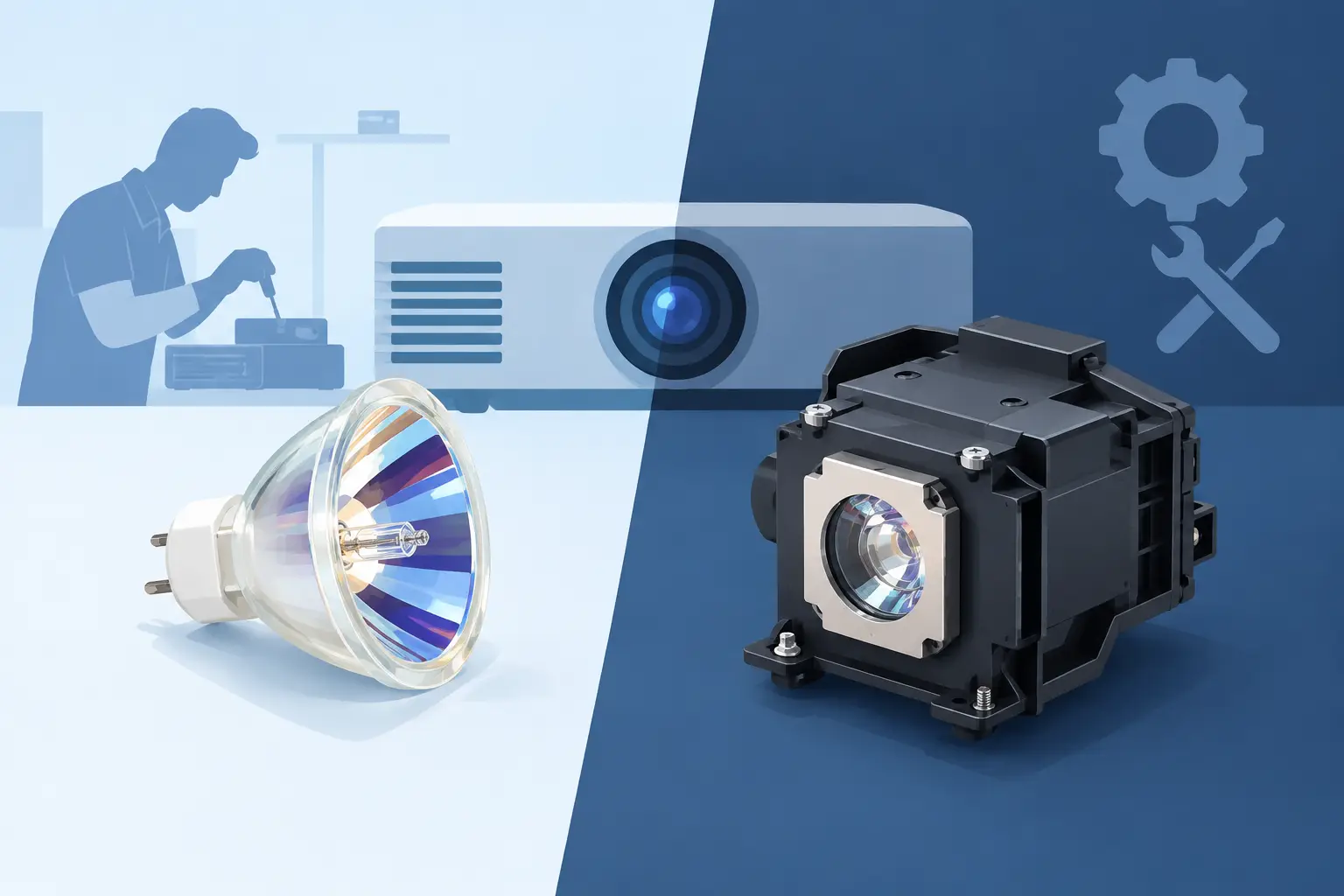
A projector bulb is the bare lamp burner. It is the light-producing component inside the projector’s lamp assembly. Depending on the design, it may include the reflector but does not include the complete external housing, mounting frame, connector arrangement, or protective enclosure supplied with a full lamp module.
A projector module, also called a lamp assembly, is a ready-to-install replacement unit. It normally contains the lamp burner installed in a model-specific housing with the required connector, mounting points, and airflow structure. The technician removes the old assembly and installs the new one as a complete part.
This distinction matters because projector manufacturers design the module, not only the lamp, as a system. Housing geometry affects positioning at the optical path, while connectors and ventilation features affect electrical connection and operating temperature. A correctly matched module reduces the number of variables during replacement.
For a service provider managing a diverse fleet, modules are generally the safer standard product. Bare bulbs can be a strong commercial option when the repair team has the right procedures, tools, and experience.
Why Lamp Modules Cost More
A module typically has a higher purchase price because it includes more than the light source. It requires a projector-specific cage or housing, electrical terminals, mounting hardware, and assembly labor. For some models, the housing itself is a substantial component, especially where lamp alignment, cooling channels, or safety shielding are integrated into the design.
The higher part cost can be offset by lower labor cost. A qualified technician can often replace a complete module quickly with minimal disassembly. In high-volume education, corporate, exhibition, and rental environments, reduced service time can be more valuable than the difference in unit price.
Modules also simplify receiving and inventory control. The part number can be tied directly to a projector model or series, making it easier for purchasing teams and field engineers to confirm compatibility before dispatch. This lowers the chance of sending a technically correct burner that cannot be installed without further work.
When a Bare Projector Bulb Makes Sense
Replacing only the bulb can reduce material cost and can help repair businesses protect margin, particularly when the original lamp housing remains in good condition. This approach is most practical when technicians routinely rebuild lamp assemblies and can verify each housing before reuse.
A bare bulb replacement is not simply a lower-cost version of a module replacement. It is a repair operation. The technician must open the original housing, remove the failed burner, transfer or reconnect required components, install the new lamp correctly, and reassemble the unit without compromising alignment or insulation.
This option can work well for specialized repair centers that service repeat projector models in volume. It is less suitable for a field technician working under time pressure at a customer site. A module usually offers a more predictable result in that situation.
The Compatibility Risks Are Different
With a module, the main compatibility task is identifying the correct projector model and matching lamp module part number. Similar-looking housings are not necessarily interchangeable. Connector locations, screw patterns, fan clearances, and power requirements can differ even among projectors from the same manufacturer.
With a bare bulb, compatibility is more complex. The replacement burner must match the original lamp’s electrical rating, physical dimensions, reflector design where applicable, arc position, and connection configuration. A lamp that fits mechanically but does not place the arc in the correct optical position can reduce brightness uniformity, affect focus, or produce poor image performance.
The condition of the reused housing is equally important. Heat exposure can weaken terminals, deform plastic components, damage insulation, or leave deposits around airflow paths. Rebuilding a lamp assembly with a compromised housing can lead to unstable performance even if the new burner itself is high quality.
For this reason, technicians should inspect the old module before recommending a bulb-only repair. If there are signs of overheating, cracked plastic, burned connectors, loose terminals, or damaged wiring, a complete module is normally the better decision.
Labor, Safety, and Service Consistency
High-pressure projector lamps operate at high temperature and require careful handling. A replacement procedure should begin only after the projector has cooled fully and has been disconnected from power. Technicians should follow the projector manufacturer’s service instructions and use clean handling practices. Oils, fingerprints, or contamination on lamp surfaces can contribute to heat concentration and early failure.
Module replacement reduces handling of the burner and keeps more of the lamp system enclosed. That supports consistency across multiple technicians and locations. It is particularly useful for distributors and integrators that need repeatable field-service procedures rather than bench-level repair work.
Bare-bulb replacement introduces more technician-dependent variables. Fastener torque, wire routing, terminal contact, reflector orientation, and housing closure all influence the finished assembly. A repair center can manage these variables with training and quality checks, but it should treat bulb rebuilding as a controlled process, not an improvised cost-saving measure.
Brightness and Life Depend on More Than the Format
Buyers sometimes assume that a module automatically provides better brightness or longer life than a bare bulb. That is not always true. Optical performance and operating life depend heavily on burner quality, correct electrical specifications, installation quality, cooling performance, and the condition of the projector itself.
A high-quality replacement burner installed correctly in a sound original housing can provide strong results. Likewise, a low-grade complete module may create early failures, reduced brightness, or color instability. The format does not replace the need for dependable sourcing.
For professional procurement, confirm the lamp manufacturer, stated performance targets, model compatibility, and warranty terms. ZORSIKA works with established lamp manufacturers including Philips, Osram, Ushio, and Phoenix, while also supplying replacement bulb options designed for broad market compatibility. This gives service partners options based on the repair method and cost structure of each job.
Projector maintenance also matters. Restricted airflow, dirty filters, failed cooling fans, and excessive ambient heat can shorten lamp life regardless of whether a bulb or module is installed. When a lamp fails unusually early, replacing the light source without checking the cooling path can repeat the problem.
How to Choose the Right Stocking Strategy
For most distributors and service organizations, the most effective approach is not choosing exclusively between bulbs and modules. It is stocking each format for the jobs where it makes operational sense.
Keep complete modules for high-turn projector models, customer locations where downtime is expensive, and field-service work where technicians need a fast, low-risk installation. Modules are also the preferred option when the returned housing is damaged or when a warranty claim requires a complete traceable assembly.
Maintain bare bulbs for trained repair teams, repeat-use projector platforms, and price-sensitive repair programs where the original module housing can be inspected and reused safely. This can reduce repair cost and create a competitive alternative to high-priced OEM assemblies.
Purchasing teams should also consider inventory depth. A broad module range can require substantial SKU coverage because housings are model-specific. Bare bulbs may offer some consolidation where multiple assemblies use the same burner design, but this benefit should not lead to loose compatibility assumptions. Every replacement still needs verification against the original lamp specification and assembly design.
A Practical Decision for Each Service Call
The decision should begin with the condition of the existing lamp assembly. If the housing, connector, and wiring are clean, intact, and suitable for controlled rebuilding, a compatible bare bulb may be the economical choice. If the housing shows heat damage, mechanical wear, uncertain history, or installation risk, use a complete module.
For commercial AV service, the least expensive part is not always the lowest-cost repair. A module can prevent a return visit and protect service time. A bare bulb can improve margin when installed by an experienced technician under the right conditions. Match the replacement format to the equipment condition, the service environment, and the level of control your team has over the installation.