Projector Lens Coating for Image Quality
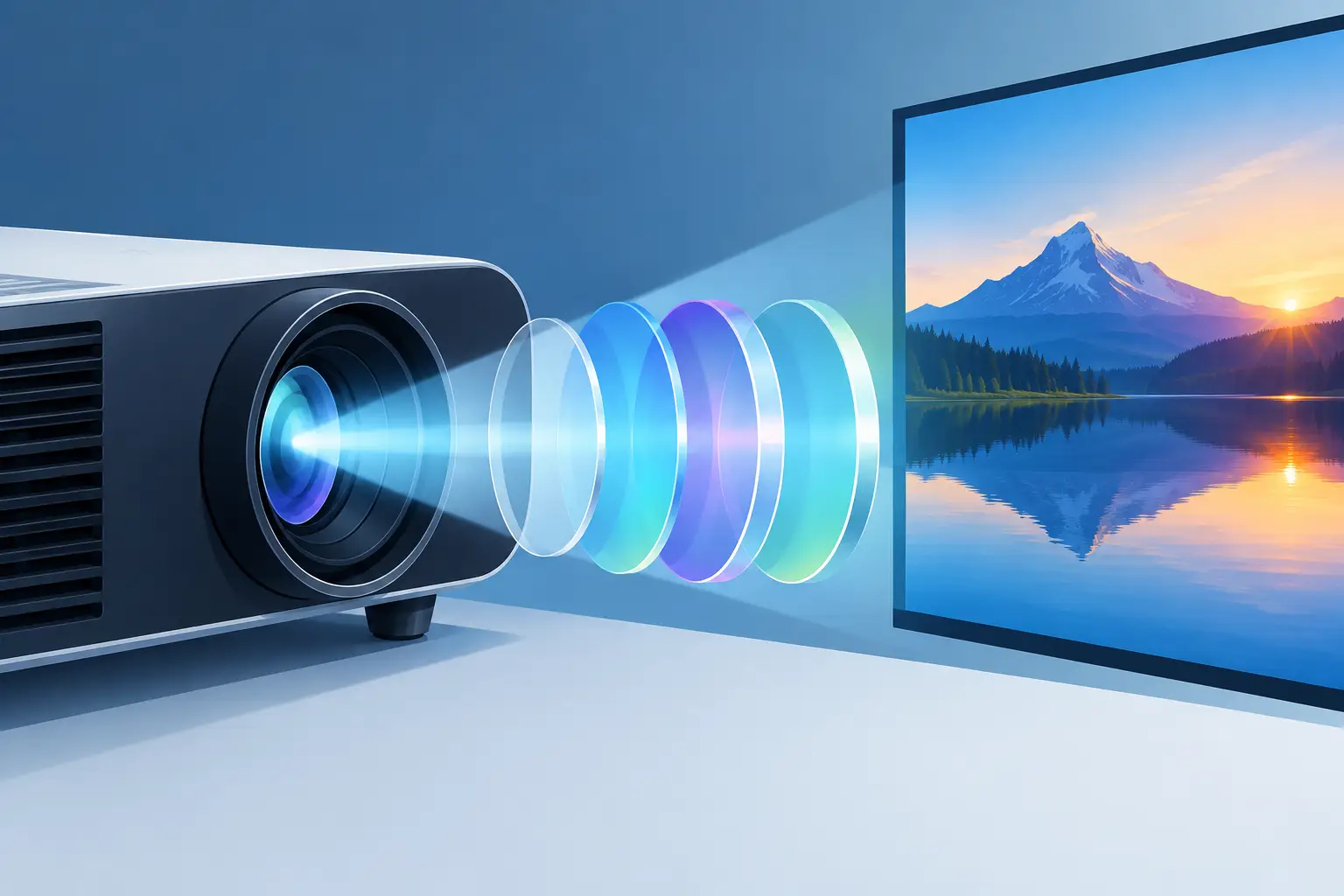
A projector lens coating can be a small part of the optical assembly, but it has a direct effect on image brightness, contrast, color consistency, and long-term service performance. For distributors, repair centers, and AV integrators managing mixed projector fleets, the coating quality on a replacement lens should be evaluated with the same care as focal range, throw ratio, and mechanical compatibility.
A lens may look clear during a basic visual inspection and still deliver poor results in operation. Weak or damaged coatings can increase reflections inside the optical path, reduce usable light output, create flare in dark scenes, and make color calibration more difficult. In commercial environments such as classrooms, conference rooms, museums, simulation rooms, and event venues, these issues can become visible quickly.
What a Projector Lens Coating Does
Projector lenses use multiple optical elements to collect, direct, and focus light from the imaging system onto the screen. Whenever light passes from air into glass or from one optical material into another, part of that light is reflected rather than transmitted. Lens coatings are engineered to reduce these unwanted reflections.
The most common optical treatment is an anti-reflective coating. Applied in one or more extremely thin layers, it improves light transmission through the lens assembly. Better transmission helps preserve brightness while reducing internal reflections that can lower contrast. This is especially relevant for high-brightness commercial projectors, where even a small percentage of light loss can affect the final image.
Coatings may also provide surface protection. A harder outer layer can improve resistance to fine cleaning marks, dust abrasion, and routine handling during installation. Some optical surfaces use treatments designed to reduce the adhesion of fingerprints, oil, or moisture. The exact coating structure varies by lens design, glass type, projector platform, and intended application.
For professional buyers, the key point is straightforward: coating performance is part of lens performance. It should not be treated as a cosmetic feature.
Why Coating Quality Matters in Replacement Lenses
Replacement lens purchasing is often driven by urgent field requirements. A customer may need to restore a projector after an optical accident, replace a damaged short-throw lens, or maintain an installed fleet that no longer has easy OEM parts availability. Price and stock availability matter, but low-cost optics with poor coating control can create repeat service calls and damage the reseller's margin.
A properly coated projector lens supports several operational requirements:
- Higher effective light transmission, helping the projector retain usable brightness.
- Better contrast performance by reducing stray light and internal flare.
- More accurate color presentation, particularly in content with subtle gradients and saturated colors.
- Greater resistance to cleaning-related wear when the external surface is handled correctly.
- More consistent image quality across replacement units supplied for the same projector model.
These benefits must be considered in context. A lens coating cannot correct an aging light engine, a weak lamp, a degraded phosphor wheel, dust contamination, or incorrect image settings. However, it prevents the lens from becoming an additional source of optical loss in an already demanding service environment.
Anti-Reflective Coatings and Image Performance
Anti-reflective coatings are commonly evaluated by their ability to reduce surface reflectance across portions of the visible spectrum. In practical projector use, the goal is not simply a brighter white image. The goal is balanced transmission across red, green, and blue wavelengths so the lens does not introduce obvious color shifts or reduce color reproduction.
This becomes more significant with 4K-capable projection systems and high-contrast applications. Fine image detail is affected by more than resolution specifications. Internal reflections, scatter, and flare can soften perceived detail, particularly around bright objects against dark backgrounds. A lens with effective optical coatings helps preserve the cleaner separation needed for presentations, digital signage, immersive displays, and technical visualization.
Buyers should be cautious about simplified claims such as “high transmission” without supporting optical and mechanical quality. Coating quality works together with lens geometry, glass material, polishing accuracy, element alignment, and assembly cleanliness. A well-designed lens requires control across the complete optical system.
Coating Color Is Not a Complete Quality Test
The reflected color visible on a lens surface can indicate that an anti-reflective coating is present, but it is not a complete measurement of coating quality. Blue, green, purple, or amber reflections may result from different layer designs and intended wavelength ranges. Appearance alone cannot confirm transmission levels, durability, uniformity, or compatibility with a particular projector.
For purchasing teams, product matching should begin with the projector brand, model, lens part number, throw requirement, and physical interface. Optical coating should then be considered as part of the supplier's overall quality specification rather than judged only by visible surface color.
Surface Durability and Cleaning Risks
A coated lens can be damaged by incorrect cleaning practices. This is a frequent issue in field service, especially when equipment has been installed in dusty venues, food-service areas, schools, or exhibition spaces. Abrasive cloths, paper towels, strong solvents, and excessive rubbing can create micro-scratches or weaken the outer coating layer.
Dust on a projector lens should first be removed without dragging particles across the surface. A clean air blower and an appropriate optical brush are generally safer than dry wiping. When wet cleaning is necessary, technicians should use approved optical cleaning materials and apply minimal pressure. The objective is to lift contamination, not polish the lens.
Cleaning damage may appear as haze, uneven glare, rainbow-like marks, reduced black level, or a loss of sharpness. These symptoms are sometimes mistaken for problems inside the projector. Before disassembling the optical engine, service teams should inspect the front and rear accessible lens surfaces under controlled light.
Environmental conditions also matter. Smoke residue, airborne oil, adhesive vapors, and high humidity can contaminate optical surfaces over time. In these locations, regular filter maintenance and correct projector ventilation are part of protecting lens performance. A good projector air filter reduces the dust load entering the equipment, but it does not eliminate the need for planned inspection in demanding environments.
What Buyers Should Verify Before Sourcing
For commercial replacement purchases, compatibility remains the first requirement. A lens that fits physically but has the wrong throw ratio, zoom range, lens shift capability, or focal design will not solve the installation requirement. Coating quality should be assessed after the correct lens platform has been identified.
Ask the supplier for clear confirmation of the applicable projector models and original part references. Confirm whether the lens is intended for standard-throw, short-throw, ultra-short-throw, fixed-focus, or interchangeable-lens applications. For interchangeable lenses, verify the mount type, installation orientation, electronic recognition requirements, and any projector firmware considerations.
It is also practical to request consistency information for repeat orders. Service providers often need the same replacement lens across multiple customer sites. Variations in coating appearance, image brightness, or color behavior between batches can complicate calibration and customer acceptance.
A dependable supplier should provide product identification that supports efficient receiving and field deployment. Clear model labeling, suitable protective packaging, inspection procedures, and warranty support all reduce the chance that a coating or handling issue becomes a costly return.
Coating Quality and Total Service Cost
The lowest unit price is not always the lowest procurement cost. When a replacement projector lens produces flare, uneven brightness, or premature surface wear, the cost includes technician labor, return shipping, customer downtime, and potential loss of future business. This is particularly relevant for resellers supporting schools, corporate campuses, rental inventories, and multi-site installations.
A practical sourcing strategy balances cost with optical reliability. Buyers should prioritize lenses designed for low light loss, stable color reproduction, high-contrast imaging, and straightforward installation. These factors support service continuity and help technicians complete work correctly on the first visit.
ZORSIKA applies this application-focused approach to projector lens development, with attention to high color reproduction, low light loss, 4K support, high contrast, and structural designs that simplify installation. For professional buyers, selecting a properly matched lens with controlled optical coating quality is a direct way to protect image standards, reduce avoidable service work, and keep installed projection systems operating as expected.