Projector Optics Procurement Guide for Buyers
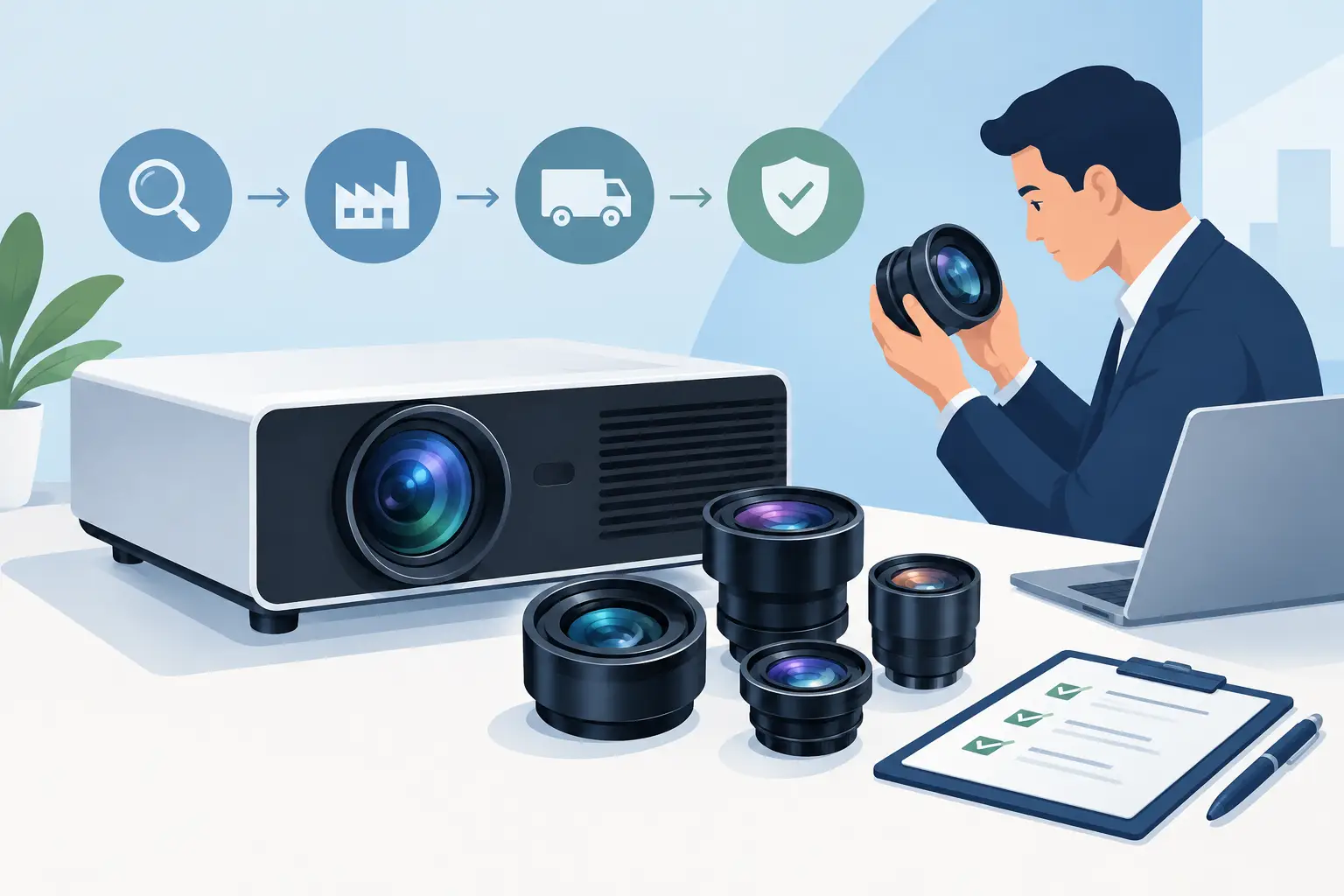
A projector lens purchase can either restore an installed system quickly or create a costly return, missed service window, and dissatisfied end user. This projector optics procurement guide is designed for professional buyers who need to source replacement lenses accurately across mixed projector fleets while controlling cost, availability, and compatibility risk.
For distributors, repair centers, system integrators, and AV service teams, optics procurement is not simply a matter of ordering by projector brand. Lens assemblies are mechanical, optical, and electronic components. A correct purchase must match the projector platform, the required throw range, the installation environment, and the service expectation of the customer.
Start With the Exact Projector and Lens Identification
The projector model is the starting point, but it is not always enough. Manufacturers may release several versions of a projector platform, use regional model numbers, or offer multiple compatible lens options for the same chassis. Before requesting a quote or placing an order, verify the full projector model number from the rating label, not only the model shown in an asset list or on an old invoice.
Then identify the lens part number whenever possible. This number is usually found on the lens barrel, lens housing, original packaging, or service documentation. It provides a more reliable match than a broad description such as “short-throw lens for Epson” or “replacement lens for Panasonic.”
For installed systems, procurement teams should also collect the current installation data: screen width, throw distance, mounting orientation, projector position, and required image offset. This is especially important when replacing an optional interchangeable lens. A lens may physically fit a projector while still being unsuitable for the room.
A practical identification record should include the projector brand and complete model, existing lens part number, serial number if available, installation type, and photos of the lens mount and connector area. Clear records reduce back-and-forth communication and help suppliers confirm compatibility before shipment.
Evaluate Optics by Application, Not Price Alone
The lowest unit cost is rarely the lowest operating cost. A lens with poor transmission, weak focus consistency, or mechanical alignment issues can increase labor time and generate repeat service calls. For commercial AV work, the useful question is whether the optic will deliver acceptable image performance over the expected service period.
Key performance criteria include color reproduction, light loss, focus uniformity, resolution support, contrast performance, and mechanical stability. These factors matter most in meeting rooms, classrooms, museums, simulation environments, houses of worship, exhibitions, and large venues, where viewers may notice edge softness, brightness loss, or color inconsistency immediately.
Resolution and image requirements
Many fleets still contain Full HD projectors, but replacement parts must increasingly support 4K-capable systems and higher pixel density. A lens that cannot maintain detail across the image field can limit the value of an otherwise capable projector. Ask whether the replacement optic is designed for the target resolution and whether focus remains consistent from center to edge.
High contrast applications require additional attention. Internal reflections, lower-grade coatings, and poor assembly tolerances can reduce perceived black level and image clarity. This may not be obvious in a quick bench test, but it becomes visible in dark scenes, presentation graphics, and blended projection installations.
Throw ratio and placement tolerance
Throw ratio determines how large an image a lens produces at a given distance. It is one of the most common sources of procurement error. A short-throw lens may be required when projector placement is constrained, while a long-throw lens may be essential for auditoriums, control rooms, or rear projection layouts.
Do not assume that two lenses with similar descriptions are interchangeable. Verify the published throw-ratio range against the actual screen width and measured throw distance. Zoom range, vertical and horizontal lens shift, and mounting orientation should be checked at the same time. A technically compatible lens that cannot achieve the required image position is not a viable replacement.
Confirm Electrical and Mechanical Compatibility
Modern projector lenses often include more than glass elements and a focus ring. Motorized zoom, focus, iris, and lens shift functions may depend on contacts, communication protocols, gear arrangements, and physical tolerances specific to the projector platform.
A compatible lens must therefore match the mount interface and any electronic control requirements. Procurement teams should confirm whether the replacement supports all required functions or whether it is intended as a manual or limited-function alternative. For service contracts, this distinction should be made before the technician arrives on site.
Check the following information with the supplier before ordering larger quantities:
- Exact compatible projector models and series
- Lens part number or equivalent reference
- Lens mount type and connector configuration
- Motorized zoom, focus, iris, and shift requirements
- Throw-ratio range and supported screen sizes
- Physical condition, including whether the item is new, refurbished, or aftermarket
For repeat purchases, build an internal cross-reference table that records verified projector-to-lens matches. This protects purchasing staff when experienced technicians are unavailable and makes it easier to support customers with older installed equipment.
Assess Supplier Capability and Warranty Terms
Availability is only useful when product information is dependable. Professional buyers should work with suppliers that can provide clear compatibility confirmation, consistent quality standards, and a defined response process for technical questions or warranty cases.
Ask how the supplier controls incoming inspection and whether lenses are checked for image quality, mechanical operation, and packaging protection. Optical products are vulnerable to damage from impact, dust, and improper handling. A lens that leaves the warehouse in acceptable condition can still arrive unusable if packaging does not protect the mount, barrel, and glass surfaces.
Warranty terms should be reviewed beyond the headline duration. Confirm what defects are covered, what evidence is required for a claim, whether advance replacement is available, and who is responsible for freight in different scenarios. For service organizations supporting critical installations, response time can be as significant as warranty length.
ZORSIKA focuses on projector accessories for professional buyers, with lens products designed around high color reproduction, low light loss, 4K support, high contrast, and installation practicality. For procurement teams, this type of product specialization is valuable when sourcing alternatives to high-cost OEM parts without giving up the performance needed for commercial use.
Balance OEM, Compatible, and Refurbished Options
There is no single procurement path for every project. OEM lenses may be required where a customer specification, manufacturer warranty condition, or specialized application demands the original part. They can also be appropriate when the cost of downtime is substantially higher than the price difference.
Compatible replacement lenses can offer a practical alternative when they have been matched to the projector model, tested for the intended function, and backed by a credible warranty. They can improve margin for resellers and keep older projector fleets operational when OEM supply is limited or expensive.
Refurbished optics may fit a narrow budget or legacy-equipment requirement, but their condition must be evaluated carefully. Ask about cosmetic condition, optical inspection, functional testing, replaced components, and warranty coverage. A refurbished lens may be reasonable for a low-use classroom unit, while a high-visibility event installation may justify a new replacement product.
The right choice depends on the application, customer expectation, service-level commitment, and planned life of the projector. Procurement should document that choice rather than treating all replacement lenses as equivalent commodities.
Plan Inventory Around Failure Risk and Lead Time
Reactive buying increases freight cost and leaves technicians waiting for parts. For common projector models in your customer base, maintain stock of fast-moving lenses or establish confirmed replenishment lead times with your supplier. Review service records to identify models with recurring lens damage, high usage hours, or installations where access is difficult.
Stocking every possible optic is not efficient. Instead, separate products into high-turn replacement items, project-specific interchangeable lenses, and low-volume legacy parts. High-turn items may justify local inventory, while specialized lenses can be sourced against confirmed project demand. This approach protects cash flow without exposing customers to avoidable delays.
Before approving a purchase order, make sure the optic is matched to the actual projector and the actual room, not just a familiar product name. That extra verification step is usually faster than resolving a return after an installer is already on site.