Projector Parts for Schools That Reduce Downtime
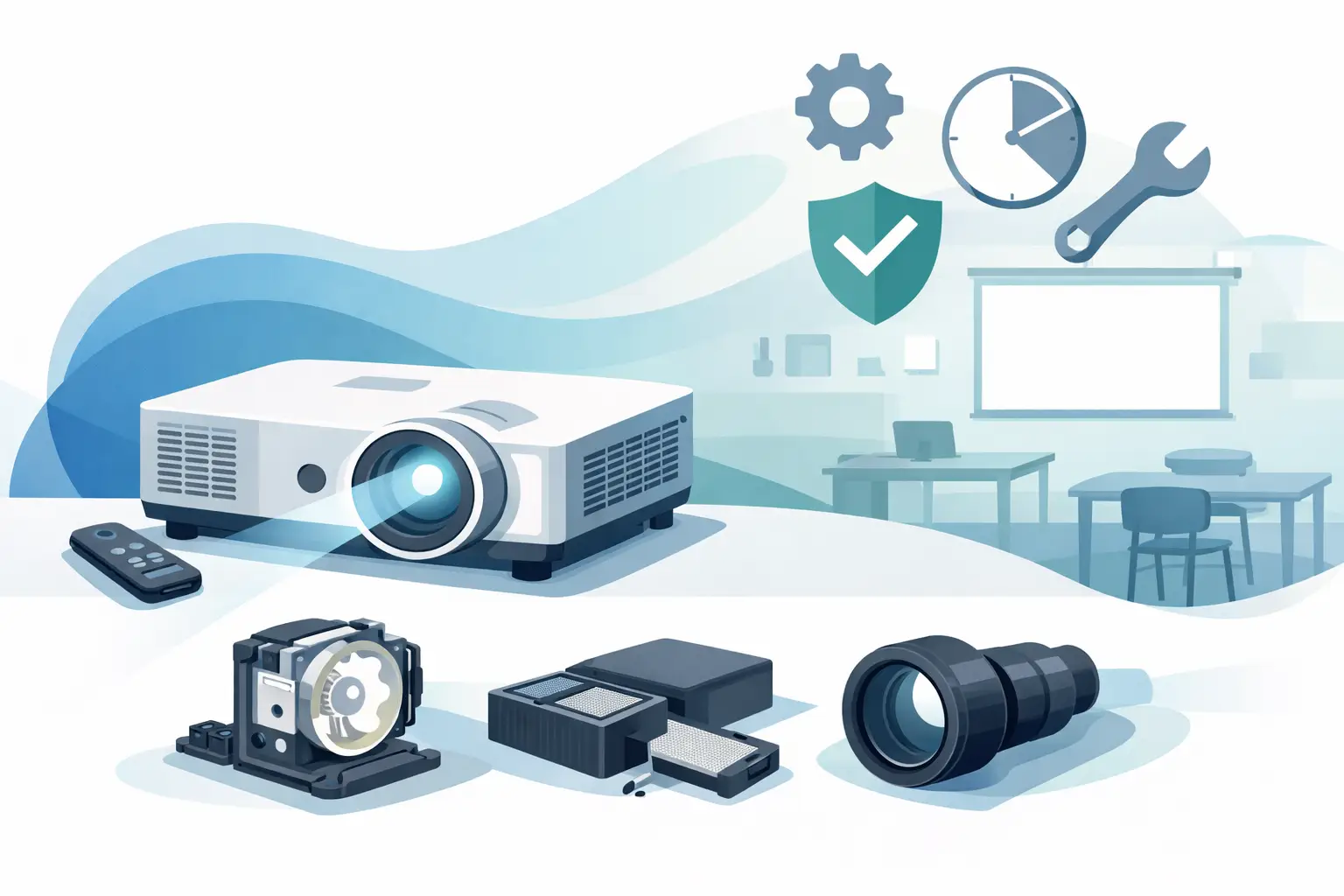
A classroom projector can be working perfectly at 8:00 a.m. and become an immediate service issue before the first lesson ends. For distributors, AV service companies, and school procurement teams, sourcing projector parts for schools is not simply a replacement-parts task. It is a way to keep instruction moving, protect equipment budgets, and reduce repeat service calls across a varied installed base.
School districts often operate projectors from multiple generations, manufacturers, and installation environments. A ceiling-mounted unit in a dusty gym has different service demands from a short-throw projector in an elementary classroom or a high-brightness model in an auditorium. The right parts strategy must account for compatibility, operating conditions, replacement intervals, and the practical need to return equipment to service quickly.
What Schools Need From Projector Parts
Education buyers are usually balancing two pressures: limited budgets and high expectations for uptime. Teachers need displays to work when a lesson begins. Technology teams need parts that can be identified quickly and installed with confidence. Service providers need dependable supply and margins that make recurring support contracts viable.
This changes how projector accessories should be evaluated. Lowest initial price is rarely the only buying criterion. A low-cost lamp with unstable brightness, poor fit, or a short operating life can create another truck roll, another classroom interruption, and a dissatisfied customer. Similarly, an incorrect filter may restrict airflow or fail to provide adequate dust protection.
For school fleets, the most useful replacement program combines accurate model matching with dependable alternatives to high-cost OEM parts. It should also give buyers a practical way to stock the components most likely to be needed during the school year.
The Core Projector Parts for Schools
Replacement lamps and bulb assemblies
Projector lamps remain one of the most frequently replaced components in education environments. Lamp life varies by projector model, operating mode, ventilation, and usage patterns. A projector used six hours each school day will consume its lamp life far faster than a unit reserved for occasional meetings.
Buyers should distinguish between a bare bulb and a complete lamp assembly. A bare bulb can be economical for repair businesses with qualified technicians and appropriate handling procedures. A complete assembly is typically faster to install and reduces the risk of housing damage, alignment errors, or contamination during service. The appropriate choice depends on the service team's capability and the required turnaround time.
Brightness performance matters as much as rated lamp hours. Classroom projectors may operate with ambient light from windows and overhead fixtures, so visible output is essential. A compatible replacement should provide stable brightness and color performance appropriate to the original projector design. ZORSIKA works directly with established bulb manufacturers including Philips, Osram, Ushio, and Phoenix, while offering self-developed burners for broad market compatibility. This provides professional buyers with a practical imported-bulb alternative where price and availability are critical.
Projector air filters
Air filters are often overlooked until a projector begins to overheat, produce excessive fan noise, or shut down unexpectedly. In schools, dust exposure can be substantial. Hallways, art rooms, cafeterias, workshops, and gymnasiums place more airborne debris into circulation than many office installations.
A filter must balance filtration with ventilation. A filter that is too restrictive can reduce cooling airflow. One that allows too much dust through can contribute to heat buildup on optical and electronic components. Properly matched replacement filters help protect the projector's internal system while maintaining normal operating conditions.
For service partners, filters are an effective preventive-maintenance item. Replacing them during planned lamp service can reduce separate visits and support a clearer maintenance schedule. However, not every projector uses a user-replaceable filter, and some models have different filter designs for intake and exhaust areas. Model-level verification is necessary.
Projection lenses
Lenses are particularly relevant in auditoriums, lecture halls, multipurpose rooms, and larger campus installations where throw distance, screen size, and mounting location vary. A damaged lens, unsuitable throw ratio, or poor optical performance can make an otherwise functional projector unusable for the room.
When selecting a replacement or optional lens, buyers should confirm the projector series, lens mount type, throw-ratio requirement, screen dimensions, and installation distance. High-resolution installations also require optics capable of supporting the required image detail and contrast. A lens is not interchangeable simply because it appears physically similar.
Quality lens construction affects image clarity, color reproduction, light transmission, and installation efficiency. For school projects with standardized rooms, properly selected lenses can help integrators use the same projector platform across different room sizes while maintaining consistent image quality.
Other service components
Depending on the installed fleet, schools and service companies may also need remote controls, ballast assemblies, color wheels, fans, power boards, main boards, and mounting-related accessories. These parts should not be purchased by appearance alone. Product photos are useful for initial identification, but model number, part number, connector style, board revision, and physical dimensions should be checked before ordering.
Electronic components require additional caution. A power or main board may have revisions that are not cross-compatible, even within closely related projector models. For these parts, a technical confirmation process is more valuable than a quick substitution.
Build a Better Matching Process
Compatibility risk is one of the largest cost drivers in replacement-parts purchasing. An incorrectly matched lamp or filter may be noticed before installation. An incorrect board or lens may not be identified until a technician is already on site. A disciplined identification process prevents avoidable returns and delays.
Before quoting or ordering, collect the projector's full model number from the product label, not only the series name shown in a menu or asset database. Record the original part number when available, along with the required quantity and whether the unit uses an OEM assembly, bare bulb, or compatible alternative. For lenses, include throw distance and screen information. For electronic components, photos of labels, connectors, and board revisions can be useful supporting information.
It is also wise to confirm the projector's actual fault before selecting a part. A dim image may indicate lamp aging, but it can also be caused by optical contamination, an incorrect power setting, or a failing ballast. An overheating warning may point to a blocked filter, a failed fan, or environmental conditions. Replacing a part without diagnosis can create cost without solving the problem.
Stock Parts Around School Service Cycles
School buying patterns are different from many commercial AV applications. Major maintenance is often scheduled during summer break, holiday periods, or other low-occupancy windows. Yet urgent failures occur throughout the academic year, when classrooms cannot wait for a long procurement cycle.
Distributors and service providers should review service records to identify the highest-volume projector models and the most common replacement needs. Maintaining stock of fast-moving lamp assemblies and filters for those models can sharply reduce downtime. Less common lenses and boards may be better sourced on demand, particularly when model variation is high and inventory carrying cost is a concern.
A practical stocking plan should consider four factors:
- Installed quantity of each projector model across supported schools
- Average lamp replacement interval based on real operating hours
- Environmental exposure, especially dust, smoke, and high-temperature locations
- Supplier lead time, warranty terms, and availability of compatible alternatives
There is no single inventory ratio that fits every district. A service company supporting many campuses with a standardized fleet can justify deeper local stock. A reseller serving small schools with diverse legacy models may gain more value from a supplier with wide coverage and responsive confirmation support.
Evaluate Quality Beyond the Purchase Price
Professional buyers should assess replacement parts using total service cost. This includes acquisition price, expected working life, installation time, compatibility confidence, warranty handling, and the potential cost of another site visit. The cheapest part may be the right option for a low-use backup projector. It may be the wrong option for a heavily used classroom display where another failure disrupts instruction.
For lamps, compare brightness consistency, expected life, housing quality, and warranty coverage. For filters, assess fit, airflow, and filtration performance. For lenses, prioritize optical performance, mechanical design, and support for the installed projector's resolution requirements. For every category, verify that the supplier can support the volume and model range your business needs rather than only a small number of popular units.
Long-term supplier relationships also matter when schools operate older equipment. A supplier focused on projector accessories can help service partners extend the useful life of installed assets when replacement budgets are delayed. That does not mean every projector should be repaired. If multiple major components are failing, or the projector no longer meets brightness and connectivity requirements, replacement may be more economical. The decision should be based on the condition of the unit and the requirements of the learning space.
A well-managed parts program gives schools more than replacement components. It gives teachers fewer interrupted lessons, technicians clearer maintenance work, and AV partners a dependable way to support equipment through its useful service life.