Projector Parts Sourcing Guide for AV Buyers
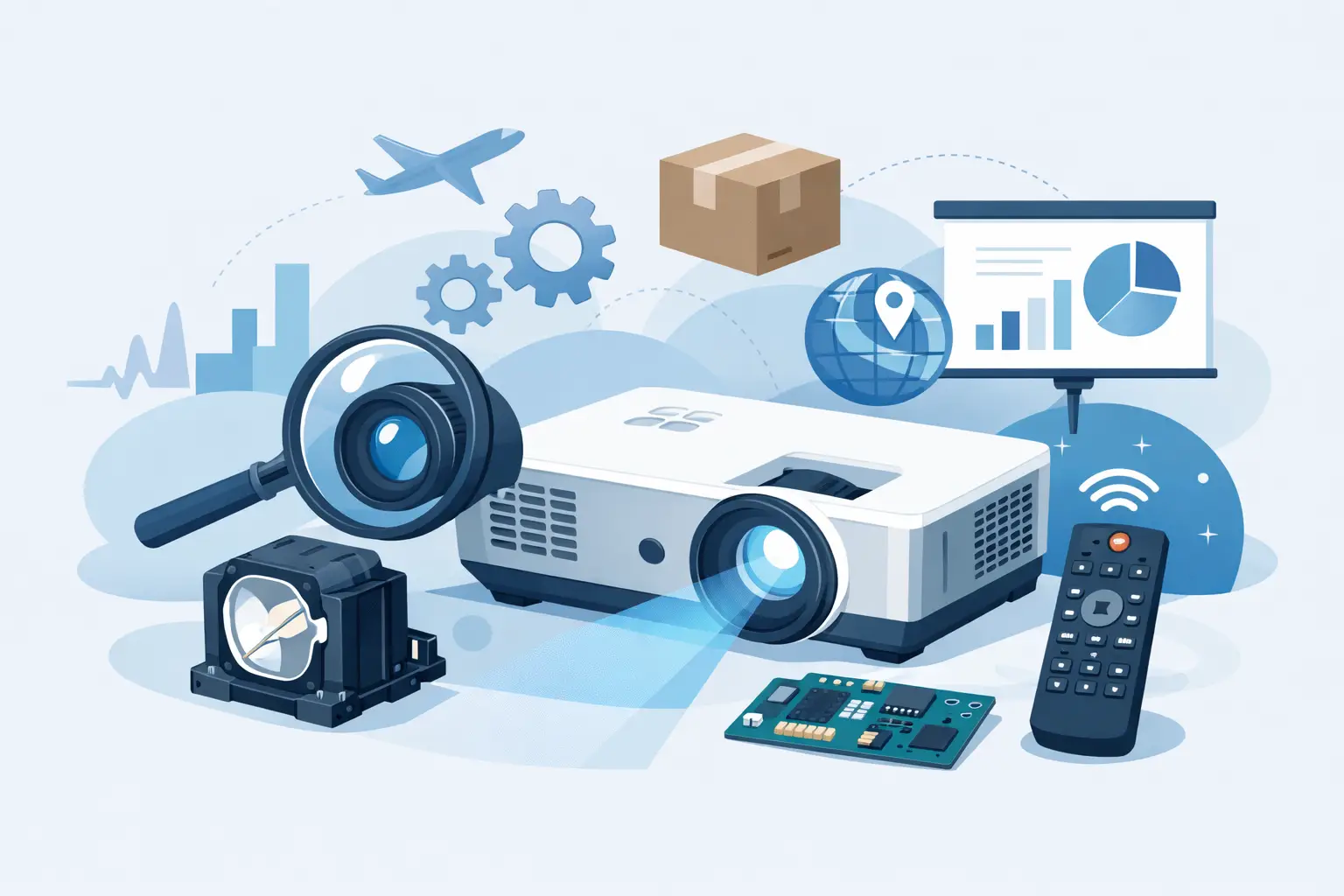
A projector repair can be profitable or costly long before a technician opens the chassis. The difference usually comes down to part identification, supplier verification, and whether the replacement will perform reliably in the installed environment. This projector parts sourcing guide is designed for AV distributors, service providers, integrators, and procurement teams managing projector fleets across multiple brands and applications.
The goal is not simply to find a lower-priced replacement. It is to source the correct component with predictable performance, clear warranty terms, and enough supply continuity to keep customer equipment operating.
Start With the Exact Projector Configuration
A projector model number is essential, but it is not always sufficient. Manufacturers may release regional versions, production revisions, or chassis variants that use different lamps, filters, lens mounts, power boards, or optical assemblies. A part that appears compatible in a generic listing may still fail to fit a specific revision.
Collect the projector brand, complete model number, serial number range when available, and the original part number from the removed component. For lamp assemblies, verify the lamp module reference and housing design. For lenses, confirm the projector series, mount type, throw ratio requirement, and any motorized zoom, focus, or lens-shift functions. For filters, match the filter frame dimensions, retention points, and airflow direction rather than relying only on a broad model-family description.
Photos are useful when the original part number is missing, particularly for older projectors. A clear image of connectors, mounting tabs, label markings, and the removed component can prevent an avoidable return. For fleet operators, maintain an internal cross-reference file that records each installed projector model, approved replacement part, supplier SKU, and service history.
Source by Part Category, Not by Price Alone
Projector accessories do not carry the same technical risk. Procurement requirements should reflect the role each component plays in image quality, thermal management, and equipment uptime.
Projector bulbs and lamp modules
The lamp category requires the closest attention because brightness, stability, life expectancy, and safety depend on both the burner and the completed module. Buyers should distinguish between a bare lamp, a lamp installed in a compatible housing, and a complete original module. These are different products with different service procedures and risk profiles.
For a replacement lamp module, ask what burner brand is used, whether the housing is manufactured to match the original fitment, and how the lamp is tested before shipment. A low initial price is not a saving if early dimming, arc instability, overheating, or incorrect housing alignment causes a repeat service call.
Compatible lamp solutions can be commercially sensible for many installed fleets, especially when OEM parts are costly or difficult to obtain. However, they should be selected based on measured output, operating life expectations, connector accuracy, and warranty support. A supplier should be able to state whether the lamp is intended as an OEM equivalent, an import alternative, or a basic aftermarket option.
Projector lenses
A projector lens is an optical component, not a simple mechanical accessory. Compatibility includes more than whether the lens locks into the projector. The selected lens must support the required throw distance, screen size, resolution, brightness target, and installation geometry.
For corporate meeting rooms and classrooms, the correct standard or short-throw lens may be the priority. For museums, simulation, large venues, and projection mapping, buyers may need specialty throw ratios, edge blending capability, low distortion, and reliable motorized adjustment. A lens that is technically mount-compatible but unsuitable for the projection distance can create a costly redesign on site.
Confirm color reproduction, light transmission, resolution support, contrast performance, and installation requirements before approving a lens. For 4K-capable systems, optical precision matters even more. Ask whether the lens has been developed for the projector platform and whether its structural design supports repeatable installation without excessive adjustment time.
Air filters and thermal protection parts
A filter is inexpensive compared with a lamp or optical engine, but poor filtration can create expensive failures. Dust accumulation reduces cooling efficiency and can contribute to overheating, brightness loss, fan noise, and shortened component life. In environments with smoke, construction dust, kitchens, warehouses, or high visitor traffic, filter quality directly affects maintenance intervals.
Evaluate both filtration and ventilation. An overly restrictive filter can reduce airflow, while a weak filter may allow dust into sensitive optical and thermal areas. The correct product should fit securely in the designated filter path and preserve the projector's designed airflow pattern. For customers operating large fleets, scheduled filter replacement kits can be more efficient than ordering single units after an alert appears.
Verify the Supplier Before Placing Volume Orders
A capable supplier should make technical verification easier, not shift all compatibility risk to the buyer. Before committing to a new source, review the supplier's product specialization, part-matching process, quality controls, warranty terms, and response process for defects or incorrect shipments.
Ask practical questions. Can the supplier cross-reference by projector model and original part number? Can it confirm availability for repeat orders? Are product labels, packaging, and carton quantities consistent for warehouse handling? Is there a defined process for technical claims and returns?
For commercial buyers, sample evaluation remains valuable. Test representative parts in the same projector models and operating conditions used by your customers. For lamps, record brightness, startup behavior, fan response, and stability over an appropriate burn-in period. For lenses, inspect focus consistency, image uniformity, color performance, and mechanical seating. For filters, confirm fit, airflow, and no interference with access panels or sensor functions.
ZORSIKA supports this type of sourcing requirement with specialized projector lenses, bulbs, air filters, and other replacement accessories developed for broad market compatibility and professional service use.
Build a Clear Compatibility and Quality Checklist
The most reliable purchasing process uses a standard approval checklist. It should include the exact projector model and revision, original component reference, replacement supplier SKU, application environment, and required delivery date. Add technical requirements specific to the category, such as lamp burner source, lens throw ratio, or filter dimensions.
Commercial terms belong on the same checklist. Confirm minimum order quantities, lead times, packaging specifications, warranty duration, return authorization requirements, and replacement terms for verified defects. If you serve schools, event venues, or enterprise customers, consider whether spare stock is needed locally to cover failures between scheduled shipments.
A supplier quotation should be comparable line by line. Do not compare a bare lamp price with a complete lamp module price, or a generic filter with a custom-fit filter. Clarify the unit of sale, included hardware, packaging, and product grade. This avoids a common procurement problem: approving a low quote that later requires additional parts, labor, or expedited freight.
Plan Inventory Around Failure Risk and Service Commitments
Stocking every projector part is rarely efficient. A better approach is to rank items by installed base, failure frequency, replacement lead time, and the cost of projector downtime. High-volume lamp modules and filters for common fleet models often justify local inventory. Slow-moving lenses or specialized optical components may be sourced to order unless they support a critical venue or contracted service account.
Historical repair data is useful here. If a customer operates hundreds of identical projectors, the service team can forecast lamp and filter demand based on operating hours and maintenance schedules. If a projector model is discontinued, secure a reasonable supply of high-risk replacement parts before availability becomes uncertain.
Also consider the lifecycle stage of the installed fleet. Early in a model's life, supply is usually straightforward and demand is moderate. As the model ages, OEM parts may become expensive, discontinued, or subject to long lead times. Qualified alternative parts can protect service continuity, but only when compatibility has been validated in advance.
Treat Warranty as an Operational Tool
Warranty language should be specific enough to support your service workflow. A broad warranty statement has limited value if it does not explain coverage, claim evidence, response time, and replacement handling. For lamps, understand whether coverage is based on hours, a fixed period, or both. For lenses and filters, confirm what constitutes a manufacturing defect versus installation damage or normal wear.
Keep installation records, projector hour counts, and photographs of failed parts when possible. This documentation helps suppliers assess claims accurately and helps your team identify whether failures are related to the part, the projector's cooling system, power quality, or operating conditions.
The strongest sourcing decision is usually the one that reduces total service cost, not just purchase cost. When the correct projector part arrives on time, fits without modification, performs as specified, and is backed by a workable warranty process, your technicians spend less time on rework and your customers spend less time without projection.