Projector Replacement Parts FAQ for Service Teams
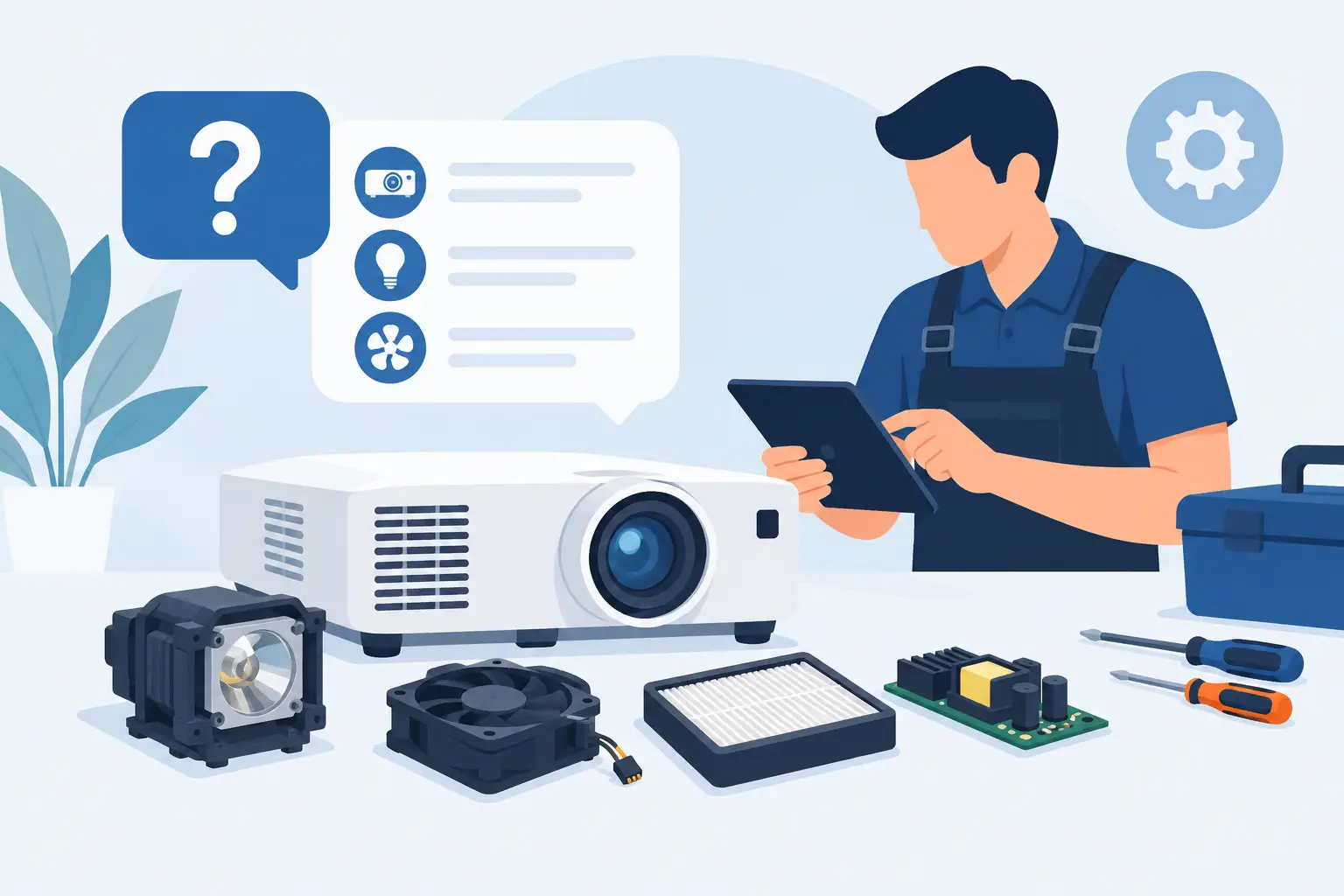
A lamp warning in a classroom, a dim image in a conference room, or an overheating projector at an event creates the same operational problem: the correct part is needed quickly, and an incorrect order extends downtime. This projector replacement parts FAQ addresses the questions service teams, distributors, and procurement buyers should resolve before ordering lamps, lenses, air filters, and related components.
Start With Compatibility, Not the Part Name
Projector parts are often described by a brand name, a projector family, or a visual similarity. None of those is sufficient for purchasing. A lamp housing that looks identical may use a different connector, reflector geometry, ballast requirement, or control-board setting. A lens with a compatible mount may still have the wrong throw ratio for the installed room.
The safest identifier is the complete projector model number from the product label, followed by the original part number when available. For fleet maintenance, record both in the service database. Include the projector's serial range when manufacturers have made mid-production revisions, particularly for lamp modules and air filters.
What information should a buyer provide?
A complete request should include the projector brand and model, the existing part number, photos of the label and connector when uncertainty exists, and the application. The application matters for lenses because screen size, mounting distance, projector orientation, and desired image brightness affect the correct choice.
For a replacement lamp, also confirm whether the requirement is for a full lamp module or the bare burner only. A full module includes the housing and is generally the more practical service option. A bare burner can reduce part cost, but installation requires trained technicians, careful handling, and proper alignment. The labor and warranty risk can outweigh the initial saving for many service operations.
How Should Buyers Evaluate Replacement Lamps?
A replacement lamp should be assessed as an operating component, not as a commodity. Brightness stability, arc performance, electrical matching, reflector quality, and expected service life all affect the result after installation. A low-priced lamp that dims prematurely or creates unstable output can generate repeat service calls and damage the reseller's margin.
Buyers should ask whether the burner source is identified, whether the module is built for the specified projector model, and what warranty terms apply. Reputable alternatives can provide a practical balance between availability, performance, and cost. ZORSIKA works with established bulb manufacturers including Philips, Osram, Ushio, and Phoenix, while supplying replacement solutions intended to deliver more than 95% of original brightness and more than 90% of original lamp life.
Do not assume every lamp-related fault is caused by the lamp. A projector can display a lamp warning because of a failed ballast, thermal issue, door interlock, timer setting, power-board fault, or firmware condition. When a new lamp does not strike, inspect the housing fit, connector engagement, lamp-door switch, and error code before declaring the replacement defective.
When should the lamp timer be reset?
Reset the lamp timer only after the replacement lamp has been installed and the projector has been tested. The timer does not measure actual lamp output, but it supports maintenance scheduling and warning functions. Resetting it without changing the lamp makes future service decisions less reliable.
What Makes a Replacement Lens Suitable?
Lens selection is a calculation, not a visual match. The required throw ratio is determined by the throw distance divided by the image width. Once that ratio is known, compare it with the lens specifications approved for the projector series. A lens outside the permitted range may not mount correctly, communicate properly with the projector, or achieve focus across the full image.
For commercial AV installations, also confirm lens shift range, zoom range, f-number, screen format, and projector position. A short-throw lens may solve a space constraint but can increase sensitivity to alignment and screen flatness. A long-throw lens can support rear projection or large venues but may require greater light output to maintain the required image brightness.
Image quality should remain central to the purchase decision. A properly engineered replacement lens should preserve color reproduction, limit light loss, support the projector's resolution and contrast capability, and allow reliable installation. This is especially relevant in museums, simulation environments, boardrooms, and large-format display projects where edge focus and color consistency are visible to the audience.
Why Are Air Filters a Service-Critical Part?
Air filters are inexpensive compared with lamps, optics, and main boards, yet poor filter maintenance can shorten the life of all three. Dust buildup restricts airflow, raises internal temperature, and allows contamination to settle on optical components. Smoke, grease, and fine airborne particles create additional risk in hospitality, industrial, and high-traffic public environments.
Replace or clean filters according to the projector manufacturer's maintenance schedule, then shorten that interval when the operating environment demands it. A filter should fit the designated air path without gaps or deformation. High filtration is valuable, but a filter that restricts ventilation too severely can create another thermal problem. The correct design balances dust capture with stable airflow.
When servicing a heavily contaminated unit, replacing the filter alone may not restore normal operation. Inspect fan performance, vents, temperature sensors, and internal optical areas as appropriate. This prevents a new filter from being installed into a projector that already has a heat-related fault.
When Is Repair Better Than Replacement?
The answer depends on the part, the projector's age, and the value of the installed system. Replacing a lamp, filter, lens, fan, or control button assembly is often sensible when the projector remains within its useful performance range. For a current commercial model with compatible accessories and sufficient brightness, targeted repair can preserve a customer's investment and reduce disruption.
Full projector replacement may be the better decision when multiple high-cost components have failed, the unit no longer meets resolution or brightness requirements, or OEM support has ended. Service providers should consider labor, installation changes, spare-part availability, and the cost of downtime rather than comparing part price alone.
For managed fleets, standardizing compatible replacement parts can improve both response time and purchasing efficiency. Keep a controlled stock of fast-moving lamp modules and filters for high-volume models, while sourcing lenses and lower-demand assemblies against confirmed project requirements. This approach limits inventory exposure without leaving common service calls unsupported.
Projector Replacement Parts FAQ: Common Buyer Questions
Are aftermarket projector parts always lower quality than OEM parts?
No. Quality depends on the component source, manufacturing control, compatibility verification, and supplier warranty. Some aftermarket parts are poorly matched, while qualified alternatives can offer dependable performance at a more workable cost. Evaluate the supplier's technical documentation, coverage by model, stated performance specifications, and support process rather than relying only on the OEM versus aftermarket label.
Can a replacement lamp increase projector brightness?
A new lamp can restore brightness lost as the old lamp aged, but it cannot reliably exceed the projector's designed optical output. If the image remains dim after replacement, check the projector's lamp mode, lens cleanliness, filter condition, image settings, screen gain, and ambient light level. In some cases, the issue is optical contamination or room conditions rather than the lamp.
Can one lens fit several projector brands?
Usually not. Even where lenses appear similar, manufacturers use different mechanical mounts, electrical contacts, firmware recognition methods, and optical specifications. A lens should be selected for the specific projector series and installation requirement. Cross-brand substitution without documented compatibility introduces unnecessary operational risk.
Is it acceptable to keep using a projector with a filter warning?
Only long enough to schedule immediate maintenance if the projector remains stable. Ignoring the warning can lead to restricted cooling, elevated internal temperatures, accelerated lamp wear, and avoidable failure. For installed fleets, filter warnings should trigger a planned service action, not a wait-until-failure response.
The most reliable replacement order begins with accurate identification, then matches the part to the operating environment and service objective. That discipline protects uptime, reduces repeat labor, and gives technical teams a clearer basis for every purchasing decision.