Why Do Projector Bulbs Fail? Main Causes
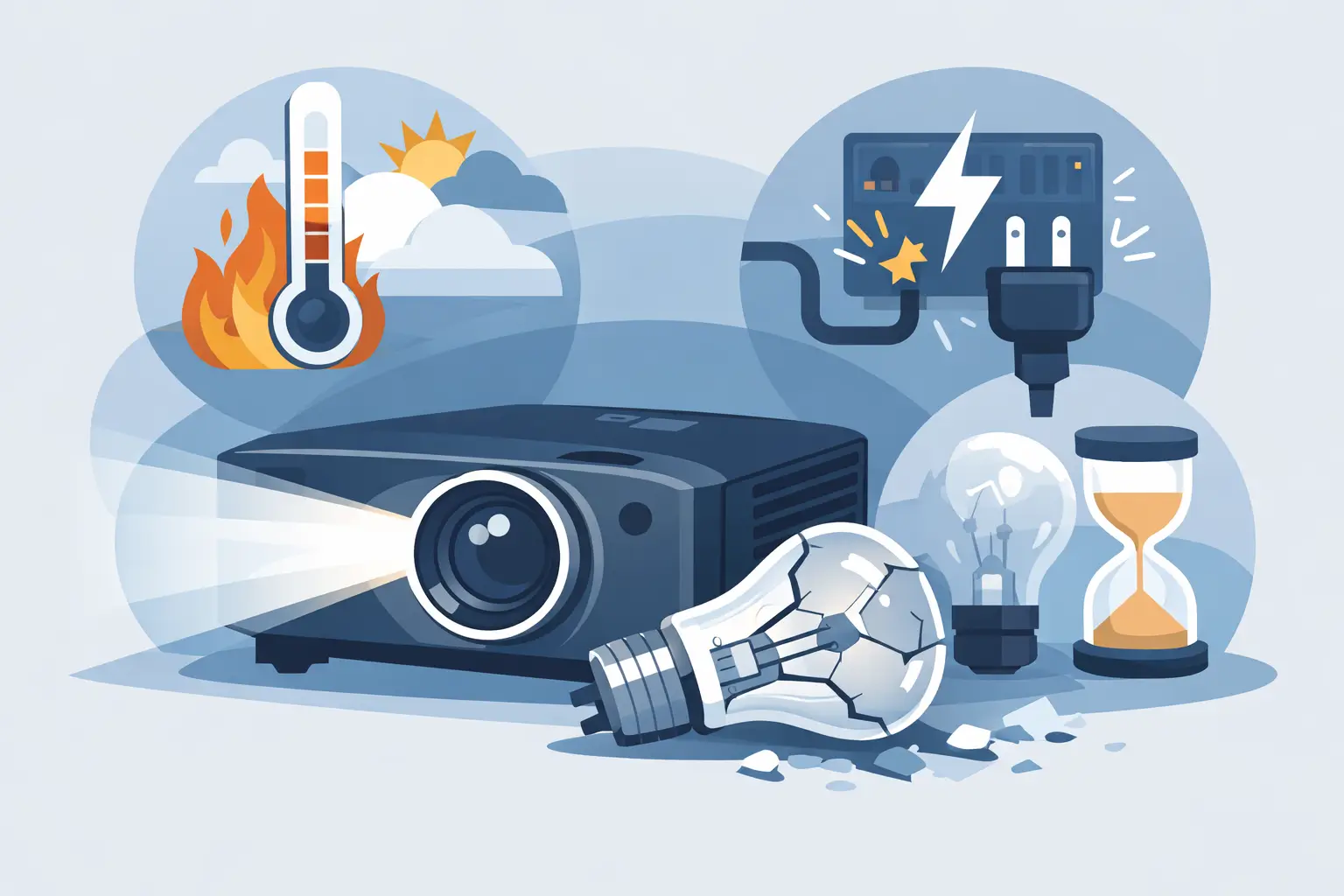
A projector lamp that fails during a classroom session, conference, exhibit, or rental event is rarely just an isolated parts issue. For service teams managing installed fleets, understanding why do projector bulbs fail is necessary to reduce repeat repairs, protect margins, and avoid preventable downtime. Most lamp failures result from cumulative operating conditions: heat, restricted airflow, unstable power, incorrect installation, or a replacement lamp that does not match the projector's electrical and optical requirements.
Projector bulbs are consumable high-pressure arc lamps. They operate at extremely high temperature and pressure to produce the brightness required for projection. Their rated life is therefore a controlled expectation, not a guarantee of identical hours in every installation. A lamp specified for 2,000 or 3,000 hours may deliver more or less depending on the projector, environment, operating mode, and maintenance history.
Why Do Projector Bulbs Fail Before Their Rated Life?
Early lamp failure usually has more than one contributing factor. A lamp can look normal at installation, run reliably for weeks, and then fail because the projector has gradually accumulated heat or dust. The following causes should be reviewed before simply replacing another lamp.
Excessive operating temperature
Heat is the primary enemy of projector lamps. The arc tube, reflector, lamp housing, ballast, and surrounding optical components all depend on the projector's cooling system. When internal temperature rises beyond design limits, the lamp electrodes wear faster, the arc becomes less stable, and the risk of rupture increases.
Common causes include clogged air filters, blocked intake or exhaust vents, failed cooling fans, fan-speed errors, and projector placement inside tight cabinets. A projector installed near a ceiling, wall, or rack surface may have insufficient clearance for exhaust air even when its vents appear unobstructed.
High ambient temperature also matters. Equipment used in warm control rooms, retail displays, outdoor enclosures, and temporary event environments often experiences shorter lamp life than the same model operating in a climate-controlled meeting room. Before fitting a replacement lamp, technicians should verify airflow and check that all fans start, run at the correct speed, and remain active through the cooldown cycle.
Dust, smoke, and contaminated airflow
Dust does more than make a projector look neglected. It coats filters, reduces air volume, insulates heat-producing components, and can contaminate lamp and optical compartments. Smoke, oil vapor, and fine airborne particles are especially damaging in restaurants, factories, warehouses, houses of worship, and venues that use haze effects.
A filter may still appear partly open while restricting enough airflow to raise operating temperature. This is why a planned filter replacement schedule is more dependable than waiting for a visible warning message. High-ventilation replacement filters help protect the projector, but the correct filter must also fit the model properly. A loose or poorly sealed filter can allow bypass dust into the chassis.
Power instability and ballast problems
The projector's lamp ballast provides the high-voltage ignition pulse and then regulates lamp current during operation. If the ballast is weak, damaged, or receiving unstable input power, it may struggle to ignite the lamp or maintain a stable arc. The result can be flickering, brightness fluctuation, repeated shutdowns, or a lamp that appears to fail well before its expected life.
Power events are particularly relevant in older buildings, mobile AV setups, event sites, and regions with inconsistent mains supply. Surge protection and properly specified power conditioning can reduce risk, but they cannot correct a failing ballast or an internal power-supply fault.
Technicians should avoid diagnosing every no-light condition as a bad bulb. If a known-good, compatible lamp does not strike, or if the projector reports lamp errors immediately after replacement, inspect the ballast, lamp door switch, thermal sensors, fans, and power circuitry. Replacing lamps without correcting the root cause raises service cost and can create unnecessary warranty claims.
Frequent on-off cycles and interrupted cooldown
Each startup places significant stress on a high-pressure lamp. The ignition phase requires high voltage, while repeated heating and cooling expands and contracts the lamp structure. A projector used for many short sessions can consume lamp life faster than one operating continuously for the same total number of hours.
Interrupting the cooldown cycle adds further risk. If AC power is disconnected immediately after shutdown, the fans cannot remove residual heat from the lamp and optical engine. This can shorten lamp life and increase heat-related damage elsewhere in the projector.
For permanent installations, control systems should be programmed to allow the manufacturer's full shutdown and cooldown sequence. For portable and rental equipment, operators should be trained not to unplug the projector until fan operation has stopped. Eco mode can extend lamp life in suitable applications, although it may not provide enough brightness for large screens or high-ambient-light spaces.
Incorrect lamp installation or poor module fit
Lamp replacement is straightforward only when the correct module is used and installed correctly. Misaligned lamp housings, loose retaining screws, damaged connectors, improperly seated lamp doors, and contamination from fingerprints can all create operating problems.
Technicians should handle the lamp assembly by its housing rather than touching the bare quartz arc tube. Oils and residues on quartz can create localized hot spots. The lamp compartment should also be checked for broken glass, dust buildup, heat discoloration, and connector damage before a new module is installed.
Compatibility is equally important. Projector lamps may look similar across models while using different wattage, reflector geometry, connector configuration, burner position, or control requirements. A physically installable lamp is not necessarily electrically or optically correct. Buyers should match the projector model and lamp part number, then confirm whether the requirement is for a complete lamp module or a bare bulb for professional rebuilding.
Lamp Quality, Burner Quality, and Expected Service Life
Not all replacement lamps deliver the same result. In the professional AV channel, the lowest purchase price can become expensive if a lamp has unstable brightness, poor reflector alignment, early failure, or inconsistent compatibility across a service fleet.
A complete lamp module includes the burner, reflector assembly, housing, wiring, and connectors. The burner is the arc lamp itself and has the greatest effect on ignition, brightness stability, color performance, and usable service life. Housing quality also matters because proper positioning keeps the light source aligned with the projector's optical path and supports safe heat management.
Original manufacturer lamps are often the reference point, but availability and cost can be challenging for older or high-volume projector fleets. A qualified import alternative should be evaluated on more than a claimed operating-hour figure. Professional buyers should consider burner source, electrical compatibility, brightness performance, module construction, quality control, warranty terms, and supplier support for accurate model matching.
ZORSIKA supplies projector lamp solutions using bulbs sourced through long-term cooperation with leading manufacturers, alongside self-developed burners for broad market compatibility. For distributors and repair providers, the practical objective is a replacement option that supports reliable operation, predictable purchasing, and competitive service pricing without creating avoidable return rates.
Warning Signs Before a Projector Lamp Fails
Lamp failure is not always sudden. A noticeable reduction in brightness is often the first sign of normal lamp aging, particularly in projectors used at full power. Color may look less balanced, the image may flicker during startup, or the projector may require several attempts to strike the lamp.
Other signs require immediate inspection. A projector that shuts down after a few minutes may be responding to an overheating condition. Popping sounds, a sharp loss of light, or fragments in the lamp housing can indicate lamp rupture. In these cases, the unit should be powered down, allowed to cool fully, and cleaned according to the manufacturer's service procedure before another lamp is installed.
Do not reset the lamp timer merely to clear a warning while retaining an aged lamp. The timer is not a direct measurement of lamp condition, but it gives service teams a useful maintenance reference. Reset it only after a verified replacement has been installed.
A Practical Maintenance Standard for AV Fleets
The best response to lamp failure is preventive service tied to the operating environment. High-use projectors should have their lamp hours recorded, filters inspected at planned intervals, and ventilation checked whenever a projector is moved or reinstalled. Sites with smoke, dust, or extended daily runtimes need more frequent maintenance than clean office environments.
For service organizations, it is also useful to record the failed lamp's hours, failure symptoms, projector location, filter condition, and power history. Patterns quickly become visible. If several lamps fail early at one site, the problem is usually environmental, electrical, or mechanical rather than a series of unrelated lamp defects.
A dependable replacement lamp is only one part of projector uptime. When correct model matching, clean airflow, stable power, proper cooldown, and documented maintenance work together, lamp replacements become planned service events instead of urgent disruptions.