In the design of high-precision optical systems, the eccentricity tolerance of optical components has a decisive impact on imaging quality. Components near the aperture diaphragm, which directly modulate light rays across the entire field of view and full aperture, are particularly prone to aberration issues caused by eccentricity. This paper adopts Seidel Aberration Theory as the core analytical framework to systematically dissect the physical mechanism of eccentricity sensitivity in components at the diaphragm, explore the differential effects of eccentricity on typical aberrations such as coma and astigmatism, and ultimately provide actionable theoretical basis and technical guidance for tolerance allocation and alignment optimization in optical system design.
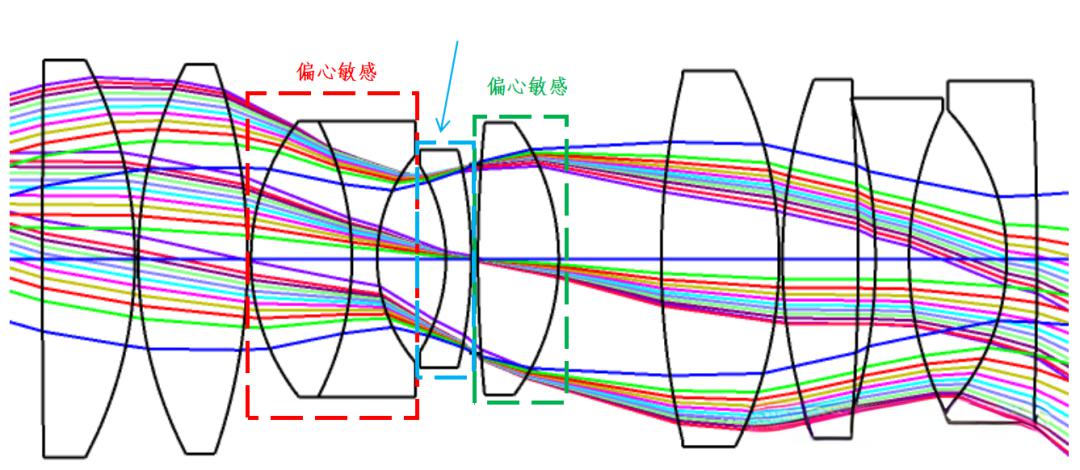
1. Introduction
In the design of high-precision optical systems, the eccentricity tolerance of optical components has a decisive impact on imaging quality. Components near the aperture diaphragm, which directly modulate light rays across the entire field of view and full aperture, are particularly prone to aberration issues caused by eccentricity. This paper adopts Seidel Aberration Theory as the core analytical framework to systematically dissect the physical mechanism of eccentricity sensitivity in components at the diaphragm, explore the differential effects of eccentricity on typical aberrations such as coma and astigmatism, and ultimately provide actionable theoretical basis and technical guidance for tolerance allocation and alignment optimization in optical system design.
2. Aberration Modulation Mechanism of Optical Component Eccentricity
2.1 Quantitative Relationship Between Eccentricity and Wavefront Error
Eccentricity of an optical component is defined as the lateral offset (Δx, Δy) between its optical center (e.g., lens optical axis) and the system's mechanical reference axis. From the perspective of wavefront aberration theory, this offset introduces an additional wavefront error term, which can be mathematically expressed as:
W(x,y)=W0(x,y)+Δx⋅∂x∂W0+Δy⋅∂y∂W0
Here, represents the ideal wavefront function when there is no eccentricity. For small eccentricity values (typically Δ < 0.1mm), the first-order partial derivative terms dominate, indicating that eccentricity primarily modulates the tilt component of the wavefront rather than high-order wavefront distortion. 2.2 Modulation Effect Under Seidel Aberration Theory
Within the framework of Seidel Aberration Theory (covering 5 primary aberrations), component eccentricity modulates its inherent Seidel aberration coefficients in a linear manner. It is particularly emphasized that this modulation effect is significantly stronger for components at the diaphragm—since the diaphragm serves as the "reference plane" for the system's aperture, the wavefront contribution of components here directly covers light rays across all fields of view and aperture heights. Even minimal eccentricity is amplified progressively through light propagation, ultimately exerting the maximum impact on the system's total aberrations.
3. Sensitivity Performance of Coma to Eccentricity
3.1 Physical Mechanism and Mathematical Characterization of Coma
Coma is a typical third-order off-axis aberration, characterized by the formation of asymmetric "comet-shaped" (diffraction spots) when an off-axis point light source is imaged, severely impairing the detail reproduction at the edge of the image. From the perspective of wavefront aberration, the mathematical expression of coma is:
Where is the normalized aperture coordinate (), is the azimuth angle, and is the coma coefficient—its value directly determines the severity of coma. 3.2 Linear Modulation Law of Eccentricity on Coma
When a component is located at the diaphragm, its eccentricity Δ linearly modulates the inherent coma coefficient, with the specific relationship expressed as:
In this equation, is the inherent coma contribution of the component without eccentricity, and is the eccentricity-coma modulation coefficient (determined by the component's focal length, refractive index, and its power ratio in the system). For positive lenses, is usually a large positive value, meaning that even micron-level (μm) eccentricity can trigger a significant change in the coma coefficient, leading to severe deterioration of the diffraction spot morphology. 3.3 Fundamental Cause of Coma's High Sensitivity
The exceptional sensitivity of coma to eccentricity stems from its dual odd-function property: in terms of aperture coordinates (), the coma wavefront function varies with (odd function in the direction); in terms of field coordinates (), the coma coefficient also varies linearly with the field height (odd function in the field direction). This dual odd-function attribute makes coma extremely sensitive to any factor that disrupts system symmetry (such as eccentricity)—even minor perturbations can break the original balance and induce significant aberrations. 4. Response Characteristics of Astigmatism to Eccentricity
4.1 Formation Mechanism and Wavefront Characteristics of Astigmatism
Astigmatism is another common off-axis aberration, whose physical essence lies in the difference in light-focusing capabilities between the meridional and sagittal planes. This ultimately results in the formation of two mutually perpendicular focal lines (meridional focal line and sagittal focal line) when an off-axis point is imaged, rather than an ideal point image. Its wavefront expression is:
Wastig=B⋅ρ2⋅cos2θ+C⋅ρ2⋅sin2θ
Here, and are the astigmatism coefficients in the meridional and sagittal directions, respectively—the larger the difference between them, the more pronounced the astigmatism. 4.2 Quadratic Response Relationship Between Eccentricity and Astigmatism
Unlike the linear response of coma, the modulation of astigmatism by eccentricity exhibits a second-order nonlinear relationship, whose mathematical model can be simplified as:
Where is the variation in the difference between the astigmatism coefficients, and is the eccentricity-astigmatism modulation coefficient. This implies that for small eccentricity values, the variation in astigmatism is relatively small; however, when the component is positioned at a large field of view (e.g., the edge field of a wide-angle lens), the increase in field height amplifies the quadratic effect of eccentricity, leading to a significant intensification of astigmatism variation that requires focused attention. 5. Comparative Analysis of Sensitivity Among Different Lens Types
5.1 Sensitivity Differences Between Positive and Negative Lenses
In imaging systems with positive total optical power (such as camera lenses and projection lenses), there are significant differences in eccentricity sensitivity between positive and negative lenses, rooted in their distinct power contribution methods and light modulation roles:
5.1.1 Positive Lenses: Core Causes of High Sensitivity
Positive lenses are the primary providers of convergent optical power in the system, and their high sensitivity to eccentricity can be attributed to three key factors:
- Light Propagation Path: Positive lenses are mostly located downstream in the optical path, directly processing converged light rays. The light deviation caused by eccentricity is transmitted directly to the image plane, leaving no room for compensation by intermediate components;
- Coma Contribution Characteristics: The inherent coma coefficient of positive lenses is usually a large positive value. Combined with the equation , eccentricity linearly amplifies this positive contribution, leading to rapid accumulation of coma;
- Light Angle Deviation: Positive lenses bear the main optical power, resulting in a larger light deflection angle deviation ( is the optical power, is the refractive index) caused by eccentricity, which exerts a more significant disturbance on the subsequent optical path.
5.1.2 Negative Lenses: Inherent Logic of Low Sensitivity
Although negative lenses may have a large absolute value of optical power, their net contribution to the system's total optical power is negative, resulting in significantly lower eccentricity sensitivity compared to positive lenses:
- Net Deviation Cancellation: The power contribution of negative lenses is opposite to that of positive lenses. The light deviation introduced by their eccentricity is partially canceled at the system level, with the net deviation approaching
Δθnet=Δ⋅(ϕpositive−∣ϕnegative∣)
- Subsequent Compensation Space: Negative lenses are mostly located upstream in the optical path, and the eccentricity errors they introduce can be partially compensated by fine position adjustments of the downstream positive lens group;
- Coma Cancellation Effect: The inherent coma coefficient of negative lenses is negative, which can partially cancel the residual positive coma from other components in the system, reducing the impact of eccentricity on total coma.
5.2 Special Sensitivity Analysis of Meniscus Lenses
Meniscus lenses (with one convex and one concave surface, and a significant difference in curvature radii) exhibit "unconventional" eccentricity sensitivity at the diaphragm, which is closely related to their surface refraction lever effect and wavefront modulation characteristics:
5.2.1 Lever Effect of Surface Refraction
The two surface curvature radii () of a meniscus lens differ significantly (typically ). When located at the diaphragm, its second surface (either concave or convex) acts as a "powerful lever" for light deflection due to its large curvature radius—eccentricity Δ causes an additional offset in the incident angle of light rays on this surface. This offset is amplified as the difference in curvature radii increases, ultimately translating into a substantial change in the edge light angle and efficiently inducing coma. 5.2.2 Quantitative Characteristics of Wavefront Modulation
The wavefront modulation function of a meniscus lens at the diaphragm can be refined as:
Wmeniscus=R1R2h⋅Δ⋅(n−1)⋅(R2−R1)
Where is the height of light rays on the lens surface, and is the lens refractive index. When is large (i.e., the meniscus shape is more pronounced), even minimal Δ generates significant wavefront errors—this is the mathematical essence of the high sensitivity of meniscus lenses. 5.2.3 Coefficient Law of Aberration Contribution
The coma contribution coefficient of a meniscus lens at the diaphragm can be expressed as:
Ameniscus=k⋅H2⋅R12R22(R22−R12)
Here, is the Lagrange Invariant (reflecting the light-transmitting capacity of the system), and is a constant. This equation indicates that the coma contribution of a meniscus lens is proportional to the square difference of its curvature radii, further explaining why meniscus lenses with large curvature differences are more sensitive to eccentricity. 6. Design Recommendations and Tolerance Allocation Strategies
6.1 Accurate Identification of Key Sensitive Components
In the early design stage, tolerance sensitivity analysis (e.g., Monte Carlo simulation) should be conducted to prioritize the identification of highly sensitive components at the diaphragm:
- Core Focus Objects: Positive lenses adjacent directly to the diaphragm, and meniscus lenses with significant curvature differences;
- Auxiliary Identification Indicators: Component power ratio (components with >30% power require focused monitoring), and Seidel aberration coefficient contribution (components with an absolute coma contribution coefficient >0.1λ require strict control).
6.2 Hierarchical Tolerance Allocation Principle
A hierarchical strategy of "strict control for core components, relaxed tolerance for secondary components" is adopted to balance performance and manufacturing costs:
- Level 1 Tolerance (Strictest): Eccentricity tolerance of positive lenses and meniscus lenses at the diaphragm is controlled within 5-10μm;
- Level 2 Tolerance: Eccentricity tolerance of negative lenses near the diaphragm can be relaxed to 15-20μm;
- Compensation Design: Reduce the system's sensitivity to eccentricity of individual components through "symmetric optical path layout" (e.g., symmetric component parameters around the diaphragm), or offset minor eccentricity errors of core components using tolerance combinations of multiple low-sensitivity components.
6.3 Adaptive Design of Mechanical Structure
Mechanical design should provide support for the eccentricity control of optical components:
- Reference System: Establish a mechanical reference axis centered on the diaphragm, ensuring that the coaxiality error of the lens barrel inner hole and positioning steps is <5μm;
- Stiffness Assurance: Use high-stiffness materials (such as titanium alloy, carbon fiber composite materials) to manufacture the lens barrel, avoiding structural deformation caused by assembly or temperature changes;
- Thermal Compensation: Predict the impact of temperature changes on component positions through Finite Element Analysis (FEA), and adopt material combinations with "matched thermal expansion coefficients" (e.g., the difference in thermal expansion coefficients between the lens and lens barrel is <5×10⁻⁶/℃) to reduce additional eccentricity caused by temperature variation.
6.4 Alignment and Testing Technical Solutions
- Active Alignment: Adopt an active alignment technology combining "real-time wavefront detection + precision displacement adjustment". Use an interferometer to measure wavefront errors in real time, and drive a piezoelectric ceramic translation stage to adjust the position of sensitive components until aberration indicators such as coma and astigmatism meet design requirements;
- Performance Verification: After alignment, verify the full-field imaging performance through Modulation Transfer Function (MTF) testing, ensuring that the system's MTF value still reaches over 90% of the design value under actual tolerance conditions, and avoiding the problem of "theoretically qualified but practically ineffective".
7. Conclusion
In the study of eccentricity tolerance sensitivity of optical components, coma exhibits a first-order linear response to eccentricity and is the most sensitive aberration type; astigmatism shows a second-order nonlinear response with lower sensitivity. From the perspective of component types, positive lenses at the diaphragm bear the main optical power, with errors transmitted directly to the image plane, while meniscus lenses amplify the impact of eccentricity through the surface refraction lever effect—together, they form the core components most sensitive to eccentricity in the system. Therefore, in the design of high-precision optical systems, the eccentricity tolerance of all lens types at the diaphragm should be treated as a core control indicator, and combined with hierarchical tolerance allocation and active alignment technology to ultimately ensure the stability of the system's imaging quality.