
Light is the most familiar presence in our lives. When we open the window in the early morning, the first ray of sunlight gently falls on our faces; when we press the switch at night, the light instantly drives away the darkness in the room. To put it more bluntly, we can see the colorful flowers, plants and trees, the row upon row of high-rise buildings, immerse ourselves in wonderful movie scenes, and browse information on mobile phone screens. All of these are inseparable from the gift of light. But have you ever stopped to think: what exactly is the light that surrounds us every day? Do you really understand its essence, classification and characteristics?
Light is the most familiar presence in our lives. When we open the window in the early morning, the first ray of sunlight gently falls on our faces; when we press the switch at night, the light instantly drives away the darkness in the room. To put it more bluntly, we can see the colorful flowers, plants and trees, the row upon row of high-rise buildings, immerse ourselves in wonderful movie scenes, and browse information on mobile phone screens. All of these are inseparable from the gift of light. But have you ever stopped to think: what exactly is the light that surrounds us every day? Do you really understand its essence, classification and characteristics?
The Essence of Light: Both a "Wave" and a "Particle"?
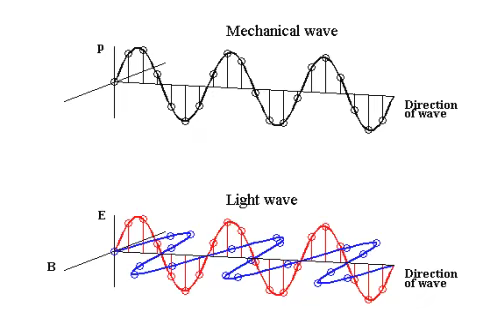
When it comes to the essence of light, many people may first think of the interesting term from animation — "dynamic light wave". Although this is just a fictional humorous setting, light is indeed closely related to "waves". In a sense, light waves, like the mechanical waves we are familiar with, have obvious wave properties.
However, from the perspective of quantum mechanics, the essence of light is far more complex than we imagine. It not only has wave properties but also particle properties, which is what we often call wave-particle duality. Simply put, "wave-particle duality" means that light propagates like a "wave" and exists like a "particle".
The wave property is reflected in: just as water waves spread outward and sound waves can travel in the air, light also moves forward in the form of waves and can produce typical wave phenomena such as interference and diffraction (these phenomena will be introduced in detail later).
The particle property is manifested as: light is composed of tiny "photons", and each photon has energy, like small particles. For example, the famous photoelectric effect (when light shines on metal, it can knock out electrons in the metal) clearly reflects the particle property of light.
Why does light have such dual properties? This is because in the microcosm, the behavior of micro-particles (including photons) cannot be simply defined by the macro-world thinking of "either wave or particle". Experiments have clearly proved that light is more like a wave in the process of propagation, and more like a particle when interacting with matter. This unique "both wave and particle" characteristic is the core of wave-particle duality.
Classification of Light: Visible Light is Just the "Tip of the Iceberg"
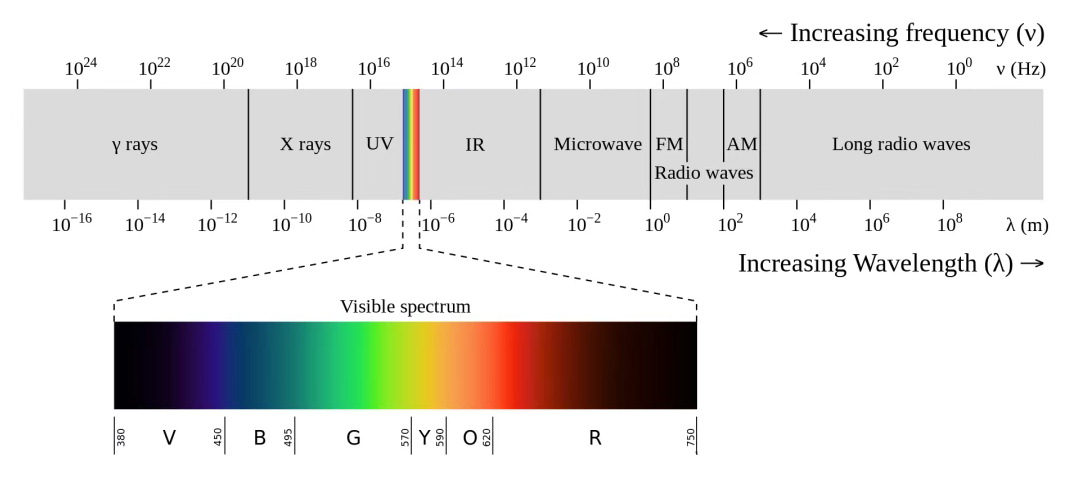
The red, orange, yellow, green, blue, indigo, violet and other "visible light" we see daily is actually just a small part of the light family. The entire light family has many members arranged in order of increasing wavelength (corresponding to decreasing frequency):
1. Gamma rays: They are the light with the shortest wavelength and the highest energy. In the medical field, they are used for tumor radiotherapy to accurately kill cancer cells; in industry, they can be used to detect internal defects of metals to ensure product quality.
2. X-rays: Their wavelength is slightly longer than that of gamma rays. In hospitals, X-ray films can penetrate human tissues, helping doctors clearly observe the condition of bones; in security inspection scenarios, they can easily check the inside of luggage to eliminate potential safety hazards.
3. Ultraviolet rays: Their wavelength is shorter than that of violet light in visible light. They have a strong bactericidal effect and are often used for disinfection; when checking banknotes, the fluorescent patterns on the banknotes will emit bright light under ultraviolet rays, making it easy to identify authenticity.
4. Visible light: This is the light we can see directly, with a wavelength range of approximately 400-760 nanometers. It allows us to perceive colorful colors and is the basis for vision formation.
5. Infrared rays: Their wavelength is longer than that of red light in visible light. In daily life, remote controls transmit instructions through infrared rays; night-vision devices use infrared rays emitted by objects to form images, allowing us to see things clearly in the dark.
6. Microwaves: They have a longer wavelength and belong to a type of radio waves. Microwave ovens use microwaves to heat food; radars also detect the position and speed of targets through microwaves.
7. Radio waves: They have the longest wavelength. The transmission of radio and television signals and communication between mobile phones cannot do without the contribution of radio waves.
It should be noted that the wavelength range of each classification is only a rough division and may vary slightly in different literatures. Each part of light is distinguished by wavelength, frequency or energy. The shorter the wavelength, the higher the frequency and the greater the energy. From this order, we can clearly see that visible light is like a "drop in the ocean" in the entire spectrum, while those invisible lights have long been quietly medical treatment, communication, industry and other fields, silently playing an indispensable and important role.