
PPI is an important indicator to measure the display effect of a screen, and it directly affects our visual experience. It is a unit of measurement used to describe the number of pixels within each inch of length on the screen.
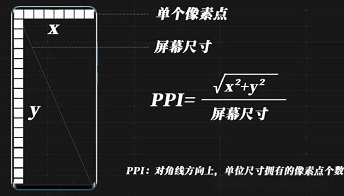
Before getting a new mobile phone or tablet, friends always check a key parameter in the product introduction - PPI. What exactly is PPI? It's a professional term.
PPI (Pixels Per Inch), refers to pixels per inch. PPI is an important indicator to measure the display effect of a screen, and it directly affects our visual experience. It is a unit of measurement used to describe the number of pixels within each inch of length on the screen. Pixels are the basic units that make up digital images, and when arranged together, they form the pictures we see on the screen. Generally speaking, a higher PPI value means more dense pixels on the screen, and the image will be clearer. When PPI reaches 450 or higher, we won't feel any graininess.
- Standard RGB arrangementStandard RGB is the most common pixel arrangement on TFT screens. It divides a pixel into three sub-pixels arranged side by side. Through red, green, and blue color filters (CF), the white light from the TFT backlight module is filtered to form the corresponding red, green, and blue (RGB) sub-pixel arrangement.For example, 1920 pixel points in the horizontal direction actually correspond to 1920×R.G.B = 5760 display units.
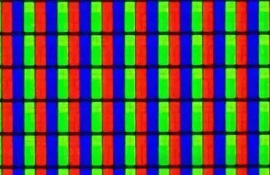
When the three sub-pixels emit light at different brightness levels, we can see patterns of different colors.
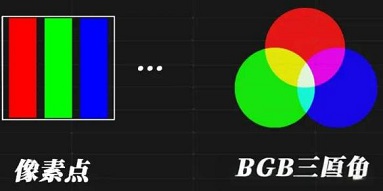
- *For self-luminous OLEDs, the luminescent materials are 2.evaporated onto the substrate.
RGB PenTile arrangement
It is mostly seen on OLED screens. Each pixel in PenTile arrangement is composed of red-green and blue-green sub-pixel combinations. The green pixels are complete, while the red and blue pixels are each reduced by half compared to the traditional RGB arrangement, and the total number of sub-pixels is reduced by about one-third. This leads to defects such as insufficient delicacy and color fringing on the edges of fonts. Its advantage is a longer panel lifespan, but this doesn't seem like an advantage for mobile phone applications.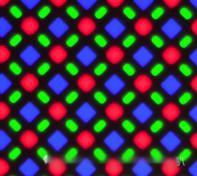
3.RGB Delta arrangement, commonly known as "little yellow duck"
In this screen pixel arrangement, the number of red, green, and blue sub-pixels is the same. However, compared to the standard RGB arrangement, the number of each color's sub-pixels is reduced by one-third. Each pixel is arranged as R-G, G-B, or B-R, and six sub-pixels share one surrounding sub-pixel. The actual pixel density is further reduced compared to PenTile, about only 70% of that of the standard RGB arrangement. It also has problems of insufficient display delicacy and color fringing on font edges.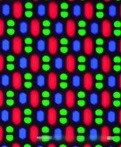
4.RGBW arrangement
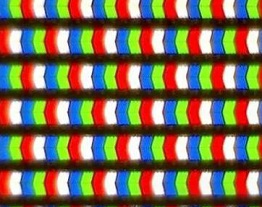
- RGBW is based on the standard RGB arrangement with an additional white pixel. The purpose of this is to improve brightness, but the corresponding color performance is weakened a lot.
There are many tricks here, and the choice depends on the user's needs.To observe these pixels, a microscope is needed; ordinary users cannot see them with the naked eye.