
Autostereoscopic 3D technology simulates and separates these two images on a 2D screen through optical methods, ensuring they reach the corresponding left and right eyes respectively. This "tricks" the brain into perceiving stereopsis.
Visual Principle: Where Does Stereopsis Come From?
The human eyes are separated by approximately 6.5 centimeters, resulting in slight differences between the images captured by the left and right eyes when viewing the same object.
The brain intelligently fuses these two distinct images and calculates the object’s depth and distance based on the differences, allowing us to perceive a three-dimensional (3D) world.
Autostereoscopic 3D technology simulates and separates these two images on a 2D screen through optical methods, ensuring they reach the corresponding left and right eyes respectively. This "tricks" the brain into perceiving stereopsis.
3D Technology Solutions for Flat-Panel Displays
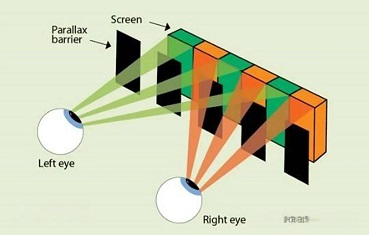
1. Barrier Type (Parallax Barrier)
Using specific algorithms, images are alternately arranged. A parallax barrier placed between the pixel light-emitting devices and the module separates the visuals visible to the left and right eyes. Due to the different viewing angles of the left and right eyes relative to the screen, the angle difference is used to block light and assign images to each eye. The user’s brain then fuses these two distinct images into a 3D image with spatial depth information.
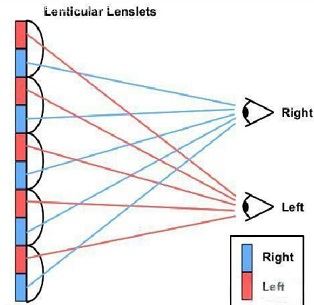
2. Lenticular Lens Technology
Light emitted from a single pixel on the screen is refracted when passing through the lenticular lenses above, directing it to specific angles. Through precise calculation and arrangement, the left eye receives a set of pixels designed for it, while the right eye receives another dedicated set. Upon receiving these slightly different images, the brain automatically fuses them to interpret depth information, creating a vivid 3D effect.
3. Directional Light Source (LCD)
Core Principle: Time Division Multiplexing (TDM) and Persistence of VisionThe following steps are cycled through in an extremely short time:
- Display right-eye image: The backlight is precisely directed to the right eye, while the LCD panel shows the right-eye image.
- Display left-eye image: The backlight quickly switches to target the left eye, and the LCD panel switches to the left-eye image.
- High-speed cycling: The above two steps repeat at an extremely high frequency.
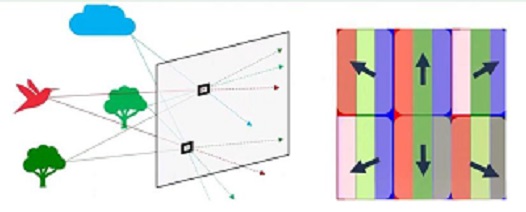
4. 3D Light Field
- Microlens Array Imaging: A microlens array is inserted between the camera’s main lens and image sensor. Each microlens separates and records light from different directions on the sensor. Consumer-grade Lytro light field cameras adopt this solution, enabling the "shoot first, focus later" function.
- Microlens Light Field Display: When the device can accurately reproduce the recorded light information and project it into the user’s eyes, the visual system perceives a real 3D object, generating highly realistic stereoscopic vision. (Each 6 pixels correspond to light from 6 different directions.)

Advantages and Disadvantages of Each Technology
These four technologies represent an evolution from "meeting basic needs" to "pursuing perfection":
- Parallax Barrier and Lenticular Lens: Currently the mainstream technologies in the market, each prioritizing either cost-effectiveness or performance – practical choices for mass adoption.
- Directional Light Source: Theoretically a powerful optimization of the first two, aiming to balance image quality and glasses-free experience, but awaits technological maturity.
- 3D Light Field: The ultimate future-oriented solution, committed to fundamentally restoring the most realistic stereoscopic vision, but faces the greatest technical challenges.