






Eiki Original Lens AH-D23010 Zoom is an original optical accessory for Eiki engineering projectors. It is a long-throw lens (Long Throw) with a throw ratio of 2.56-4.16:1. The original compatibility list covers 1 model. Before installation, simply verify the projector model and panel size; there is no need to make do with adapter rings. The value of an original lens lies not in the extra figures in the specification table, but in the fact that it is calibrated at the factory to the optical path and mount of that projector series: the image circle, edge illumination, and focusing travel all meet the design specifications, so there is no need to use keystone correction to compensate for image quality.
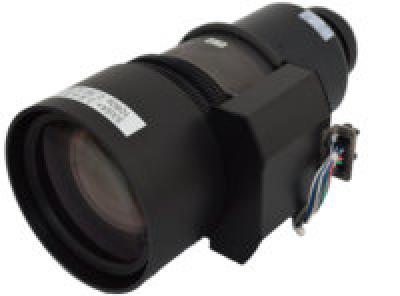
1. Lens Specifications
| Brand | Eiki (Eiki) |
| Lens Model | AH-D23010 Zoom |
| Throw Ratio | 2.56-4.16:1 |
| Product Type | Long Throw |
| Compatible Models | 1 model |
| Warranty | 12 months; damage not caused by the user is eligible for after-sales service, based on the date on the shipping document |
The above specifications are subject to the original manufacturer's specifications. For mechanical dimensions, flange distance, and mount type not shown in the specification table, please check with us using the projector model as the reference. Ordering solely because the model is similar carries the risk that the lens will not fit.
2. Calculating Installation Distance from Throw Ratio
The throw ratio is the ratio of the installation distance to the image width. This original lens is a zoom lens (2.56-4.16:1), so a given image size corresponds to a range of installation distances, and the lens can focus at any distance within that range.
| Image Size | Image Width | Required Installation Distance |
|---|---|---|
| 100 inches | 2.15 m | Approx. 5.50 – 8.94 m |
| 120 inches | 2.58 m | Approx. 6.60 – 10.73 m |
| 150 inches | 3.22 m | Approx. 8.26 – 13.42 m |
| 200 inches | 4.30 m | Approx. 11.01 – 17.89 m |
These are the clear distances from the front surface of the lens to the screen, excluding space at the rear of the projector for cooling and cable connections. The figures are calculated for a 16:10 image; in practice, refer to on-site measurements and the manufacturer's manual.
Image quality varies between the two ends of the zoom range: near the close end, the image is brighter and the edges are slightly softer; near the far end, the edges are sharper and brightness decreases slightly. When the venue allows, it is recommended to use the middle of the range. After installation, first find the sharpest position using the focus ring, then fine-tune the lens shift.
3. Compatible Models (1 model)
The following table is taken from the original manufacturer's compatibility list. Brightness and resolution are populated from the model database; where the data cannot be found, “—” is listed and no assumptions are made.
| Model | Brightness | Resolution |
|---|---|---|
| EIKI EIP-UJT100 | — | — |
For models not included in the list, please send us photos of the projector nameplate and the existing lens for verification. Projectors based on platforms of the same generation often share a mount, but ordering based on a similar model is not worth the risk.
Throw Ratios by Projector Series
The nominal throw ratio differs when the same AH-D23010 Zoom lens is fitted to the following series, so use the value corresponding to the series of the actual projector.
| Projector Series | Throw Ratio |
|---|---|
| — | 2.56-4.16:1 |
4. Three Checks Before Replacement
- Confirm the projector chip and resolution. Original lenses are designed for specific panel sizes. If the panel specifications differ, the image circle cannot cover the full image, resulting in vignetting or edge light loss after installation.
- Calculate the installation distance first. This lens has a nominal throw ratio of 2.56-4.16:1; use the table in Section 2 to calculate the distance for your venue. A fixed-focus lens offers no tolerance in installation distance, and even a zoom lens should allow an extra 10–20 cm at both ends.
- Verify the mount and locking mechanism. Original lenses are calibrated to the mount of the relevant projector series, and you must hear the locking mechanism engage fully after installation. A skewed image or soft edges are usually caused by incomplete locking, rather than by a problem with the lens itself.
If you are unsure, take one photo each of the projector nameplate and the existing lens nameplate and send them to us. Verification against the actual items is the safest approach.
Get a Project Consultation
If you need Zorsika's help selecting an original AH-D23010 Zoom lens, project configuration recommendations, or a complete compatibility list, contact us via the following:
| Phone | 0086-20-38551187 |
| sales@zorsika.com | |
| Working Hours: Monday to Friday 9:00-18:00 | |
The lens model, OEM part number, and compatible projector models in this article are sourced from the original manufacturer's compatibility list and the Zorsika product database. The data is continuously updated; please confirm the details in your quotation inquiry.