
China's projector industry is currently in a critical phase of overall volume adjustment and sustained price wars. According to RUNTO (洛图) data, in the first half of 2026, the total full-channel sales volume of China's smart projector market (excluding laser TVs) reached 2.056 million units, down 26.0% year-on-year; sales revenue stood at 3.34 billion yuan, down 27.0% year-on-year. Meanwhile, the engineering projector market is expected to ship more than 124,000 units for the full year.

In the first half of 2026, two core listed companies in the smart projection track — XGIMI Technology and Appotronics — successively disclosed their semi-annual reports. Against a backdrop of industry-wide inventory competition and pressure on domestic consumer electronics demand, the two financial reports vividly present the revenue divergence, profit structure changes and new competitive logic among leading players. The top players no longer simply compete on hardware shipment volume, but through differentiated strategic choices, each has taken a completely different growth path, providing a reference sample for the industry's subsequent technology positioning and market breakthroughs.
Fundamentals: The Profit Structure Diverges Amid Industry Pressure
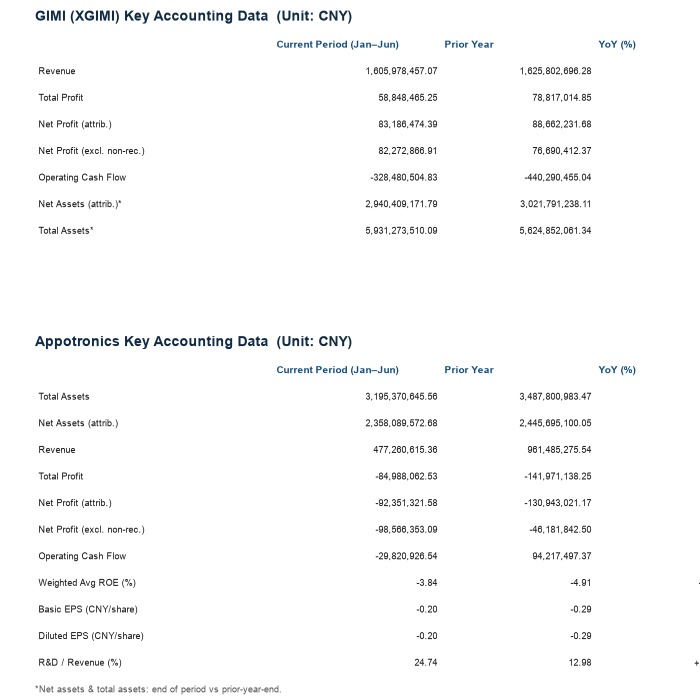
Looking at core financial data, although both companies face the same environment of slowing consumer electronics demand, their performance differs.
Strategic Path Comparison: One Breaks Outward, the Other Contracts Inward
In the first half of 2026, XGIMI achieved revenue of 1.606 billion yuan, down 1.22% year-on-year. Net profit (attributable) was 83.19 million yuan, down 6.18% year-on-year; net profit excluding non-recurring gains rose 7.27%. Total net assets and total assets both declined slightly. In contrast, Appotronics posted revenue of 477 million yuan in the same period, down 50.36% year-on-year. The sharp drop in performance was mainly driven by the contraction of automotive and consumer-side (C-end) business revenue; the narrowing net loss was largely due to the elimination of large one-off losses from previous-year litigation, while the enlarged loss excluding non-recurring items was directly driven by the decline in revenue scale. Notably, Appotronics' gross margin also rose sharply from 26.91% a year earlier to 39.85%, nearly at the same level as XGIMI.
Strategic Path Comparison: An Outward Breakthrough vs an Inward Consolidation
The operating moves of the two companies in the first half of 2026 are also noteworthy. XGIMI's core growth engine has already shifted, with overseas markets becoming the most striking structural variable in this report. During the period, XGIMI's overseas revenue reached 748 million yuan, surging 87.63% year-on-year, and its share of total revenue jumped from 24.52% a year earlier to 46.58%, nearly matching the domestic market.
On the channel side, while maintaining high growth in online channels such as its own site and Amazon, XGIMI steadily expanded offline network coverage in core regions including Europe, North America, Japan and Australia. It no longer relies solely on online traffic, gradually building a global sales system that coordinates online and offline channels. The rapid rise in the share of high-margin overseas business directly offset the profit pressure from domestic price competition, becoming the core pillar supporting the first-half performance.
Appotronics, meanwhile, fully launched a business "subtraction" model in the first half. In the automotive optics track, in the face of intensifying competition and squeezed product unit prices and gross margins, the company proactively abandoned homogeneous, low-price competition and kept only designated projects aligned with its strategic direction, leaving automotive business revenue and profitability both under pressure.
In the consumer-side smart projector segment, under the squeeze from low-price LCD products, Appotronics actively adjusted its product structure, focusing entirely on the laser track and shrinking all marginal, low-margin and loss-making product lines. During the period, C-end business revenue scale and loss narrowed simultaneously, but overall profitability still has significant room to improve. Subsidiary data clearly reflect this structural change: Chongqing Fengmi, which handles C-end business, posted revenue of only 74 million yuan and a loss of 23 million yuan in the first half; while the cinema business entity Zhongying Guangfeng contributed a stable net profit of 54 million yuan, becoming the company's most solid cash-flow foundation.
2026 First-Half New Product Launches by XGIMI and Appotronics
On the product front, in the first half of 2026 XGIMI launched four flagship series at once, all targeting the high-end market and covering four scenarios — professional picture quality, all-around flagship, laser TV and artistic projection — namely the long-throw XGIMI X50 Ultra series, RS30 series, AURA3 series laser TV, and MIRA 4K series.

XGIMI pursued a dual-line strategy with its full-series tri-color laser engineering projectors and four high-end home new products, using 22,000-lumen scatter-reduction technology and a 10,000:1 native contrast ratio to break through foreign technology barriers. Through its "listen to users" approach, it built hit products such as the X50 Ultra, bringing professional picture quality down to an accessible 13,999 yuan price point and redefining the essence of high-end projection.
This batch of new products is priced at 6,000 yuan and above, with the highest approaching 20,000 yuan. The goal is clear: to challenge the high-end home projector market monopolized by overseas brands such as Sony, JVC and Epson, and establish a benchmark for domestic high-end products. This is also XGIMI's core move to pursue premium growth after the industry entered inventory competition.
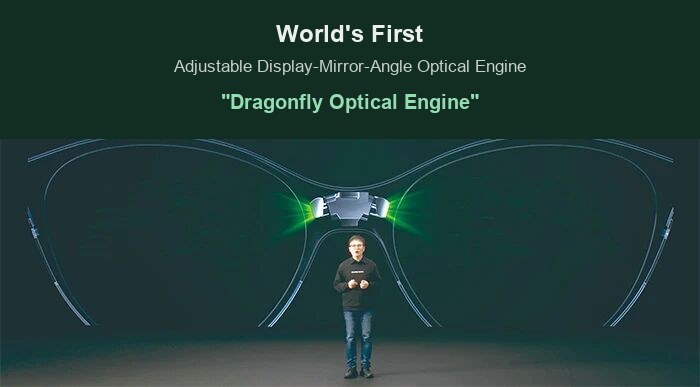
In January 2026, Appotronics unveiled the heavyweight Dragonfly C1 AR optical engine at CES in the US. This light engine is the world's only full-color LCoS AR optical engine supporting a "one-drive-two" architecture, with a monocular volume of only 0.42cc.
It also joined the AR Alliance, co-serving as co-chair of the system architecture working group alongside Meta representatives, gaining a seat at the global AR core technology decision-making level and participating in the formulation of laser display standards.
Appotronics continued to enrich its cinema product line, launching the new-generation S-series light source and the GeniLaser™ series light source built on self-developed upstream core components, with a focus on expanding overseas cinema markets.
New-Layout Race: Differentiated Track Choices Under Multi-Scenario Expansion
Beyond the traditional consumer-grade projection boundary, both companies are plotting a second growth curve, but with different focal points.
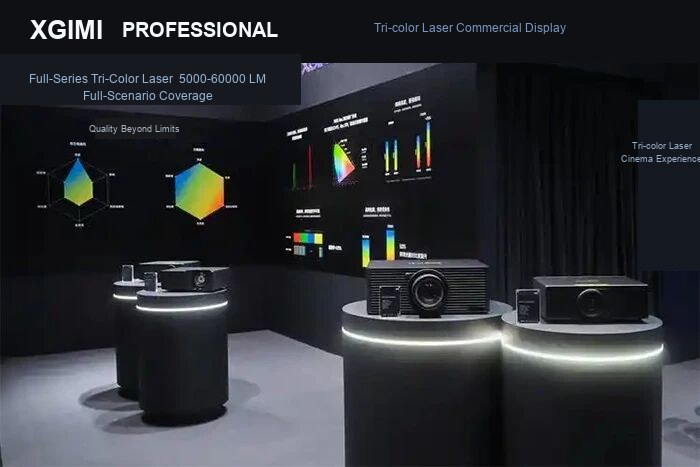
XGIMI's new business matrix has formed three clear landing paths. In the commercial display field, it officially released its full-series tri-color laser strategy, with product brightness covering 5,000 to 60,000 lumens. The first batch of "Huashan" series mass-production projects targets the 5,000-8,000 lumen range. As the EU's relevant energy-efficiency directives take effect, the structural advantages of laser solutions over traditional mercury-lamp commercial products in lifespan, energy efficiency and maintenance costs have become prominent, giving XGIMI a policy-dividend window in the overseas commercial display market.
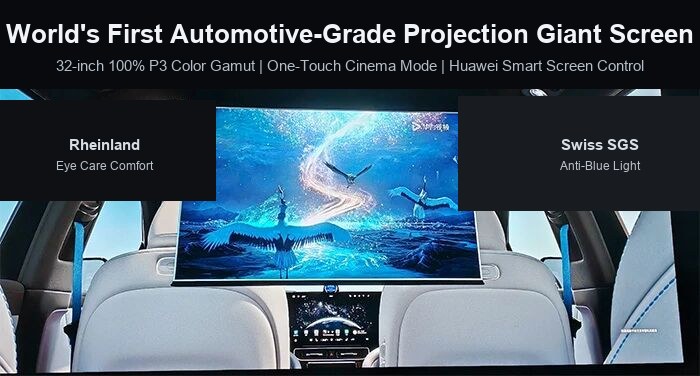
In the automotive optics business, the company has reached cooperation with leading domestic new-energy automakers, with smart cockpit projection products successfully installed on flagship models such as the Zunjie S800 and AITO M9. During the period, it also added designated development points for cockpit projection from two more leading domestic automakers, formally transitioning from "single-model landing" to the "simultaneous expansion with multiple automakers" stage of scaled growth.
In the AI smart hardware direction, the company invested 37.63 million yuan in research projects this period, with its first product already launched via overseas crowdfunding, pre-positioning itself in the smart hardware track for the next generation of interaction forms. Supporting the landing of this series of new businesses is XGIMI's continuously thickened R&D foundation. As of June 30, 2026, the company had 601 R&D staff, covering the full technology chain of optical display, algorithm development and complete-machine development, driving the company from a single consumer-grade projector brand toward an optical display solution provider spanning home, commercial and automotive scenarios.
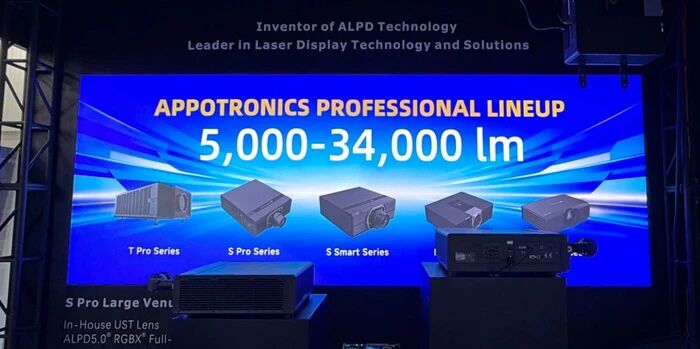
Appotronics' new business expansion, meanwhile, is tightly centered on the core advantage of its own ALPD® laser technology. In the cinema business segment, it launched the new-generation S-series light source and the GeniLaser™ series light source built on self-developed upstream components in the first half, further compressing costs through self-developed lasers and focusing on overseas cinema markets to consolidate its traditional advantage in the laser projection track. In the professional display field, it has built a product matrix covering the 5,000-34,000 lumen range, deepening the integration of AI technology with professional display, and officially released the first AIGC 3D Mapping software — AIMapper — which effectively solves the complex content production and debugging pain points of traditional projection projects, greatly shortening the debugging cycle of light-and-shadow projects while continuously strengthening brand recognition in the overseas professional audio-visual market through coordinated software and hardware efforts.
Postscript: From the public reports of XGIMI and Appotronics, the two leading players in the projection industry have made different strategic choices based on their own resource endowments. XGIMI, through global expansion and multi-scenario business landing, is moving from a single-category leader toward a globalized, multi-scenario optical display group, presenting a clear pattern of "short-term pressure, long-term improvement"; Appotronics, by actively contracting its business front, has refocused resources on the cinema and professional display tracks where its laser technology advantage is most pronounced, waiting for industry demand to recover as it develops.
Breaking down the results of the two companies reveals the real laws of development of the current projection industry. The penetration rate of the domestic home projector market has hit a stage ceiling, and the era of expansion by pure low-price volume sales is over. Leading enterprises must find their second growth curve in overseas market expansion, B-end scenario penetration, light source technology iteration and non-projection new business layout — which is precisely the underlying reason why XGIMI and Appotronics showed completely different performance trends in the first half of 2026.
With the new layout in the second half of the year, whether these strategic choices of the two companies can be truly translated into sustainable performance growth will become the core bellwether for observing the direction of China's entire smart projection industry.