
JMGO IRIS Ultra and IRIS Ultra Max Debut: 4K 120Hz Triple Laser, 6,500 ISO Lumens
Published
JMGO has launched the IRIS Ultra Max and IRIS Ultra 4K triple-laser projectors in Japan via Makuake, with 6,500 and 4,500 ISO lumens, up to 10,000:1 native contrast, a 15-blade dual iris, 0.88-1.7:1 optical zoom and full-path 4K at 120Hz.
On November 4, 2026, JMGO launched two 4K triple-laser projectors in Japan through the crowdfunding platform Makuake: the flagship IRIS Ultra Max and the IRIS Ultra. Early-bird tiers start at JPY 453,700 and JPY 311,870 including tax (35 percent off, limited to 90 and 30 units), against planned retail prices of JPY 698,000 and JPY 479,800. The campaign runs until January 21, 2027, with first deliveries scheduled for the end of November and a two-year warranty on the hardware.
This is the first time JMGO has shipped true 4K at 120Hz as a whole-machine capability. Two DLPC8545 controllers run in parallel, carrying 4K at 120Hz from the HDMI input all the way to the wall, which the company calls the world's first 4K at 120Hz smart projector. A demo unit is on display at Tsutaya Electrics in Futako-Tamagawa, Tokyo.
1. Choosing between the two: brightness, contrast, gimbal
Both models share one optical platform and one chassis. The differences come down to three things: brightness, native contrast and the gimbal.
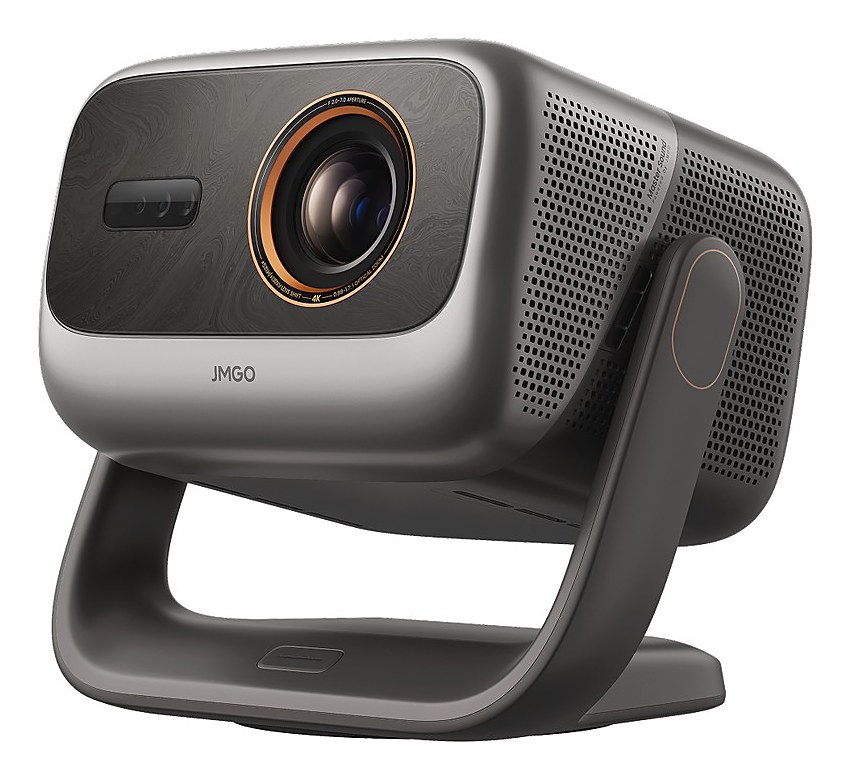
IRIS Ultra Max: 6,500 ISO lumens, 10,000:1 native contrast, motorized gimbal
The IRIS Ultra Max is rated at 6,500 ISO lumens and 10,000:1 native contrast, and adds a motorized gimbal that turns 360 degrees horizontally and 150 degrees vertically, memorizing up to ten screen positions, sizes and projection directions. The IRIS Ultra drops to 4,500 ISO lumens and 7,000:1 and uses a manual gimbal. Both run the MT9679 processor, though the Ultra carries 3GB of RAM against 4GB in the Max.
Both use a 0.47-inch DMD (TI DLP472TP) shifted to a 3,840 by 2,160 image, with a projection size of 40 to 300 inches. The body measures 308.3 by 229.6 by 273 mm including the base, weighs 7.0 kg and 6.7 kg, and draws 300 W and 240 W respectively.
2. MALC 6.0 and the dual iris: 15 blades of light control
The light source is the sixth-generation MALC triple-laser engine built around the latest QuaLas 42 lasers, with independent red, green and blue emitters and no phosphor wheel. Color coverage reaches 110 percent of BT.2020 with color accuracy rated at Delta E of 0.7 or better.
Contrast control is the focus of this generation. The IRIS series combines two variable apertures into a single optical assembly, six blades plus nine, for 15 in total. JMGO claims 11.34 percent higher stray light suppression than conventional designs, along with six manual iris steps from F2.0 to F7.0. Closing the iris buys deeper blacks at the cost of brightness, which is the key to reading the contrast figures below. Native contrast is measured in FOFO (full on, full off) mode at f/7.0.
AI DBL, the company's dynamic black level processing, adjusts laser power and picture contrast frame by frame and zone by zone, with an emphasis on preserving shadow detail and natural skin tones.
3. 4K at 120Hz is not just for gaming: dual DLPC and hardware anti-RBE
A single DLP controller cannot drive 4K at a full 120Hz. JMGO's answer is a pair of DLPC8545 controllers working in parallel. As a result, both HDMI 2.1 inputs accept a 4K at 120Hz signal (one supports eARC), 1080p tops out at 240Hz, input latency is rated at 1 ms in Game Mode, and VRR and ALLM are supported. A game menu pops up automatically when a console is connected, complete with crosshair options and picture modes for FPS, RPG, racing and sports titles.
Rainbow effect is handled in hardware rather than through software interpolation or a faster color wheel. JMGO stresses that it reduces rainbow artifacts without adding noise, which matters for long viewing sessions on a triple-laser DLP projector. Dolby Vision is supported up to 4K at 120Hz as well.
4. Placement: 0.88 to 1.7 optical zoom and four-way lens shift
Both models offer a 0.88 to 1.7:1 optical zoom and four-way lens shift covering plus or minus 130 percent vertically and plus or minus 53 percent horizontally. This is pure optical adjustment rather than digital keystone correction, so it costs neither resolution nor brightness. Against typical 1.2 to 1.5:1 designs, JMGO puts the gain in placement flexibility at roughly 176 percent.
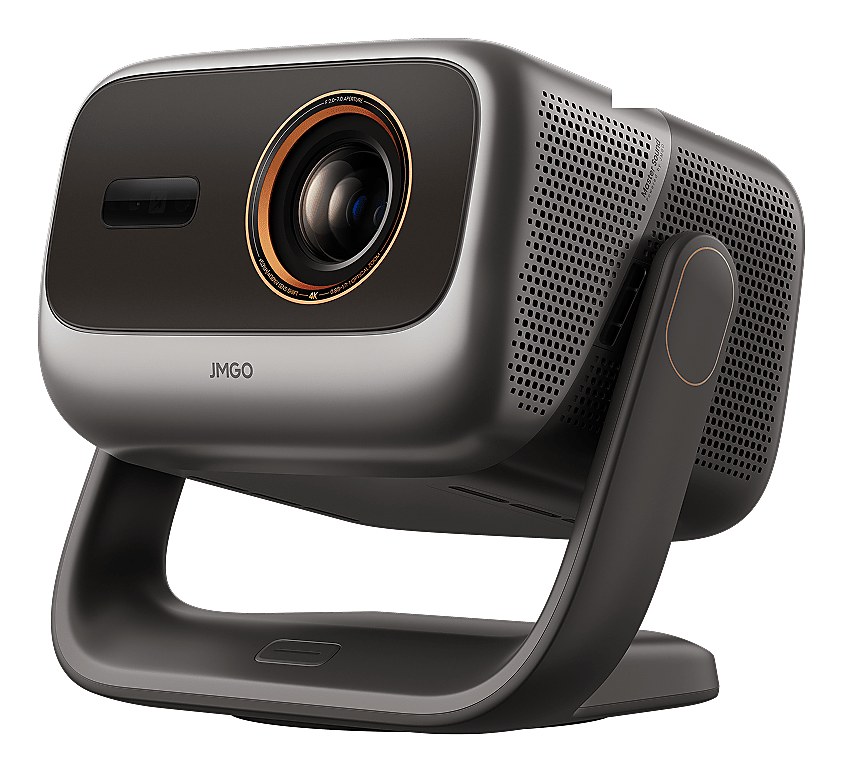
IRIS Ultra: 4,500 ISO lumens, 7,000:1 native contrast, manual gimbal
The Ultra Max gimbal can be steered from the remote, and pairs with AI spatial memory that remembers walls and frequently used apps, AI screen alignment and TOF plus CMOS autofocus, so the projector can sit on a shelf edge or in a corner and still frame the screen. The Ultra requires manual gimbal adjustment but keeps every other automatic correction feature. Both support ceiling mounting.
5. System, sound and connectivity
The platform is Google TV 5.0 with Gemini for TV, which accepts natural-language requests for content. Netflix, Prime Video and other services sign in directly, and Google Cast is built in. Audio comes from two side-firing 12.5 W drivers with 58 mm cones, reaching down to 35 Hz, with Dolby Audio and DTS:X support. Noise is quoted at 26 dB or less, with a 17 dB background level in the Standard picture mode at startup.
Connectivity covers two HDMI 2.1 inputs (one with eARC), USB 3.0 and a 3.5 mm audio output, plus Wi-Fi 6 and Bluetooth 5.4, with 64 GB of storage. 3D playback is supported in frame packing, side-by-side and top-and-bottom formats. For eye comfort, the RGB wavelengths avoid the 400 to 450 nm blue band, and because the image is reflected off a screen the light source never points at the viewer.
6. Pricing and availability
Japan gets the IRIS series first through Makuake, with discounts that shrink by tier. The Ultra Max has five tiers and the Ultra has three. The 35 percent tier is limited to 90 Max units and 30 Ultra units, and buyers must complete payment by 23:59 on November 25 to receive delivery at the end of November; later payments ship when the project closes. A 2.2 percent platform fee is added at checkout before tax.
| Model / tier | Price incl. tax | Discount | Delivery |
|---|---|---|---|
| IRIS Ultra Max | JPY 453,700 | 35% | End of Nov |
| IRIS Ultra Max | JPY 474,000 | 32% | End of Nov |
| IRIS Ultra Max | JPY 488,000 | 30% | End of Dec |
| IRIS Ultra Max | JPY 558,000 / 593,000 | 20% / 15% | End of Dec / Jan |
| IRIS Ultra | JPY 311,870 | 35% | End of Nov |
| IRIS Ultra | JPY 383,000 / 407,000 | 20% / 15% | End of Dec / Jan |
| Planned retail | JPY 698,000 / 479,800 | None | After campaign |
Reference prices elsewhere: USD 3,299 (list USD 3,499) and USD 2,199 (USD 2,399) in the United States, and MYR 15,999 and MYR 10,999 in Malaysia (list MYR 19,199 and MYR 12,999, with two years of local warranty). Mainland China pricing and the local launch date have not been announced.
7. A note on the 6,500-lumen figure
Both the 6,500 and 4,500 ISO lumen ratings are manufacturer figures measured in Dynamic mode under the ISO 21118 standard, and they are not the same as brightness in a calibrated cinema mode. Japanese reviewers noted at launch that independent measurements of the local units have yet to appear. Closing the iris to F5.0 or F7.0 to gain black level reduces usable brightness noticeably, which is the same trade-off that produces the 10,000:1 native contrast figure. In practice: use the high-brightness setting for a daylit living room, and the closed-down iris for a dark room.
8. Specifications
| Item | IRIS Ultra Max | IRIS Ultra |
|---|---|---|
| Light source | MALC 6.0 triple laser | MALC 6.0 triple laser |
| Brightness (ISO) | 6,500 lumens | 4,500 lumens |
| Native contrast | 10,000:1 (FOFO, f/7.0) | 7,000:1 (FOFO, f/7.0) |
| Chip / resolution | 0.47″ DMD, 3840×2160 | 0.47″ DMD, 3840×2160 |
| Refresh rate | 4K@120Hz / 1080p@240Hz | 4K@120Hz / 1080p@240Hz |
| Iris | Dual, 6+9 blades, F2.0–F7.0 | Dual, 6+9 blades, F2.0–F7.0 |
| Throw ratio | 0.88–1.7:1 | 0.88–1.7:1 |
| Lens shift | ±130% V / ±53% H | ±130% V / ±53% H |
| Projection size | 40–300 inches | 40–300 inches |
| Color gamut / accuracy | 110% BT.2020 / ΔE≤0.7 | 110% BT.2020 / ΔE≤0.7 |
| Gimbal | Motorized, ±360° H / ±150° V | Manual, ±360° H / ±160° V |
| Processor / memory | MT9679, 4GB + 64GB | MT9679, 3GB + 64GB |
| System | Google TV 5.0 + Gemini | Google TV 5.0 + Gemini |
| Inputs | HDMI 2.1×2 (eARC), USB 3.0, 3.5mm | HDMI 2.1×2 (eARC), USB 3.0, 3.5mm |
| Speakers | 12.5W×2, 35Hz | 12.5W×2, 35Hz |
| Noise / power | ≤26dB / 300W | ≤26dB / 240W |
| Dimensions | 308.3×229.6×273mm | 308.3×229.6×273mm |
| Weight | 7.0kg | 6.7kg |
JMGO has put this generation's weight behind two things: brightness and speed. The 6,500 ISO lumen rating makes a daylit living room viable, and the dual DLPC design makes 4K at 120Hz a whole-machine capability rather than a marketing label. What only time will settle is the real black level once the iris is closed down, and whether rainbow suppression on this triple-laser engine holds up over long viewing sessions the way the company claims.
Was this article helpful?
Join the technical discussion
Comments are published after review. Edited comments are reviewed again.