
At a glance
Can projector filters be reused? See when cleaning is safe, when replacement is required, and how airflow protection reduces projector downtime and cost.
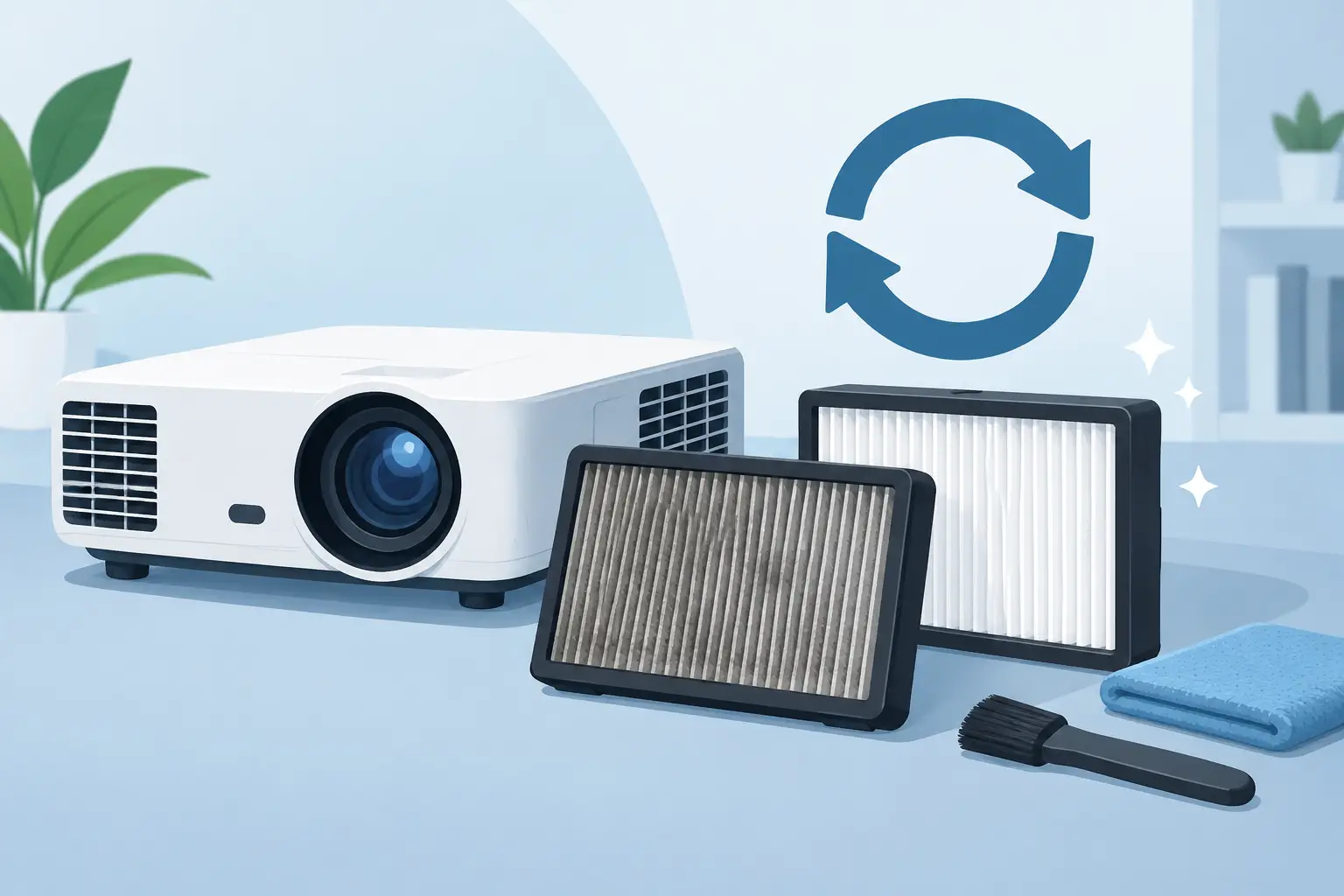
A filter that looks clean after a quick rinse can still restrict airflow enough to raise operating temperatures. For service teams managing installed projector fleets, the question is not simply, can projector filters be reused. The practical question is whether a cleaned filter can return to its intended airflow, fit, and dust-capture performance without creating a preventable failure risk.
The answer depends on the filter construction, the contamination involved, and the projector manufacturer's service guidance. Some projector air filters are designed for cleaning and reuse. Others are disposable parts that should be replaced on schedule or whenever they become contaminated. Treating every filter as washable may reduce a small parts cost while increasing the chance of lamp, optical engine, or thermal-system problems.
Can Projector Filters Be Reused? It Depends on Construction
Projector filters are not a single product type. Many use a foam or mesh media mounted in a plastic frame. These filters may be reusable if the material remains intact and the manufacturer permits cleaning. Other models use fine nonwoven, pleated, electrostatic, or multi-layer media intended for replacement rather than washing.
A reusable foam filter generally tolerates gentle vacuuming or washing because its open-cell structure is designed to regain airflow after cleaning. Even then, its service life is finite. Repeated cleaning can deform the foam, weaken the adhesive bond to the frame, or leave embedded particles that are difficult to remove.
Disposable filter media presents a different issue. Water, compressed air, brushing, or aggressive vacuuming can damage the fiber structure and enlarge the paths through which dust passes. The filter may look usable while providing substantially less protection. Fine dust entering the projector can settle on LCD panels, DLP components, fans, heat sinks, and optical surfaces, where removal is more costly than filter replacement.
For commercial buyers, the safest starting point is the part specification. Confirm whether the exact projector model uses a washable filter, a replacement-only filter, or an integrated filter assembly. Do not make a reuse decision based only on how similar the part appears to another brand or series.
Why Airflow Matters More Than Surface Appearance
A projector filter protects the cooling path, not just the air intake opening. When dust accumulates, the fan must work harder to move air through the chassis. Internal temperatures rise, fan noise may increase, and the projector can generate thermal warnings or shut down.
Restricted airflow also affects consumable life. Traditional lamp projectors are especially sensitive to excess heat because lamp operating conditions influence brightness stability and service life. Laser projectors eliminate lamp replacement, but they still depend on stable cooling to protect laser modules, phosphor systems, power supplies, and imaging components.
A cleaned filter should therefore be judged by performance, not appearance. If the media remains visibly stained, compressed, oily, warped, or loose in its frame, it should not return to service. Filters exposed to smoke, cooking residue, construction dust, textile fibers, or oily industrial air are particularly poor candidates for reuse. These contaminants can bond to the media and continue restricting airflow after surface cleaning.
How to Evaluate a Filter for Reuse
Technicians should inspect a removed filter under good lighting before deciding whether it can be cleaned. Start with the frame. Cracks, distorted edges, broken tabs, and poor seating can allow unfiltered air to bypass the media. A filter that cannot seal correctly is not providing reliable protection, regardless of how clean it looks.
Next, examine the media itself. Foam should be evenly shaped and resilient, without tears, thinning areas, hardened sections, or crumbling. Mesh should not be stretched or detached. Pleated media should retain its original spacing and form. If folds have collapsed or fibers appear fuzzy, damaged, or separated, replacement is the appropriate action.
Odor is also a useful field indicator. A persistent smoke, grease, or chemical odor suggests contamination that has penetrated the filter. Reinstalling that filter can introduce residue back into the projector as operating heat rises. In high-use commercial environments, replacing the filter is usually the more economical service decision.
For fleet operators, a simple rule helps standardize work: reuse only when the filter type is explicitly washable, its frame and media pass inspection, and it can be fully dried before installation. Replace when the construction is disposable, the contamination is heavy, or the condition is uncertain.
Cleaning Reusable Projector Filters Correctly
If the projector documentation permits cleaning, remove the filter with the projector powered down and disconnected from power. Follow the equipment-specific access procedure. Some filters are located behind an intake cover; others are part of a removable cartridge. Avoid touching internal optics or forcing panels and tabs.
Use the least aggressive cleaning method that removes loose dust. A low-suction vacuum with a soft brush attachment is often suitable for dry dust on durable foam or mesh filters. Hold the filter securely so suction does not deform the material. Do not use high-pressure compressed air, which can rupture media, drive particles deeper into the filter, or scatter contamination into the service area.
When washing is permitted, use clean water and mild detergent only if the manufacturer allows it. Rinse thoroughly and let the filter air-dry completely. Reinstalling a damp filter is not acceptable. Moisture can promote contamination inside the air path and may create electrical or corrosion risks depending on the projector design.
Do not improvise with household cleaners, solvents, lubricants, or fragrance products. These can leave residues that collect dust or degrade foam and adhesives. Cleaning should restore the condition of an approved reusable filter, not alter its material.
Replacement Is Often the Better Commercial Choice
A replacement filter is a low-cost maintenance item compared with a projector's optical assembly, laser engine, or emergency service call. That changes the purchasing calculation for resellers, integrators, and repair providers. If cleaning adds technician time, creates uncertain results, or risks a return visit, replacing the filter can be the more efficient option.
Replacement is especially advisable for projectors used in education, rental and staging, museums, retail displays, worship venues, manufacturing areas, and construction-adjacent spaces. These environments often produce recurring fine dust or fibers that are difficult to remove fully from filter media. Systems running long daily hours also benefit from predictable replacement intervals rather than visual-only maintenance.
The correct replacement filter must match the projector model and fit the intended slot without modification. Dimensions alone are not enough. Frame depth, gasket position, tab design, airflow direction, media density, and sensor compatibility can all affect performance. Buyers supporting multiple projector brands should maintain model-based records and avoid generic substitutions unless compatibility has been verified.
ZORSIKA supplies projector air filters developed for effective ventilation and dust and smoke protection, helping service partners source practical replacements across diverse installed bases. For commercial maintenance programs, dependable fitment and consistent availability are as important as the initial part price.
Set Maintenance Intervals by Environment, Not Guesswork
Projector manuals may provide a baseline filter cleaning or replacement interval, but real conditions should determine the final schedule. A conference room with controlled HVAC requires different maintenance from a classroom near an exterior entrance or a venue using haze effects.
Record the projector location, average operating hours, observed contamination, and any thermal or fan-related alerts. Over several service cycles, these records show whether the interval should be shortened. They also help procurement teams forecast filter demand, reduce urgent orders, and keep common parts available for field technicians.
A useful practice is to inspect the filter whenever a lamp is replaced, a projector is removed for preventive maintenance, or a thermal warning is reported. For laser units without regular lamp changes, scheduled filter checks become even more valuable because there may be fewer natural service opportunities.
The right decision is not to reuse every filter or replace every filter automatically. Reuse approved washable filters only when their condition and airflow capability remain acceptable. When media type, contamination, or fitment raises doubt, install the correct replacement part. A clean, properly fitted filter is one of the simplest ways to protect projector uptime, preserve image quality, and avoid service costs that should never have occurred.