
At a glance
- What Determines Filter Media Performance?
- Airflow Resistance and Pressure Drop
- Dust Capture and Dust-Holding Capacity
- Why Filter Fit Is Part of Media Performance
- Evaluating Replacement Filters for Commercial Fleets
- Service Practices That Protect Filter Performance
- Common Mistakes That Reduce Projector Protection
- Building a Practical Filter Specification
Filter media performance affects airflow, dust capture, and projector uptime. See how to select replacement filters for demanding AV fleets worldwide.
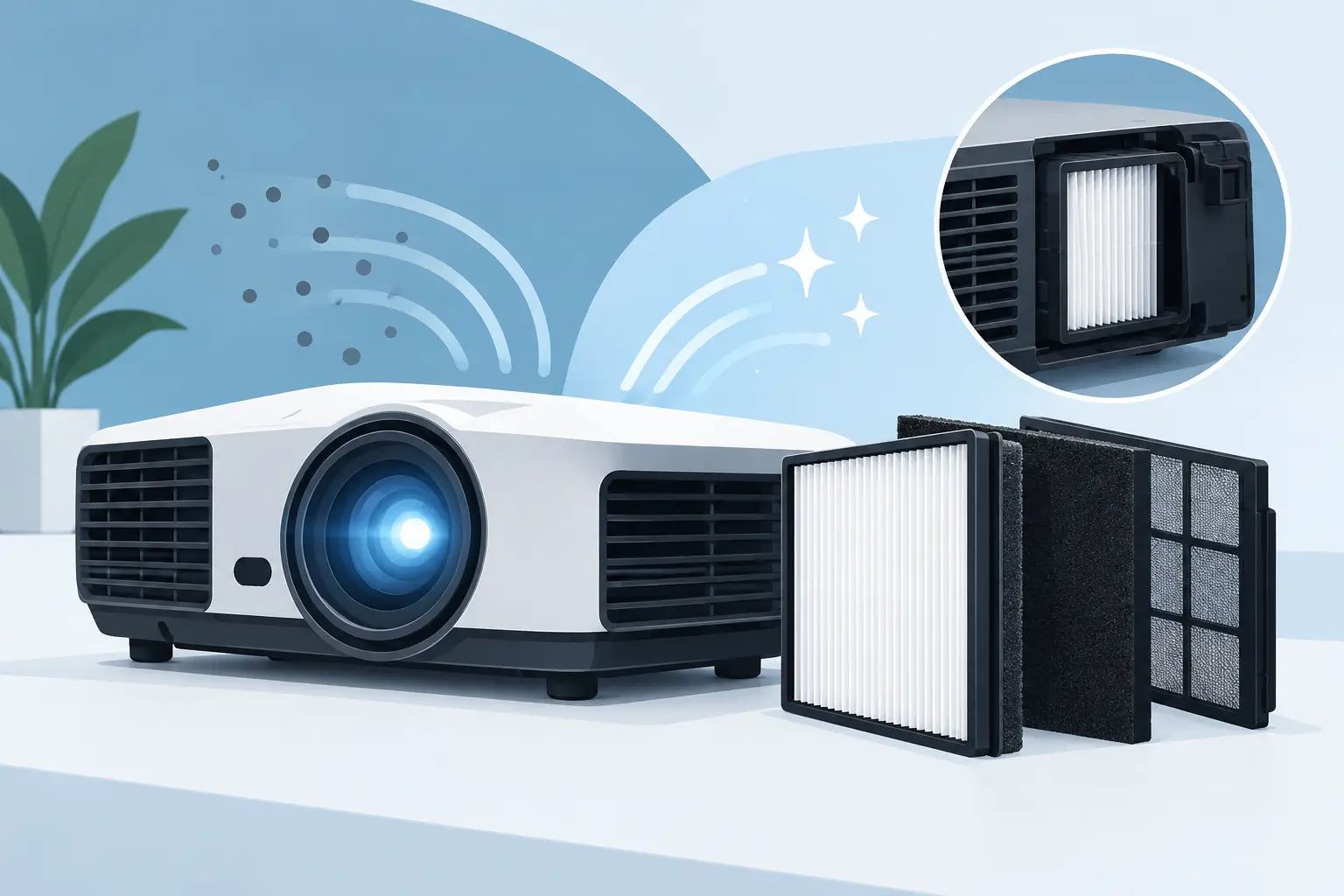
A projector filter can look clean at the intake while fine dust is already passing through the media and accumulating on the optical engine. For service teams managing classrooms, meeting rooms, museums, and rental inventory, filter media performance is therefore not a minor consumable detail. It directly affects airflow, thermal stability, cleaning intervals, lamp life, and the risk of avoidable projector downtime.
The correct replacement filter must do more than fit the filter door. It must balance particle capture with the airflow required by the projector's cooling system. A filter that is too open may allow contamination into the cabinet. A filter that is too restrictive can increase fan load, raise internal temperature, and trigger warnings or shutdowns. Professional buyers should evaluate both sides of that balance before selecting a compatible replacement.
What Determines Filter Media Performance?
Filter media performance is the combined result of how effectively a material captures airborne contaminants and how much resistance it adds to air movement. In projector applications, the target contaminants commonly include household dust, textile fibers, paper particles, smoke residue, and airborne debris found in commercial environments.
The media itself may be foam, nonwoven synthetic fiber, layered fiber material, or a combination of materials. Its thickness, fiber density, pore structure, surface treatment, and pleat design all influence performance. So do the frame, sealing edge, and overall shape of the finished filter assembly.
A high capture rate alone does not make a filter suitable. Projectors use compact cooling paths and fan systems designed around a specific airflow range. If the replacement media has substantially higher pressure drop than the original specification, the unit may run hotter even though the filter appears to provide better dust protection. Conversely, a low-resistance filter with poor capture efficiency may preserve airflow while allowing dust to settle on heat sinks, fans, color wheels, LCD panels, DLP components, and optical surfaces.
For commercial service operations, the practical goal is consistent protection without creating a cooling penalty that shortens equipment life.
Airflow Resistance and Pressure Drop
Pressure drop describes how much a filter resists air passing through it. As a filter loads with dust, its resistance increases. This is normal, but the starting resistance of a new filter matters as well.
A properly designed replacement filter provides ventilation compatible with the projector's fan capacity. It should not force the fan to operate at unnecessarily high speed or leave too little airflow under warm ambient conditions. This is especially relevant for high-brightness projectors used in auditoriums, exhibitions, houses of worship, and event installations, where heat output and operating hours are high.
Buyers should be cautious with universal cut-to-fit materials when the original projector filter uses a defined thickness, layered construction, or molded frame. The material may physically fit, but airflow behavior can differ significantly. For a service business, the small savings on generic media can be offset by repeat visits, thermal faults, or customer complaints.
Dust Capture and Dust-Holding Capacity
Dust capture refers to how well the media retains particles as air moves through it. Dust-holding capacity describes how much contamination the filter can retain before airflow becomes too restricted. Both are important.
A filter with a fine, dense surface may capture small particles effectively at first, but it can load quickly in dusty locations. A more open structure may hold more debris over time, yet permit finer dust to pass through. Layered media can help address this trade-off by catching larger particles at the air-entry side and smaller particles deeper within the material.
The installation environment should guide the service interval. A projector in a clean boardroom may need only routine filter inspection. A unit installed near entrances, workshops, kitchens, printing areas, or event venues can require much more frequent attention. Smoke and oily airborne residue deserve special consideration because they can adhere to media and internal components, reducing airflow and complicating cleaning.
Why Filter Fit Is Part of Media Performance
The media cannot perform as intended if air bypasses it. A replacement filter must match the projector's intake opening, frame dimensions, thickness, locating tabs, and sealing surfaces. Even a high-quality filter material is ineffective when gaps around the edge allow unfiltered air to enter the cabinet.
This is why model-specific filter assemblies are usually the better procurement choice for professional fleets. They reduce installation uncertainty and help technicians restore the original air path without trimming material or adapting frames in the field. A correctly matched filter also supports faster service, which matters when a school, conference facility, or display installation has limited downtime.
Frame stiffness is also relevant. A weak frame can deform during installation or under fan suction, creating bypass paths. For washable foam filters, dimensional stability after repeated cleaning is particularly important. If the foam shrinks, tears, hardens, or separates from its frame, it should be replaced rather than returned to service.
Evaluating Replacement Filters for Commercial Fleets
Procurement teams should evaluate replacement filters as a system component rather than an interchangeable accessory. The first requirement is exact projector model compatibility. Brand name alone is not enough, since a single projector series may use different filter sizes or housings across models.
Next, confirm the filter's intended installation position. Some projectors use a single intake filter, while others have separate filters for different air paths. Certain models integrate the media into a cassette or tray, and others use a washable element. Ordering by appearance alone creates unnecessary compatibility risk.
For recurring purchases, request or maintain clear product data covering dimensions, media type, frame design, compatible model list, and replacement guidance. This helps purchasing staff avoid substitutions that look similar but do not seal or ventilate correctly. It also enables technicians to standardize service kits across customer sites.
Warranty support and supply consistency should carry real weight in the decision. Filter replacement is a scheduled maintenance item, so availability matters as much as initial unit price. A supplier that can support broad model coverage and stable product matching allows distributors and repair businesses to reduce fragmented sourcing and keep common parts available.
ZORSIKA develops projector air filters with ventilation and dust protection in mind, supporting practical replacement needs across diverse projector installations.
Service Practices That Protect Filter Performance
A good filter can still fail early when maintenance practices are poor. Technicians should inspect the filter and surrounding intake area at every scheduled service visit. Dust accumulation on the outside of the cabinet can quickly transfer to a new filter, reducing its useful interval from the start.
When a washable filter is approved by the projector manufacturer, clean it carefully according to the equipment instructions and make sure it is fully dry before reinstallation. Reinstalling damp media can introduce moisture and attract additional dust. Do not use damaged, compressed, or heavily stained washable filters simply because they can be cleaned.
Avoid using compressed air to blow dust through a filter and into the projector. If air is used during cabinet cleaning, it should be controlled to prevent driving contamination deeper into vents and internal assemblies. The purpose of filter maintenance is to remove dust from the system, not redistribute it.
Service records should note the replacement date, operating environment, observed dust load, and any thermal warnings. Over time, these records help establish realistic maintenance intervals by site. A university lecture hall with daily operation may need a different schedule than a corporate training room used twice a week.
Common Mistakes That Reduce Projector Protection
The most common error is treating a filter as a cosmetic part. A filter may appear acceptable while its media is loaded with fine debris that restricts airflow. Another frequent mistake is selecting the densest available material under the assumption that more filtration is always better. In projector cooling systems, excessive resistance can be as damaging as insufficient filtration.
Improper installation is equally costly. Bent frames, missing covers, incorrectly seated tabs, and reused filters with deteriorated seals all create opportunities for air bypass. Technicians should verify that the filter door closes normally without force. A cover that does not seat correctly often indicates the wrong thickness, wrong frame, or incorrect filter orientation.
Finally, do not extend replacement intervals solely to reduce consumable cost. The expense of a timely filter change is usually far lower than emergency cleaning, fan replacement, optical contamination, lamp failure, or a projector outage during a customer event.
Building a Practical Filter Specification
For distributors, integrators, and repair providers, a practical internal specification should identify the projector model, filter part configuration, media type, dimensions, installation location, and expected service environment. It should also define the inspection interval and the conditions that require immediate replacement, such as visible loading, damaged media, deformed frame, smoke exposure, or repeated temperature warnings.
This approach makes purchasing more consistent and gives field technicians a clear standard. It also prevents a common problem in multi-site support: one team installs a carefully matched filter while another uses an unverified substitute for the same equipment.
The best filter program is not based on the lowest purchase price or the highest stated filtration level. It is based on repeatable fit, appropriate airflow, dependable dust control, and a maintenance interval matched to the real operating environment. When those factors are controlled, projector service becomes more predictable and equipment remains available when customers need it most.