






To summarize in one sentence:
LED light is scattered, incoherent light, while laser light is directional, coherent light.
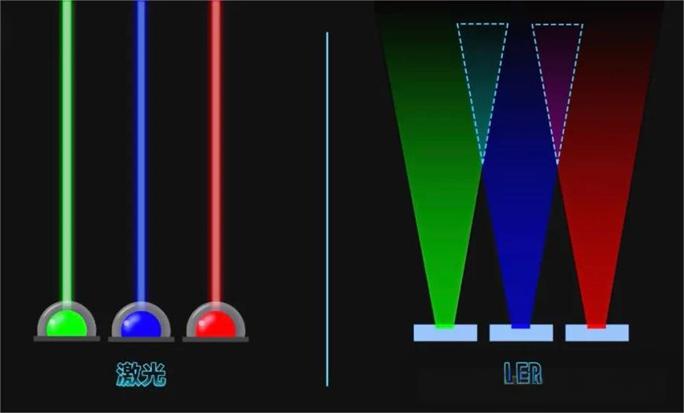
Below is a detailed comparison across key dimensions:
1. Physical Nature & Coherence
- LED light: Produced by spontaneous emission in semiconductor materials. Photons are emitted randomly in phase, direction, and wavelength, making it incoherent light.
- Laser light: Generated by stimulated radiation and amplified in a resonant cavity. Photons are highly consistent in phase, direction, and wavelength, making it coherent light.
2. Spectral Purity (Monochromaticity)
- LED light: Relatively broad spectrum, with a typical full width at half maximum (FWHM) of 15–30 nm. The red color is not a pure single wavelength, but covers a band from orange‑red to deep red.
- Laser light: Extremely narrow spectrum, with FWHM typically below 1 nm, even down to 0.01 nm. The color is highly pure and saturated.
3. Beam Characteristics (Collimation & Divergence Angle)
- LED light: Emits as a Lambertian source, radiating in all directions. Without lenses, the beam spreads rapidly. Even with lenses, an extremely narrow beam is difficult to achieve.
- Laser light: Naturally has a very small divergence angle and can remain collimated over long distances. It can be focused to a micron or sub‑micron spot size.
4. Brightness & Power Density
- LED light: Can achieve high total luminous flux (lumens), but low power density (W/cm²). Light is soft and uniform.
- Laser light: May have modest total power but extremely high power density. For example, a 1 mW laser, when focused, has far higher energy density than an LED of the same power. Thus, lasers produce thermal effects (ignition, cutting), while LEDs generally do not.
5. Visual Perception & Speckle
- LED light: Projects a smooth, even red spot on rough surfaces (white walls, paper). Comfortable for the eyes.
- Laser light: Produces speckle on rough surfaces — a grainy pattern of bright and dark spots caused by coherent interference. Prolonged viewing may cause visual discomfort.
6. Safety
- LED light: Generally safe. Temporary glare may occur, but permanent damage is unlikely even with brief direct viewing.
- Laser light: Potentially hazardous. Lasers above 5 mW can cause instant retinal burns (permanent vision damage) if shone directly into the eyes.