Understanding Stray Light: A Complete Guide Stray light refers to incident light of wavelengths other than the target absorbed light. It is generated by reflection, scattering, or external interference when light passes through optical filters. Common causes include contamination of optical components, defects in grating structures, and inadequate system design—among which gratings account for approximately 80% of stray light sources. Essentially, it is unintended "noise" in an optical system, categorized into three types: reflection from external light sources, internal thermal radiation, and abnormal propagation of imaging light.
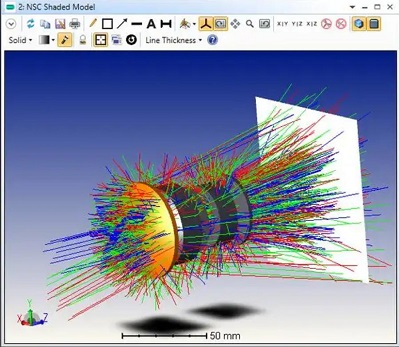
Stray light does not come from a single source; it mainly arises from the following four factors:
1、Scattering
- Surface scattering: Dust, scratches, flaws, or manufacturing defects on the surface of optical components (e.g., lenses, mirrors) cause light to undergo diffuse reflection instead of traveling along the designed path.
- Volume scattering: Bubbles, impurities, or inhomogeneities within optical materials (e.g., glass) lead to light scattering inside the material.
2、Unintended Reflection
- Mechanical structure reflection: Reflection occurs on non-optical surfaces such as the inner wall of the lens barrel, aperture blades, and sensor substrate. Even if these inner walls are painted black, they cannot absorb 100% of the light.
- Multiple reflections on optical surfaces: Light reflects back and forth between multiple lens surfaces and eventually reaches the image plane unexpectedly.
3、DiffractionWhen light passes through the edge of an aperture, diffraction occurs, producing weak, non-imaging light distribution.
4、Optical AberrationsImperfections in lens design prevent light from converging perfectly to a single point. Some light "spills over" to unintended areas, forming stray light. Examples include coma and astigmatism.
In final images or data, stray light typically appears in the following forms:
- Ghosting: When there is a strong light source (e.g., the sun, a lamp) in the frame, light spots—often inverted images of the aperture shape—appear at symmetrical positions in the image. This is caused by multiple reflections between lens groups.
- Flare: A blurred, bright area around a strong light source, which reduces the contrast of the image.
- Haze/Fogging: The entire image looks like it is covered with a thin veil, resulting in reduced overall contrast and color saturation, and impure black tones.
- Stray Images: Unexpected bright spots or patterns unrelated to the actual object appear in the image.
1、Photography
- Backlit shooting: Ghosting and flare easily occur when the sun is in or near the frame.
- Night photography: Unwanted light spots may appear when shooting streetlights or the moon.
2、Astronomical Telescopes
When observing dim celestial bodies, if there are bright planets or stars nearby, stray light will drown out the faint starlight, leading to observation failure.
3、MicroscopesWhen observing transparent or low-contrast samples, stray light reduces image clarity and detail resolution.
4、SpectrometersStray light introduces background noise into measured spectral data and may even produce "false peaks," leading to serious errors in analysis results. This is one of the most critical issues in spectral analysis.
Optical engineers use a variety of methods to suppress stray light:
- Applying Anti-Reflective Coatings: Coating the surface of lenses with a thin film to reduce reflection on each surface is the most basic and effective method.
- Using Apertures/Diaphragms: Installing a series of apertures in the optical path to allow only light needed for imaging to pass through, while blocking stray light that deviates from the path.
- Inner Wall Treatment: Designing the inner walls of mechanical structures (e.g., lens barrels, lens mounts) into threaded or stepped shapes and coating them with special black matte paint to maximize stray light absorption.
- Designing Light Baffles: Installing precisely calculated light baffles at key positions inside the system to directly block direct stray light from strong light sources.
- Optimizing Optical Design: Using computer software for "stray light analysis" to predict and eliminate potential stray light paths during the design phase.
Stray light is harmful, unintended light radiation in optical systems. It reduces image contrast, causes ghosting and flare, and distorts measurement data. Controlling and eliminating stray light is a key challenge that must be addressed when designing any high-performance optical system.