





Distortion is a crucial parameter in imaging optical lenses, especially in industrial visual measurement and defect detection. A lens's distortion significantly impacts inspection accuracy. However, when reviewing specifications from different lens manufacturers, we often encounter a problem: some refer to distortion as "TV distortion" while others refer to it as "optical distortion." What is the difference between the two? (We will not discuss Fθ distortion, as defined specifically for scanning lenses, here; if you're interested, we'll cover this later.)
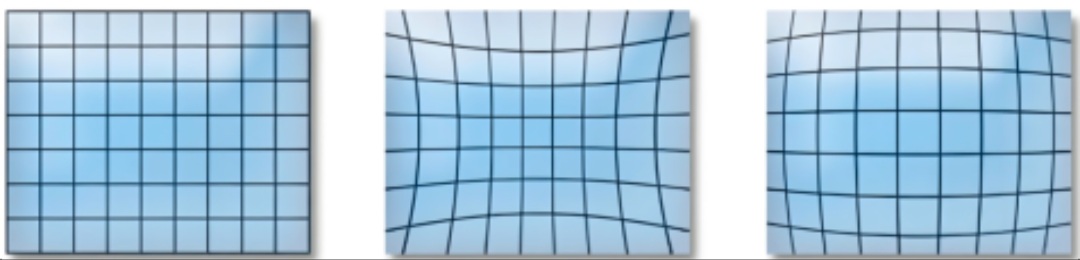
Distortion is a type of aberration in imaging lenses. It doesn't affect the clarity (resolution) of the image, but it does distort the image. (This distortion is specific to the image within the plane, not the depth of field, where objects appear larger near and smaller far. This depth distortion is caused by the lens's inconsistent optical magnification at different focus depths, not distortion itself.) Therefore, in high-precision visual inspection, selecting lenses with minimal distortion and implementing distortion correction algorithms to compensate for it are essential.
Currently, the accuracy and repeatability of visual measurement equipment (one-touch measuring instruments) on the market have reached micron levels. This non-contact method offers significant advantages over traditional probes in terms of efficiency and protection of the test parts. However, because the parts being measured appear randomly within different areas of the lens' field of view, lens parallax and distortion can affect the accuracy of each test result. To address parallax, a low-focus telecentric lens can be selected, combined with a collimated light source to enhance edge sharpness in the part image. To address distortion, a low-distortion lens is recommended. Because distortion theoretically increases with a lens's field of view, the amount of distortion is particularly important when selecting a low-magnification lens.
TV distortion and optical distortion are both different ways of expressing lens distortion. Regardless of the type of distortion, we've concluded that the cause is a change in optical magnification across different areas of the field of view within the focused object plane. (In theory, when a lens is focused at a fixed working distance, the image plane and the focused object plane have a fixed ratio, which is the optical magnification. However, in reality, the optical magnification varies between the center and the edge of the field of view, and this variation is distributed along the field of view annular zones.) A lens's distortion curve is also a function of distortion and field of view. Common optical design software, such as ZEMAX, allows you to directly view the optical distortion curve of a lens. To view the TV distortion value, you need to redefine the image plane size and calculate it using coordinate points. This can be achieved by writing a macro file; please contact us if you require this macro file.
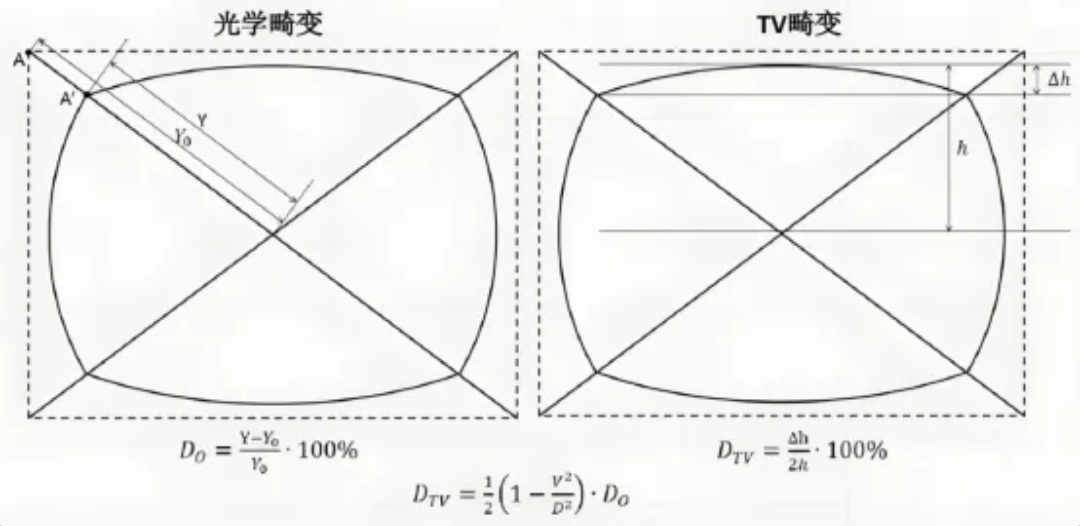
Optical Distortion: This compares the actual image height with the ideal image height, focusing on the difference between the actual and ideal images.
TV Distortion: This compares the maximum and minimum actual image heights, focusing on the distortion of the image itself.
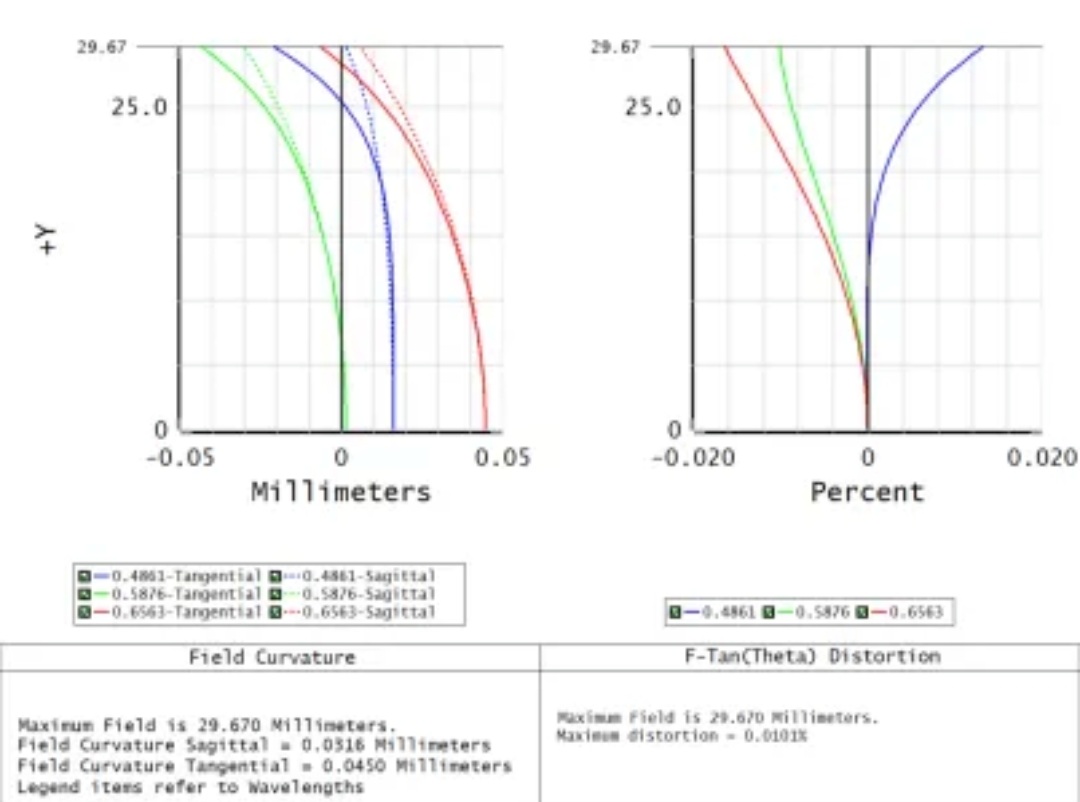
In most cases, lenses used in industrial vision applications typically specify optical distortion, while lenses used in security or consumer electronics applications typically specify TV distortion. However, if a lens manufacturer directly specifies distortion, it's worth double-checking. For applications not involving high-precision visual inspection, optical distortion is generally within 3%, making the image distortion invisible to the naked eye. Therefore, depending on the application scenario, there's no need to be extremely demanding about minimal distortion, especially with short-focus lenses. Due to their specialized applications in visual inspection, telecentric lenses often require distortion to be controlled within 0.1% or even lower, as shown in Figure 2.
Typically, a lens's TV distortion is smaller than its optical distortion, with optical distortion typically being two to three times greater than TV distortion.