






The transmittance requirement for the effective area of a lens is 98%. Does this refer to the minimum value or the average value? This question may seem simple, but aren't many friends confused about it?
Let's first look at a drawing and compare the lens aperture with the effective lens aperture:
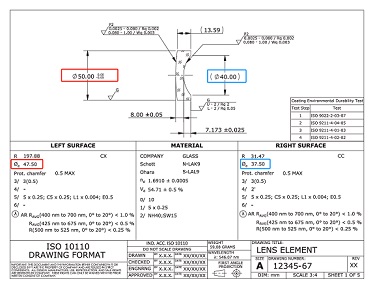
The red area on the left side of the drawing: the lens surface profile aperture is 50mm, and the effective lens aperture is 47.5mm;The blue area on the right side of the drawing: the lens surface profile aperture is 40mm, and the effective lens aperture is 37.5mm.
The so-called effective aperture refers to the effectively utilized area on the lens surface.
This is actually a very good question, as it touches on a common yet crucial distinction in optical product specifications.
The straightforward answer is: it usually means that the transmittance at any point within the effective area should not be less than 98%, not just that the average value reaches 98%.
The reason why friends ask this question is presumably that they have not distinguished between "minimum value" and "average value".
Here is a detailed explanation of the fundamental differences between the two.
The minimum value requirement means that no point can be lower than 98%. This is a stricter standard, more commonly applied to high-quality optical lenses, especially spectacle lenses.
It ensures that no matter which part of the lens your line of sight passes through, whether the center or the edge, you can enjoy a transmittance of at least 98%, guaranteeing the consistency of visual brightness and color.
For example: If the center of the lens is 99%, but a point on the edge is 97.5%, then this lens is unqualified.
The average value requirement, i.e., an average of 98%, is a relatively lenient standard. It allows some areas of the lens to have a transmittance lower than 98%, as long as the ultra-high transmittance in other areas can pull the average up to 98%.
Another example: Half of the lens area has a transmittance of 97%, and the other half has 99%. The average is indeed 98%, but when you use the area with 97% transmittance, you will feel a slight dimness.
Therefore, when you see in the lens specification that "transmittance of the effective area ≥ 98%" or "minimum transmittance 98%", you should understand it as:
In the effective optical area of the lens, the transmittance measurement value at any point must be greater than or equal to 98%.