






Dual telecentric lenses have a wide range of applications, especially in fields such as precision measurement and semiconductors. A dual telecentric lens consists of an object-side telecentric system and an image-side telecentric system.
In previous issues, we introduced the image-side telecentric lens. In this issue, we will add the object-side telecentric system to the image-side telecentric lens to form a complete dual telecentric lens system.
This means that it is necessary to simultaneously control and constrain both the object-side chief ray angle and the image-side chief ray angle—and this constraint requirement applies to the chief ray angles of all fields of view.
Design Parameters of the Dual Telecentric Lens in This Issue:
- 1、Object Height: 30mm
- 2、Object-Side NA (Numerical Aperture): 0.06
- 3、Telecentricity: 0.5°
- 4、Magnification: 0.6X
- 5、Distortion: < 0.05%
- 6、RMS (Root Mean Square): < Diffraction Limit
- 7、MTF (Modulation Transfer Function): > 0.15 @ 210lp/mm
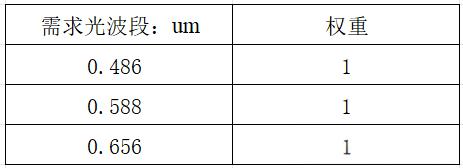
- 8、Reference Wavelengths and Their Weights:
Main Content of This Issue Includes:
- 2D Diagram of Lens Architecture
- Lens Design Results
- Lens Optimization Ideas
- Conclusions
The following content will explain these parts in detail:
1. 2D Diagram of Lens Architecture
The design result of the telecentric lens—its optical architecture—is shown in Figure 1. It consists of a front group and a rear group, with a total of 8 lenses (4 lenses in the front group and 4 lenses in the rear group). The optical architecture is symmetric front-to-back, which is beneficial for aberration optimization.
In the front group, Lens 1 and Lens 2 are arranged "back-to-back" (convex surfaces facing each other), which helps correct spherical aberration; the rear group adopts the same arrangement.
Both Lens 4 and Lens 5 are concave toward the aperture stop. The middle part adopts a classic double-Gauss lens architecture, with an additional lens added on each side, forming a "6+2" structure.
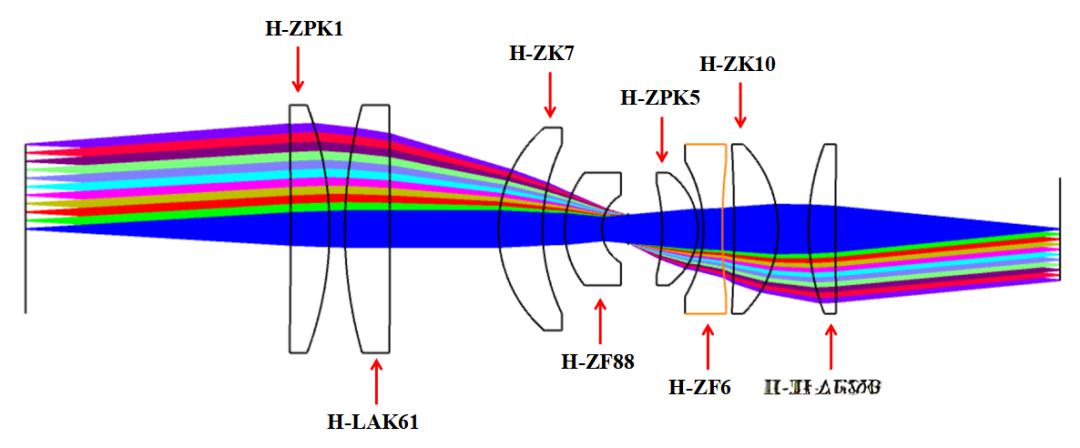
Figure 1: Optical Architecture of the Dual Telecentric Lens
2. Lens Design Results
The design results of the dual telecentric lens mainly include the lens 2D diagram, MTF curve, distortion curve, spot diagram, and lateral chromatic aberration. These will be explained step by step below:
- Lens 2D Diagram (Figure 2): The optical architecture has been described in detail in the first part, so no further elaboration is provided here.
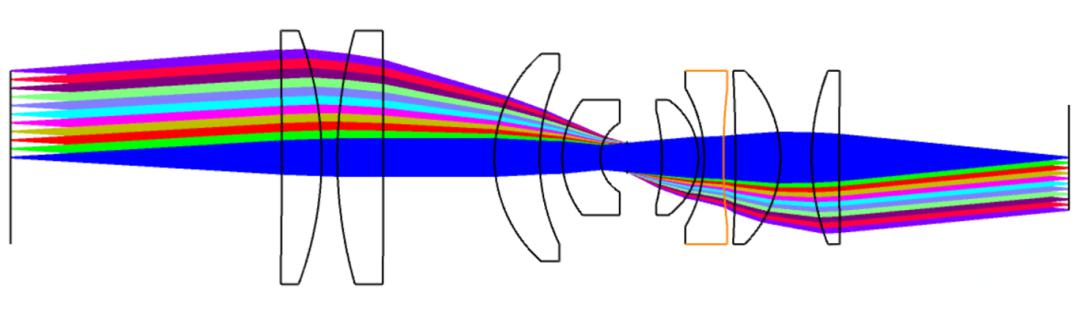
Figure 2: Lens Architecture 2D Diagram
- MTF Curve of the Dual Telecentric Lens (Figure 3): As can be seen from the figure, the MTF meets the requirement of being greater than 0.15 @ 210lp/mm.
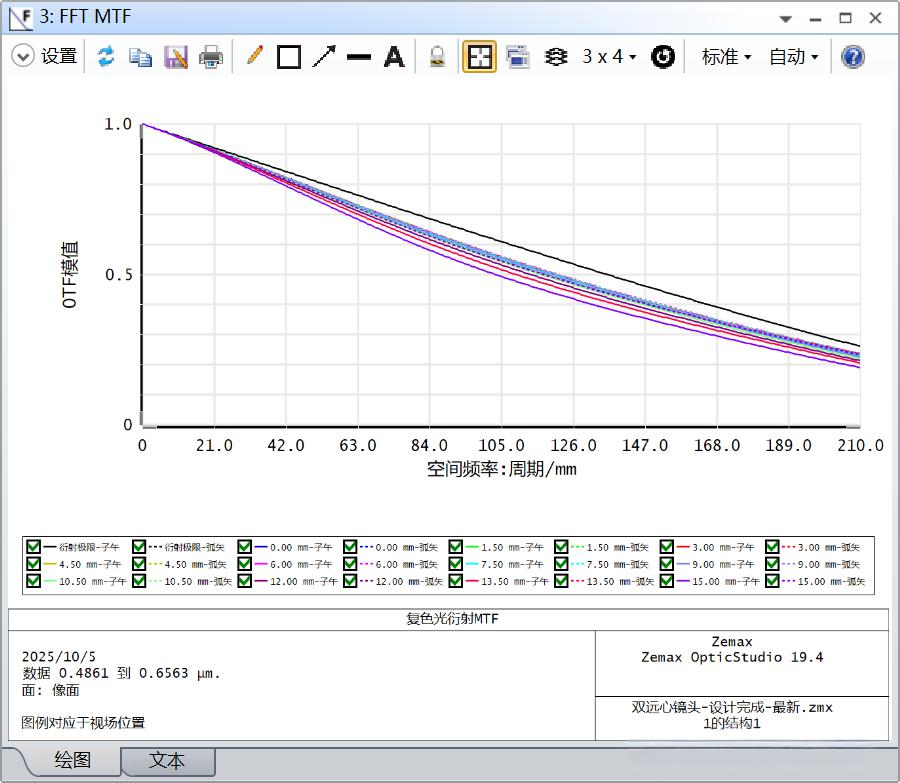
Figure 3: Lens MTF Curve
- Distortion Curve (Figure 4):
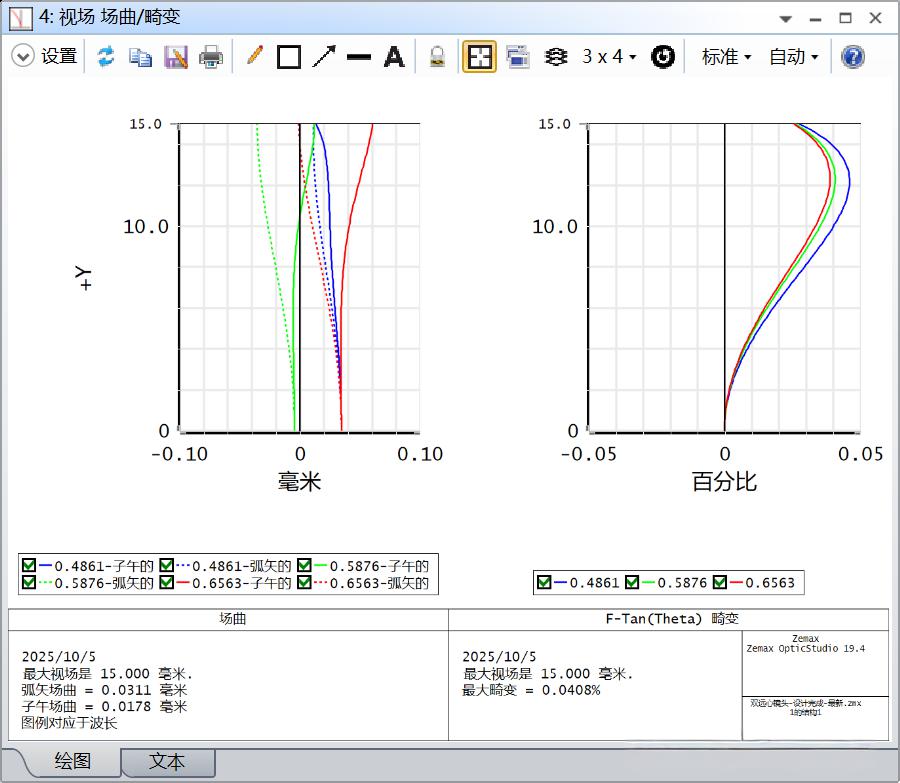
Figure 4: Lens Distortion Curve
- Lens Spot Diagram (Figure 5): It can be observed from the figure that the spot size is smaller than the diffraction limit, meeting the lens index requirements.
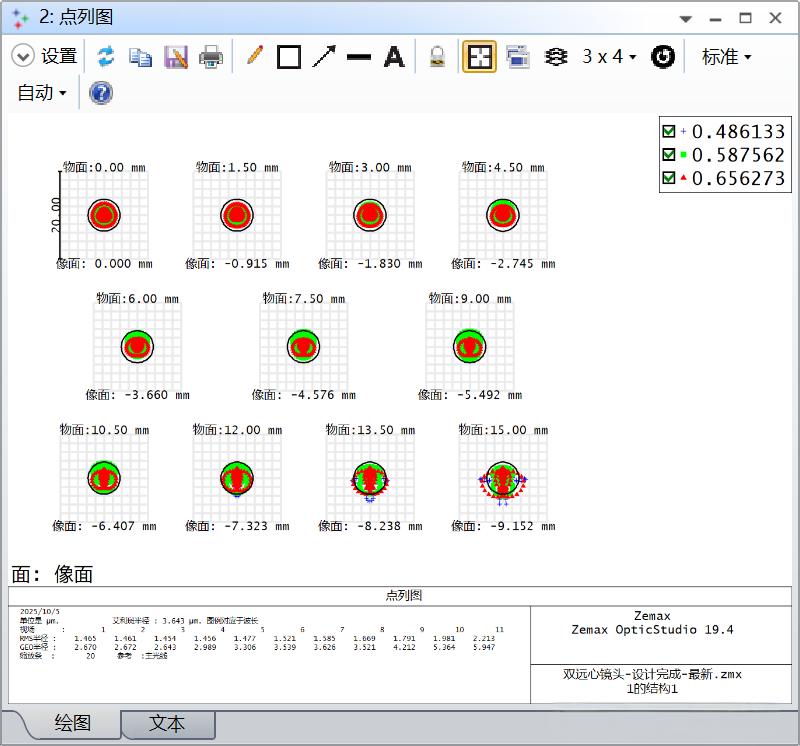
Figure 5: Lens Spot Diagram
3. Lens Optimization Ideas
Lens optimization ideas mainly consider three aspects: optical architecture, initial structure, and merit function.
(1) Selection of Optical Architecture
The selection of the optical architecture needs to comprehensively consider parameters such as object height, F-number, NA, field of view, wavelength, and magnification:
- For single-wavelength scenarios: A single lens or cemented lens architecture can be selected if the field of view is small and precision requirements are low.
- For multi-wavelength scenarios: A cemented lens (e.g., double-cemented, triple-cemented lens) or Cooke triplet architecture is required to correct chromatic aberration.
- For large field of view / high-precision scenarios: A 4-lens or double-Gauss lens architecture is preferred (such as the "double-Gauss + additional lenses" structure in this issue), which balances field of view coverage and aberration correction.
(2) Selection of Initial Structure
The initial structure can be obtained in two ways:
- Reference from Patents or Literature: Select a model with similar parameters (e.g., magnification, field of view) from optical design patents or authoritative literature, and adjust it to meet the design requirements through "focal length scaling" (e.g., scaling a structure with f=50mm in a patent to f=100mm).
- Optimization from a Parallel Plate: For simple lenses (e.g., low-precision single telecentric lenses), optimization can start from a parallel glass plate by gradually adding variables such as curvature and thickness. For complex lenses (e.g., the dual telecentric lens in this issue, mobile phone lenses), it is better to use a mature structure from patents or literature as the initial structure to reduce the blindness of optimization variables.
(3) Merit Function Design
The merit function needs to impose targeted constraints on parameters such as magnification. For this lens:
- Magnification Constraint: The PMAG operand is used to constrain the magnification.
- Spatial Constraints: MNCA (Minimum Air Gap) and MNEA (Maximum Air Gap) are used to constrain air intervals; MNCG (Minimum Glass Thickness) and MNEG (Maximum Glass Thickness) are used to constrain the thickness of glass lenses.
- Image Quality Constraints: Distortion and chief ray angles need to be constrained. DISG (Distortion Gradient) or DISC (Distortion Value) is selected according to different application scenarios.
- Manufacturability Constraints: The center or edge of the glass should not be too thin; the two radii of curvature of a meniscus lens should not be too close (to avoid processing difficulties).
Additionally, it is important to check the smoothness of light ray trajectories during optimization. Try to avoid "sharply bent light paths" (abrupt changes in light ray angles), as this can easily cause the optical system to fall into an optimization stagnation state.
4. Conclusions
- For double-Gauss lenses, the position of the aperture stop needs to be adjusted according to different magnifications.
- Both the object-side and image-side telecentricity of a dual telecentric lens need to be constrained.